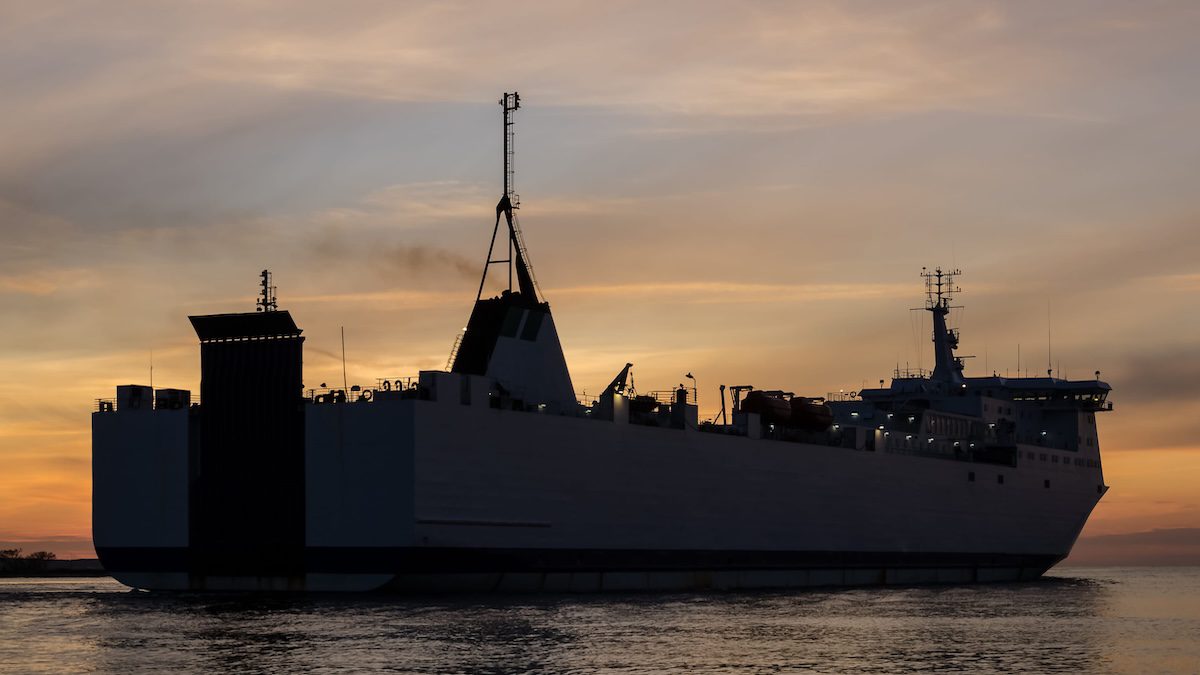
Escalating GNSS disruptions are making multi-source, multi-constellation PNT alternatives increasingly popular for maintaining continuity and trust in navigation data
A disturbing number of ships — both commercial and military — around the world are experiencing Global Navigation Satellite Systems (GNSS) disruptions.
According to maritime intelligence company Windward, since the U.S.-Israel war on Iran started in February, over 1,100 ships in the Gulf region have experienced GPS or AIS (Automatic Identification System) communications disruptions. NATO has reported similar incidents in the Baltic Sea, Black Sea and south eastern Mediterranean regions. The incidents are growing common even in peacetime.
Experts warn that GNSS disturbances pose a critical risk across maritime, aerospace, and defense operations, as the levels of interference continue to grow dangerous.
GNSS disruptions have three main causes: a jamming attack which involves denying signals to force services to shut down, spoofing or transmission of fake signals to make assets appear in false locations on the map, and GNSS-denied or distressed environments where signals naturally suffer degradation due to satellites not being in the direct line of sight. They all severely constrain accuracy and continuity of positioning data.
“The increase of GNSS disruption puts all navigation and timing requirements at risk,” says Andrew Popp, sr. director of product marketing and PLM of PNT (positioning, navigation, and timing) Solutions, at Viavi.
The disruptions severely mess up the precision and reliability of navigation and tracking applications which are used for real-time monitoring, compromising safety, while causing delays in transit.
“When position and timing data can’t be trusted, it affects everything from safety and routing to mission tempo, compliance, and insurance exposure,” Evan Fenemor, client solutions manager at Ground Control, a satellite IoT and tracking company says.
From a momentary inconvenience to dangerous deviations to heavy monetary losses, the impacts are wide-ranging. It can cause vehicles to collide, ships to veer into shallow waters, and assets to get lost.
“The challenge is that many existing systems still struggle in denied or degraded environments. Either they are vulnerable to interference, they drift over time, or they’re not independent enough to provide real assurance,” Popp says.
Single source systems that rely on a single satellite service for data struggle to provide uninterrupted PNT service. “A multi-source, multi-constellation approach is becoming the new standard,” Popp says.
Ground Control are Viavi are integrating their solutions, combining Viavi’s Secure µPNT™ STL-1000 — a software-based receiver module — with Ground Control’s RockFLEET Assured maritime asset tracking and assured navigation solution, aiming to bring assured PNT to maritime operators.
The integration enables continuous time synchronization and positioning by switching over to Viavi’s receiver, when GNSS is down, degraded, or compromised. STL-1000’s holdover timing capability allows it to maintain the synchronization, without showing immediate loss of service.
“It operates with a non-GNSS based LEO satellite constellation for location and timing that is traceable to UTC [Universal Time Coordinated],” Popp says.
STL-1000 is hooked to Viavi’s SecureTimeSM altGNSS low Earth orbit (LEO) services, powered by Iridium PNT STL, an independent service designed to be impervious to GNSS/GPS jamming, spoofing and disruptions. This enables the receiver to use a secondary source of PNT data, maintaining service in areas that struggle to receive GPS or GNSS signals. Viavi says its LEO services offer 1000x stronger signals than GNSS.
Another important feature is integrity-aware reporting, which provides operators details of the source and nature of disruptions, improving their situational awareness for safety. “Knowing when you are being spoofed is a valuable reassurance to the operators,” Pop says.
Together, they bring a secondary position source, and a solution built for real maritime operations without the frictions of integration.
For more on PNT and other defense communications topics, register for the RCR Defense Communications Forum happening April 28.