


MDU connectivity consolidation is not one story but three – told from the perspective of who owns the operators doing the consolidation. Maravedis Research sorts the MSP segment by ownership, maps where the major players sit, and examines the cost pressures squeezing the operators caught in the middle.
In sum – what to know:
Three segments – splits into three ownership models: property-owner capital, private equity, and the independent, each consolidating for different reasons and at different cost of capital.
Property capital – Categories are converging, with property-owner capital entering via financial vehicles – from Greystar behind Zentro to Bonaventure behind Internet Subway to REIT-linked backers of Aerwave and Gigstreem.
Squeezed middle – M&A, a relentless technology refresh cycle, NOI compression, and state bulk-billing legislation are jointly squeezing the middle of the market into acquisition inventory.
Last week, we argued that demand from the largest operators, the per-door economies of scale, and the direction of institutional capital are all pushing multifamily connectivity toward a smaller number of larger connectivity players. This part turns from why to who: the kinds of owners now consolidating the segment, a map of where the major operators sit, and the pressures squeezing the operators in between.
Ownership models and consolidation logic
It is a mistake to treat the MSP segment as a single category of company. There are at least three distinct ownership models in the market, each approaching consolidation with a different motive, cost of capital, and definition of a good outcome. Reading the consolidation wave correctly means knowing which kind of owner is on the other side of a given deal.
The first model is the MSP owned by a property owner. Here, a REIT, developer, or large institutional landlord builds or buys an in-house connectivity operation and treats the network as part of the real estate asset rather than as a third-party service. The logic is vertical. These operators are internalizing a cost line and capturing the connectivity margin and NOI lift for themselves, keeping the value inside the building rather than handing it to an outside provider. The large carriers run a close cousin of this model through their connected-communities arms, which function as captive distribution into properties they already serve. Consolidation, for this group, is about control of the asset first, then about door-count multiples.
The second model is the MSP owned by venture or private equity capital. This is the segment’s roll-up engine. Backed by infrastructure funds or private equity sponsors, these operators consolidate horizontally, acquiring doors, owner relationships, and engineering talent to assemble a scaled platform aimed at an eventual exit. They carry the lowest cost of capital, the highest tolerance for integration risk, and the clearest mandate to grow through acquisition. They are the most aggressive buyers in the market and the primary force behind the consolidation now underway. Their definition of success is a larger, standardized platform that commands a higher multiple than the sum of the multiples of the companies that built it.
The third model is the independent MSP, founder-led, privately held, and funded largely from its own cash flow. This group splits into two fates. The strongest independents survive as boutiques, defending defined regions or verticals on the strength of service intimacy and specialization that a national platform cannot replicate. The rest become the acquisition targets that feed the roll-ups. As the technology roadmap and the capital required to fund it outrun what a founder can finance from operations, more independents will conclude that selling into a larger platform is the rational succession plan. The independent segment is therefore both the source of the boutiques that endure and the supply of the deals that drive consolidation forward.
These distinctions are not academic. A property owner buying an MSP values resident experience and asset appreciation, and will accept thinner connectivity margins to protect the larger real estate return. A private equity platform values per-door economics and integration synergies, and will pay for scale it can standardize. An independent values survival, succession, and the legacy of the relationships it built. When two of these meet across a negotiating table, they are often optimizing for entirely different things, which is why the same set of doors can be worth very different amounts to different buyers. The lines are also beginning to blur. The June 2026 recapitalization of Zentro, in which the infrastructure arm of Greystar, the largest apartment operator in the United States, invested alongside StepStone and the company’s existing private equity backer, shows property-owner capital and financial sponsors converging on the same independent platform, a pattern that is likely to recur as the most attractive operators attract capital from every direction at once.
The MSP ownership situation
The table below places a representative set of MDU connectivity operators against the three ownership models. Several are deliberately listed across more than one category, because the categories are converging. Figures reflect the latest available company and public disclosures, and metrics attributed to a single operator should be read as company claims unless independently confirmed.
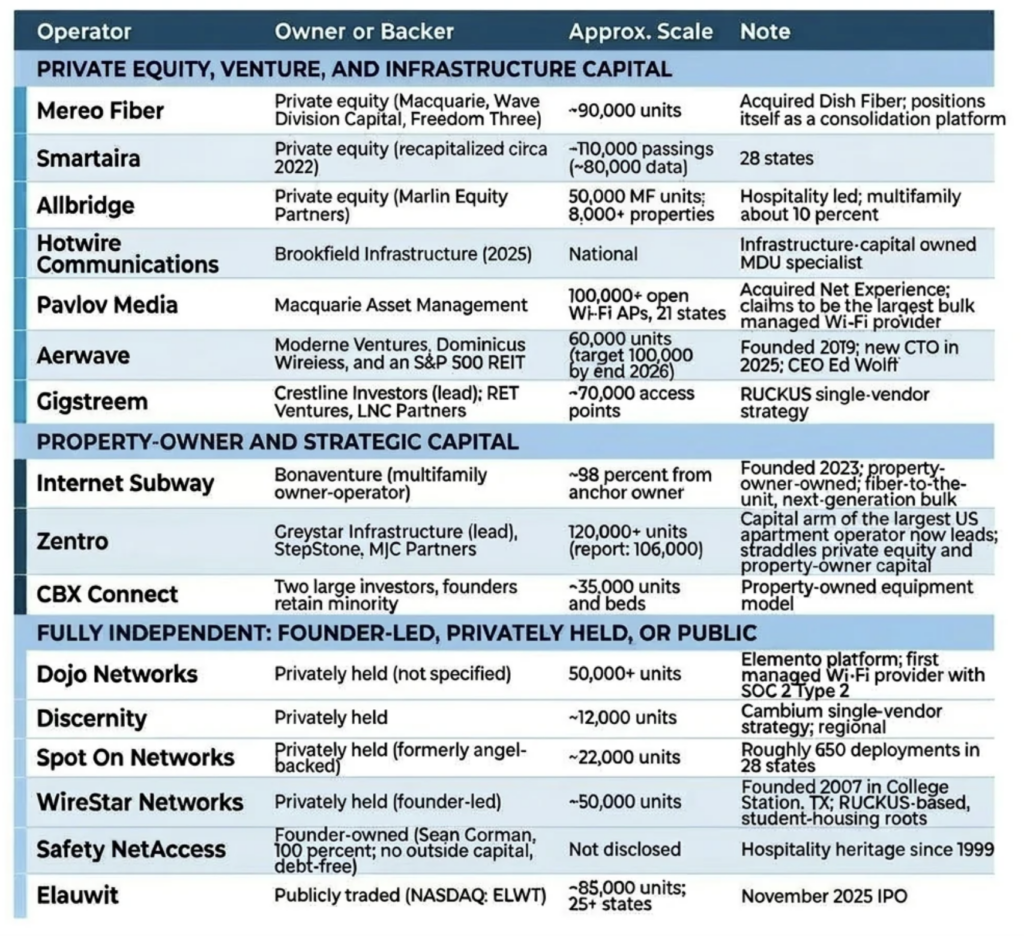
Note: Several entries straddle the categories, which is the point. Zentro’s June 2026 recapitalization brought Greystar’s infrastructure arm in as lead investor alongside its private equity sponsors. Internet Subway is owned outright by Bonaventure, a multifamily owner-operator that supplies roughly 98 percent of its units. Aerwave’s backers include an S&P 500 REIT, and one of Gigstreem’s backers, RET Ventures, is a proptech venture firm anchored by major real estate owners. Scale figures reflect company-reported data, and Maravedis estimates as of the Q1 2026 report.
Source: Multifamily Rental Market Analysis 2026-2031
M&A is no longer rare in this segment
The acquisition track record confirms that the platforms are buying. Mereo Fiber grew from roughly 30,000 units at its 2021 formation, itself a consolidation of four complementary businesses, to nearly 90,000 units in part through the acquisition of Dish Fiber. Pavlov Media completed the first acquisition in the history of the open Wi-Fi ecosystem when it bought the Net Experience controller platform, and it now claims to be the largest bulk-managed Wi-Fi provider in the country. Carriers and hybrid operators are buying too, folding regional managed Wi-Fi capabilities and mesh platforms into larger distribution machines. Each of these transactions removes an independent from the field and adds its doors, its relationships, and its engineering talent to a larger balance sheet. The cumulative effect is a market with fewer, bigger names at the top and a long tail that is gradually being absorbed.
Tech treadmill punishes subscale operators
Even without a single acquisition, the cost of staying competitive is pushing the market toward scale. The deployment standard has shifted to a 10-gig backbone infrastructure baseline, regardless of the service tier sold. Wi-Fi 7 is becoming the expected access layer for new construction and a growing share of retrofits. Property owners increasingly expect a real-time owner portal, network telemetry, and the early elements of smart building integration, from door access to leak sensors to EV charging, layered onto the same managed fabric. None of this is cheap to build, and none of it is a one-time expense. It is a continuous investment cycle that must be funded from recurring revenue.
A larger operator amortizes that investment across hundreds of thousands of doors. A subscale operator amortizes it across a few thousand or tens of thousands, which means either thinner margins, a slower technology roadmap, or both. As property owners grow more sophisticated about what they expect from a managed network, the operators that cannot fund the roadmap will find themselves losing renewals to those that can. That competitive gap is precisely what makes a smaller operator an attractive acquisition target, and an exhausted founder a willing seller.
NOI pressure favors a strong balance sheet
Two external pressures are accelerating the timeline. The first is net operating income compression across the multifamily sector, which has squeezed the pricing operators can command, particularly from the largest property owners. Margin compression is survivable for a scaled platform with a low cost of capital and a diversified door base. It is essential for a thinly capitalized regional operator that depends on premium pricing to fund service quality. The second pressure is regulatory. State-level legislation targeting bulk billing, with active proposals in California, Colorado, and elsewhere, introduces compliance complexity and business-model risk that a larger operator can absorb through legal capacity, geographic diversification, and a mix of bulk and managed Wi-Fi revenue. A single-market operator with a pure bulk model has nowhere to hide from an adverse state outcome. Scale, here, functions as insurance.
Put the ownership map together with the deal activity and the cost pressures, and the shape of the endgame comes into view.
Part 3 describes the market that results, a barbell of scaled platforms and durable boutiques, and then turns to the question that decides which platforms actually win: whether they can integrate what they buy.
Maravedis sizes and tracks the MDU market in its 2026-31 market analysis, and works directly with operators, investors, and property owners via a strategy consulting practice. Contact [email protected].

