

Should telcos invest billions in edge GPU infrastructure or wait for physical AI use cases to mature?
In sum – what we know:
- The ABI Research latency verdict – While edge deployment reduces network travel time, researchers found that compute-heavy tasks like token decoding currently overshadow those savings, making the edge unnecessary for basic chatbots.
- Physical AI requirements – Safety-critical applications such as autonomous vehicles and delivery drones require near-instantaneous inference that only distributed edge architecture can provide to ensure real-time reaction.
- A massive price tag – Modeling suggests a national rooftop GPU rollout could cost billions, leading most operators to prioritize centralized core locations before moving toward the far edge.
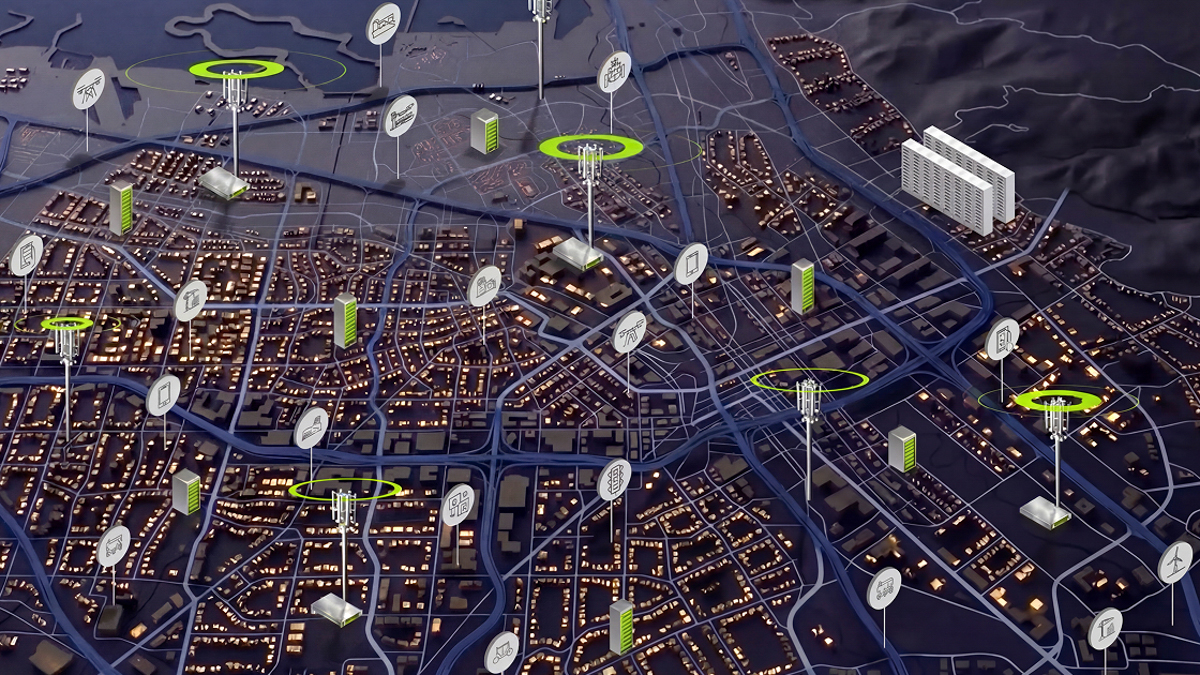
ABI Research recently put out an analysis looking at Nvidia’s AI grid concept and the bigger question hanging over it — should telcos actually be pouring money into distributed AI infrastructure right now? The report covers edge GPU deployment, network latency constraints, total cost of ownership, and the physical AI use cases that might eventually make the whole buildout worthwhile. It’s well-timed, given that Nvidia is aggressively pushing a narrative where telecommunications companies become critical nodes in a new AI grid — a framing that, it’s worth noting, benefits Nvidia more than anyone else.
The telcos exploring the AI grid space include T-Mobile US, Comcast, and SoftBank, among others. T-Mobile has made the case that physical AI starts with intelligent networks, and Nvidia has been pitching that telcos’ existing real estate, (towers, fiber, and spectrum) positions them as natural hosts for distributed inference infrastructure. But the core tension ABI’s report is really trying to untangle is whether the business case holds up today, or whether this is an expensive gamble on a future that hasn’t arrived yet.
Latency arguments and time-to-first-token
Latency is probably the most intuitive argument for deploying GPUs at the network edge — the logic being that inference servers physically closer to end users should deliver noticeably faster responses. ABI’s analysis, though, suggests this case is shakier than it sounds, at least when it comes to today’s mainstream AI workloads. For generative AI, the metric that matters most is time-to-first-token (TTFT), and network latency just isn’t a major contributor to it. Sure, standard network round-trip time can hit 100 ms. But the heavier latency culprits, which include DNS resolution, tunnel establishment, and the compute-intensive prefill and decoding phases, don’t change no matter where you physically locate the inference server. For a medium prompt around 1,000 tokens, prefill alone runs about 160 ms, and decoding can stretch into several seconds.
What this means in practice is that for conventional chatbot interactions, moving the inference server closer to the user doesn’t meaningfully improve the experience. The compute latency involved in token generation just overwhelms whatever you save on network hops. Guilherme Soubihe, CEO at Latitude, made the point in an interview with RCR Wireless. “The vast majority of DC-grade GPU capacity has already been absorbed by hyperscalers and frontier-model developers for training and fine-tuning LLMs, and these workloads see no meaningful benefit from edge locations, since network latency is largely irrelevant.”
Things are a little more nuanced, though. Nvidia’s GTC demos showed chatbot round-trip latency falling from 2,000ms to 400ms with edge deployment. And Suman Kanuganti, CEO of Personal AI, challenged the way the latency debate is typically framed around single requests. “The AI Grid is not optimized for one call. It is optimized for concurrency.” He pointed to benchmarks where a four-node AI Grid held sub-500 ms voice latency through P99 burst traffic with an 80% throughput boost over baseline, while centralized setups degraded under identical load.
“The edge advantage is not about shaving milliseconds on a single request but maintaining deterministic quality of service across millions of simultaneous sessions,” Kanuganti said. So the latency story might not land for individual consumer queries today, but for operators handling massive concurrent session volumes, the calculus starts looking different.
Physical AI and real-time use cases
Physical AI is where latency becomes an architectural requirement though. Autonomous vehicles, delivery drones and robots, video surveillance, smart glasses, and AR/VR all compress the acceptable latency window down significantly. Cloud inference simply can’t hit those requirements.
ABI drives this home with a blunt example — at 100 ms of latency, an autonomous car moving at 100 km/h is effectively blind for 2.8 meters. When you’re dealing with safety-critical systems that require near-real-time actuation, routing inference through a distant cloud data center just doesn’t work. The same principle extends across a whole range of emerging applications, including last-mile delivery robotics and real-time video analytics.
The problem, of course, is timing. Most of these physical AI use cases are still years from reaching any kind of critical mass. Ericsson spokesperson Peter Linder, Head of Thought Leadership Americas, pointed out that “the business case for GPUs deployed in mobile networks differs, as it builds on the proven cost, performance, and energy efficiency of network functions, as well as on increased revenues from distributed inference” — essentially arguing the justification needs to come from a mix of network efficiency gains and future revenue potential, not physical AI demand on its own.
Kanuganti took a more aggressive view, pushing back on the idea that this is purely a “6G foundational build.”
“Voice AI, video intelligence, and enterprise AI services are use cases that are here now. If autonomous vehicles, drones, humanoid robots are anywhere close, the buildout needs to happen now.” Whether operators actually feel that same urgency is a separate question.
The total cost of ownership
Even in a world where the latency arguments and use cases eventually converge, the financial picture for building out a distributed AI grid is intimidating. ABI concludes that a broad national rollout of edge servers aimed at reducing standard latency isn’t financially viable in the next two to three years. Cell site deployments face particularly tough unit economics — each site serves a limited subscriber base across a narrow geographic footprint, which makes per-site returns challenging outside of dense, high-value areas.
To ground the discussion in real numbers, ABI modeled a scenario where T-Mobile US retrofits its roughly 13,000 rooftop cell sites with Nvidia ARC-1 servers — priced at around $60,000 each, with one server powering three cells — achieving full rooftop GPU coverage by 2035. The cumulative price tag, factoring in deployment, cooling, and ancillary costs, lands at a modeled $3.7 billion. Spread across nine years that figure becomes more digestible, but it’s still comparable to rolling out an entirely new generation of radio network. Telcos and their investors are going to want a compelling business case before signing up for capital expenditure at that scale.
The infrastructure realities make the financial challenges even steeper. Kanuganti acknowledged that “cell towers were not built to house and cool dense compute,” which explains why early movers are starting at wired near-edge facilities with redundant power, cooling, and physical security already in place.
Linder reinforced this, noting that “radio sites are often harsh environments, so we use purpose-built ASIC-based compute to optimize power, performance, and cost, eliminating fans where possible.” Both perspectives converge on the same conclusion that the far-edge buildout hinges on hardware power efficiency improvements, purpose-built edge AI form factors, and the emergence of AI-RAN architectures that consolidate radio processing and AI inference onto shared compute platforms.
Given all these constraints, ABI projects that initial AI inference deployments will land in centralized core network locations before gradually expanding outward to cell sites as demand picks up and the economics improve. Early AI grid deployments will function mainly as a way to future-proof telecom networks, laying down the distributed compute foundations that 6G will eventually need. The telcos that move first won’t necessarily see near-term returns, but they’ll be staking out positions in what Nvidia and others are calling the AI super cycle. Whether that strategic positioning actually justifies billions in capital expenditure before the revenue streams have been proven remains to be seen.
Table of Contents

