NVIDIA on the importance of end-to-end solutions to solve enterprise AI adoption challenges
Editor’s note: NVIDIA has a free online course called “AI for All: From Basics to Gen AI Practice”. The team at RCR Wireless News has enrolled and, as we complete the units, are posting write-ups of the sessions along with a bit of additional context from our ongoing coverage of AI infrastructure. Think of this as us trying to do my job better and maybe, along the way, helping you with your own professional development—that’s the hope at least.
The evolution of AI—from early experiments to generative intelligence
AI is often described as a field of study focused on building computer systems that can perform tasks requiring human-like intelligence. While AI as a concept has been around since the 1950s, its early applications were largely limited to rule-based systems used in gaming and simple decision-making tasks.
A major shift came in the 1980s with machine learning (ML)—an approach to AI that uses statistical techniques to train models from observed data. Early ML models relied on human-defined classifiers and feature extractors, such as linear regression or bag-of-words techniques, which powered early AI applications like email spam filters.
But as the world became more digitized—with smartphones, webcams, social media, and IoT sensors flooding the world with data—AI faced a new challenge: how to extract useful insights from this massive, unstructured information.
This set the stage for the deep learning breakthroughs of the 2010s, fueled by three key factors:
- Advancements in hardware, particularly GPUs capable of accelerating AI workloads
- The availability of large datasets, critical for training powerful models
- Improvements in training algorithms, which enabled neural networks to automatically extract features from raw data
Today, we’re in the era of generative AI and large language models (LLMs), with AI systems that exhibit surprisingly human-like reasoning and creativity. Applications like chatbots, digital assistants, real-time translation, and AI-generated content have moved AI beyond automation and into a new phase of intelligent interaction.
A typical AI workflow—from data to deployment
AI solution development isn’t a single-step process. It follows a structured workflow—also known as a machine learning or data science workflow—which ensures that AI projects are systematic, well-documented, and optimized for real-world applications.
NVIDIA laid out four fundamental steps in an AI workflow:
- Data preparation—every AI project starts with data. Raw data must be collected, cleaned, and pre-processed to make it suitable for training AI models. The size of datasets used in AI training can range from small structured data to massive datasets with billions of parameters. But size alone isn’t everything. NVIDIA emphasizes that data quality, diversity, and relevance are just as critical as dataset size.
- Model training–once data is prepared, it is fed into a machine learning or deep learning model to recognize patterns and relationships. Training an AI model requires mathematical algorithms to process data over multiple iterations, a step that is extremely computationally intensive.
- Model optimization–after training, the model needs to be fine-tuned and optimized for accuracy and efficiency. This is an iterative process, with adjustments made until the model meets performance benchmarks.
- Model deployment and inference–a trained model is deployed for inference, meaning it is used to make predictions, decisions, or generate outputs when exposed to new data. Inference is the core of AI applications, where a model’s ability to deliver real-time, meaningful insights defines its practical success.
To get an idea of what that looks like in practice, consider ImageMe, a radiology clinic that provides MRIs, X-rays, and CT scans. The clinic wants to integrate AI-powered image recognition to help radiologists detect fractures and tumors more efficiently. Their AI workflow might look like this:
- Data preparation–a machine learning engineer gathers historical medical imaging datasets from hospitals and research institutes. She uses RAPIDS, an open-source, GPU-accelerated Python library, to process and analyze the data. RAPIDS Accelerator for Apache Spark further speeds up data handling by optimizing GPU-accelerated workflows.
- Model training–the clinic leverages PyTorch and TensorFlow, GPU-accelerated frameworks, to train its deep learning model.
- Model optimization–NVIDIA’s TensorRT deep learning optimizer fine-tunes the model for deployment.
- Inference and deployment–once the model is optimized, NVIDIA Triton Inference Server standardizes deployment across different IT environments, handling key DevOps functions like load balancing and scalability.
This end-to-end workflow ensures the AI solution delivers accurate, real-time insights while being efficiently managed within an enterprise infrastructure.
The intricacies of deep learning—making the biological artificial
As Geoffrey Hinton, a pioneer of deep learning, put it: “I have always been convinced that the only way to get artificial intelligence to work is to do the computation in a way similar to the human brain. That is the goal I have been pursuing. We are making progress, though we still have lots to learn about how the brain actually works.”
Deep learning mimics human intelligence through deep neural networks (DNNs). These networks are inspired by biological neurons:
- Dendrites receive signals from other neurons
- The cell body processes those signals
- The axon transmits information to the next neuron
Artificial neurons work similarly. Layers of artificial neurons process data hierarchically, enabling AI to perform image recognition, natural language processing, and speech recognition with human-like accuracy.
For example, in image classification (e.g., distinguishing cats from dogs), a convolutional neural network (CNN) like AlexNet would be used. Unlike earlier ML techniques, deep learning does not require manual feature extraction—instead, it automatically learns patterns from data.
Challenges (and solutions) to enterprise AI adoption
While AI is advancing rapidly, deploying it at scale comes with challenges:
- Exploding model complexity–modern AI models require extensive compute power and energy resources, making them costly and resource-intensive.
- Diverse AI model architectures–different tasks require different models, often needing multiple AI systems within the same application.
- Performance and scalability–training and deploying AI is an iterative, compute-heavy process. Enterprise AI must be optimized for performance and real-time operation.
NVIDIA’s end-to-end AI software stack
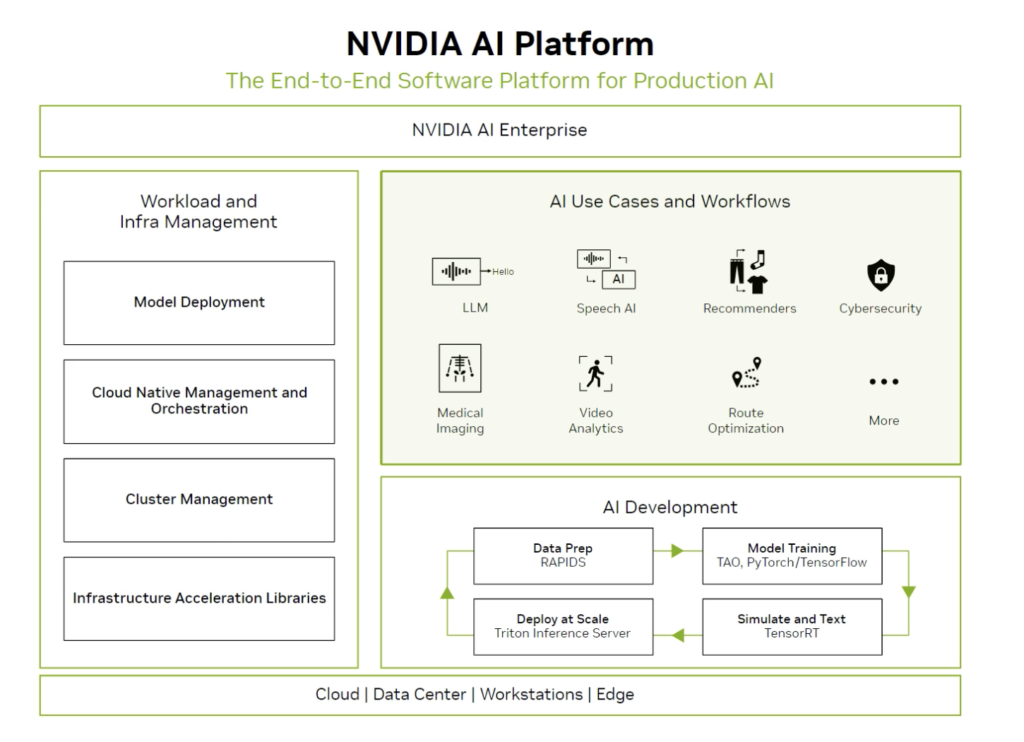
Image courtesy of NVIDIA.
To help enterprises navigate these challenges, NVIDIA offers an end-to-end AI software stack, providing:
- Development tools & frameworks for data scientists
- Pre-trained models for business-specific applications
- Orchestration & management solutions for IT teams
By enabling AI deployment across cloud, data center, and edge environments, NVIDIA aims to accelerate AI adoption while minimizing infrastructure complexity.
Understanding AI’s evolution, workflows, and real-world challenges is essential for deploying scalable and impactful AI solutions. With AI becoming an enterprise necessity, having a structured, optimized approach is key to ensuring efficient, scalable, and impactful deployments.
Table of Contents