


Mobile services offer flyers much better speed than airport Wi-Fi — sometimes reaching up to 2x Wi-Fi’s performance
In sum — what to know:
Cellular outperforms Wi-Fi in U.S. airports: Ookla found that in a majority of U.S airports, cellular is faster than Wi-Fi.
Verizon takes the crown: Verizon outperforms Wi-Fi in 34 airports, and delivers the fastest speeds among all mobile service providers in 26 airports.
Older Wi-Fi generations: Report points to older generations of Wi-Fi as the possible reason for slower speed.
Public Wi-Fi at airports has remained a popular option among flyers for catching quick YouTube videos, gaming while waiting at the gate, or downloading shows before a flight. But for most travelers, the experience is serviceable — not great. Public Wi-Fi is also hacker honeypot; cybersecurity experts routinely warn against using free Wi-Fi, especially in airports.
Now there might be an added incentive to skip the airport Wi-Fi altogether: better speed. A new Ookla report finds that mobile services are faster than Wi-Fi in most U.S. airports.
Ookla measured Wi-Fi performance across the top 50 airports, comparing results with that of mobile service providers. The findings are eye-opening: In the first half of 2025, cellular’s median download speeds were measurably faster than Wi-Fi networks in most airports. On average, mobile networks delivered twice the speed — 219.24 Mbps vs. Wi-Fi’s 101.39 Mbps.
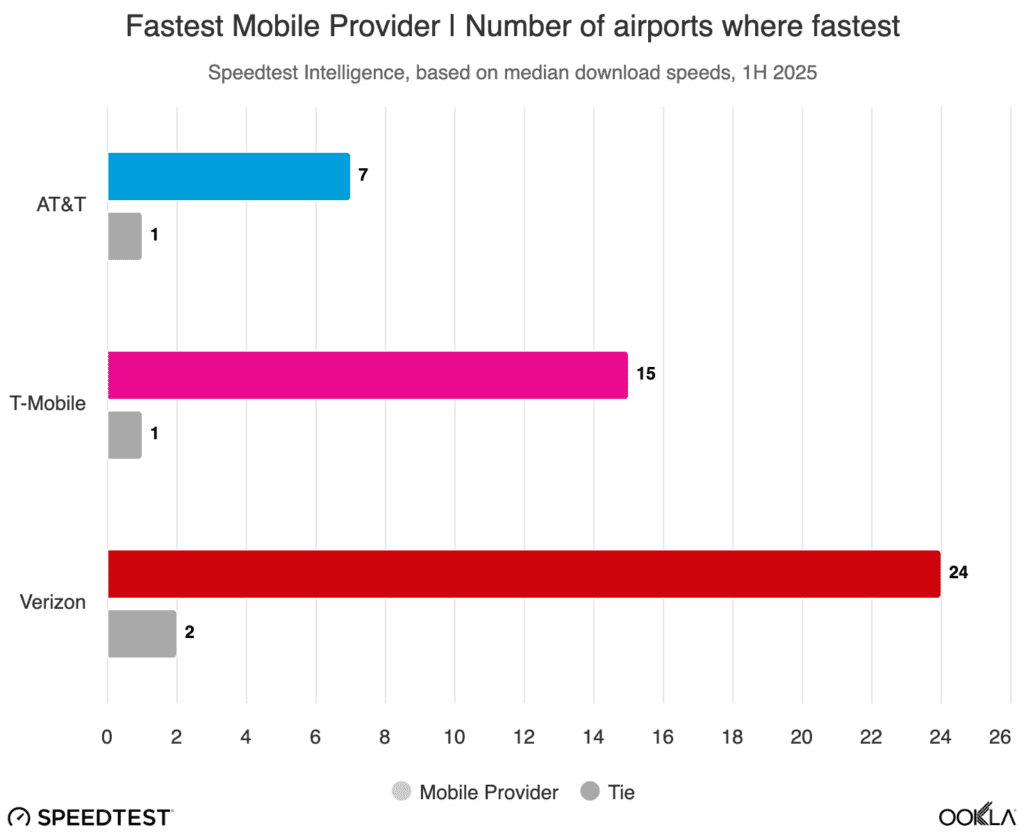
The top performers are obviously — not hard to guess — the Big Three: Verizon, T-Mobile, and AT&T — with Verizon on top with the fastest median download speeds in most airports, T-Mobile a close second, and AT&T a distant third.
Compared to Wi-Fi, Verizon was faster in 34 airports, T-Mobile in 32, and AT&T in 28. But between the carriers, the margins were much wider. Verizon delivered the fastest median download speed in 26 airports, T-Mobile in 16, and AT&T in just 8.
Airport Wi-Fi has been stuck in low gear for many years now. The report points to older Wi-Fi technologies as a possible reason for the sluggish speeds. Ookla’s Speedtest data indicates that a majority (over 70%) of the airports still use Wi-Fi 5 — which at this point is a 13 year old technology — or even older generations.
Kerry Baker, lead industry analyst for North America, Ookla, and author of the report explained the reason for this: “the cost and effort needed for upgrading an airport is undoubtedly magnitudes beyond that of swapping out the home router. Most homes don’t have capital budget planning cycles for upgrading technology infrastructure, but judging by the overall U.S. Wi-Fi 6 at 44.2% (versus 26.2% in airports), more passengers are carrying devices capable of using the upgrade.”
Another reason could be the introduction of in-flight Wi-Fi. Most airlines now have better Wi-Fi compared to what it was some years back, thanks to satellite services like Starlink that have driven up performance, delivering medians of 152.37 Mbps download speed, 24.16 Mbps upload speed, and latency of 44 milliseconds (ms). With high-speed internet available on flight, there is little urgency to upgrade the Wi-Fi infrastructure on ground.
The report spotted some exceptions as well. In five airports Wi-Fi still tops mobile. These are Cincinnati/Northern Kentucky International, San Francisco International, Orlando International, and Hartsfield–Jackson Atlanta International — and Baltimore/Washington International where it was a tie.
Conversely, in an adjacent report which RCR’s Catherine Sbeglia Nin covered, Ookla noted declining FWA download and upload speeds among all three carriers, owing to foliage-related signal loss and network congestion from mobile and FWA traffic. Read more here.

