


T-Mobile, AT&T, and Verizon experienced a ‘noticeable’ decline in FWA download and upload speeds during Q2 2025 and Q3 2025
In sum – what to know:
T-Mo reigns supreme – T-Mobile US delivered roughly double AT&T’s median download speeds in Q3 2025, while Verizon sits between the two.
FWA performance pressure – Foliage-related signal loss and possibly early signs of network congestion are named as possible culprits behind speed declines.
AT&T falls behind – The carrier trails on speed and latency — but gains are expected as new mid-band spectrum and site upgrades begin to bolster its Internet Air offering.
Ookla has released its latest report detailing the state of fixed wireless access (FWA) in the U.S., crowing T-Mobile as the “FWA speed leader.” According to the firm, the carrier achieved a median download speed of 209.06 Mbps for Q3 2025 — about double that of AT&T’s median download speed of 104.63 Mbps in the same quarter. Verizon’s median download speed was 137.81.
However, all three providers — T-Mobile, AT&T, and Verizon — experienced a “noticeable” decline in download and upload speeds during Q2 2025 and Q3 2025. Ookla’s editorial director, Sue Marek, pointed to a possible “seasonal pattern,” caused by increased foliage coverage, which can impact Fixed Wireless Access speeds.
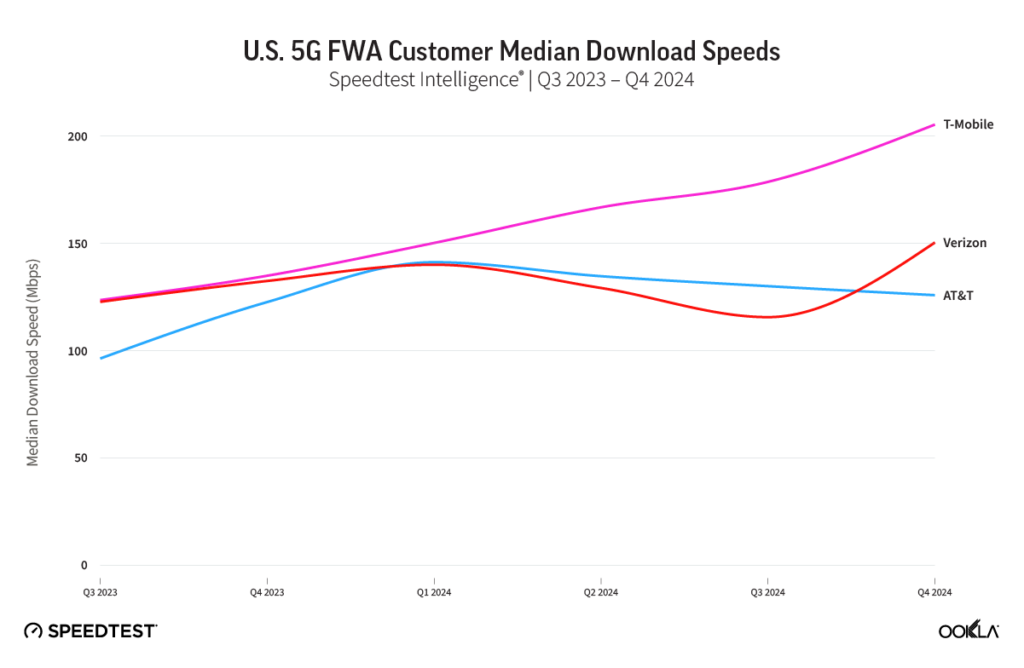
“The signal loss typically occurs during the spring and summer months (Q2 and Q3) when deciduous trees are filled with dense leaves that can weaken FWA signals,” noted Marek, citing a similarly timed decline in median upload speeds for all three operators in Q2 and Q3 2024 and a decline in download speeds for AT&T and Verizon in Q2 and Q3 2024.
“It’s also possible that this may be an early indication that strong uptake in FWA is starting to impact performance,” Marek added, explaining that network congestion could also be to blame. “There have long been concerns from the investment community and others about traffic from FWA subscribers causing congestion and impacting the performance of both mobile and FWA customers because the same 5G spectrum is being used to deliver both services.”
AT&T plays catch-up — but improvements expected
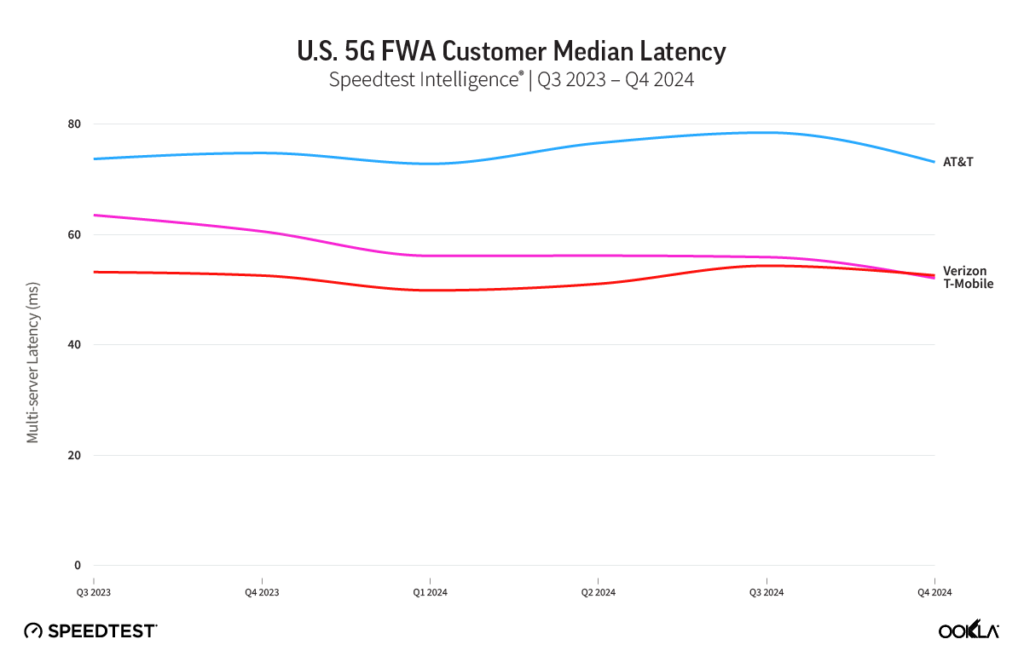
AT&T — the newest entrant into FWA — continues to lag on latency. In Q3, the carrier’s median latency was 67 milliseconds (ms) compared to Verizon at 54 ms and T-Mobile at 50 ms. On a positive note, it appears that its latency is improving every quarter from a high of 78 ms in Q3 2024.
Ookla expects further gains for AT&T Internet Air in the coming months as the carrier integrates newly acquired 600 MHz and 3.45 GHz spectrum from EchoStar. Together, the licenses cover 400 U.S. markets, Marek said. While the deal is not expected to close until mid-2026, AT&T disclosed in mid-November that it has already outfitted 23,000 cell sites with equipment capable of supporting the 3.45 GHz band, allowing both mobile and FWA customers to benefit sooner.
In September, AT&T SVP and Network CTO Yigal Elbaz told RCR Wireless News that FWA remains an important complement to the company’s fiber-first broadband strategy, rather than a replacement for it. AT&T plans to use its newly acquired mid-band spectrum to “relatively quickly” accelerate FWA deployment in areas where fiber is not yet available.
Looking beyond AT&T, Verizon and T-Mobile have both recently raised their long-term FWA targets, aiming to reach 8 million to 9 million subscribers and 12 million subscribers, respectively, by 2028.
In Q3 2025, the big three added a combined 1.04 million new subscribers, bringing the total number of Fixed Wireless Access customers to 14.7 million. “We expect U.S. operators to aggressively pursue the FWA market in the coming year and we will continue to monitor the FWA customer experience as these operators expand their offerings,” said Marek.

