

T-Mobile’s latest moves in AI-native RAN and private 5G for elite sports suggest a carrier evolving beyond its disruptive roots into something more formidable: the operator with the clearest story about where telecoms, AI, and customer experience converge.
In sum – what to know:
Brand messages – T-Mobile is aligning marketing sponsorships and infrastructure strategy, pairing premium sports experiences (PGA, MLB) with enterprise-grade private 5G, edge AI, and network slicing.
Network strategy – New work with Ericsson signals more momentum with 5G Advanced, which it already leads – moving AI-native scheduling and link adaptation into live traffic shows RAN leadership.
Narrative coherence — Verizon and AT&T are pushing their own 5G and AI stories, but T-Mobile is ably connecting investment, innovation, and experience as a single story, clear in its growth.
Personality matters, right? But so too does policy and content – if personality is to come to anything. Style and content, right? Anyone watching UK politics right now – indeed, anyone watching world politics – knows this very well. Without wishing to get into it, except that it is topical: populism holds sway (shame), by exploiting division in hard times, and amplifying it in (social) media. Etc etc. But it will be found out unless, firstly, there is credible policy behind it, and, secondly, there is lived experience that it delivers results. UK politics has none of that: no story, and no one to deliver it . Which is a half-assed rant, and a smart-assed way into a discussion about telecoms.
Anyone watching US telecoms right now – indeed, anyone watching global telecoms – knows very well that T-Mobile looks like it has this narrative logic sussed: a carrier with brand personality, backed by technical substance, tied to a coherent vision about where the industry is headed. Rather than just talking about the future of networks, it is plotting a course, one announcement at a time, to bring that future into the present. In the end, it is telling a good story – arguably better than any other operator right now. Although Verizon has told a version of it for some time (see here and here; and check the archive), and AT&T has also done so more recently (see here and here).
But T-Mobile’s plot twists are better, right now – to the point its old ‘uncarrier’ shtick, as the disruptive agitator among establishment brands, sounds a little screwy – because T-Mobile is starting to look like the one to catch in US telecoms. To wit: it has just issued two very different press releases, which present it as a premium consumer-content delivery brand, tied to one of the world’s quintessential elite establishment sports (golf), and as a live testbed go-to for aristocratic vendor firms to put their R&D through its paces. There is some symmetry, too: its new sponsorship of the PGA Championship goes with its immersive tech support for America’s favourite every-man sporting pastime, Major League Baseball.

Meanwhile, its new industry-first collaboration with Ericsson, to move the Swedish firm’s scheduler-with-link-adaptation tech into the way of commercial 5G traffic, is a consequence of the fact it retains a lead with its 5G Advanced rollout. Which is not about making this a kiss-assed editorial, either – T-Mobile has a way to go to catch these others for wireless revenues and subscribers, and even further to convince enterprises to churn away; plus it has none of the all-important fiber footprint, most immediately valuable to the AI ecosystem. But it has the best 5G network and the best 5G growth, and these things are big twists, which are connected in its marketing.
But let’s take a look at these new announcements – and report them as news. In fact, here are the press releases, lightly edited. Edit: actually, the first has been completely shorn of its marketing bluff, and the second is a straighter rewrite.
1 | Private 5G networks and public-5G slices at the 2026 PGA Championship
T-Mobile has installed a private 5G network for this week’s 2026 PGA Championship at Aronimink Golf Club in Newtown Square, in Pennsylvania. The setup, presumably (unconfirmed) by Ericsson, will deliver mainstream broadcast coverage of the event, and also to connect phones and cameras to capture player footage and analysis for fans using the event app and social media channels. T-Mobile will also make use of its public 5G network and slicing service, and manage edge compute hardware and analytics software as part of the sponsorship deal.
The 2026 event takes place this week. The tournament week started Monday (May 11) for practice rounds and media events; the event proper starts tomorrow (May 14), and concludes on Sunday (May 17). Around 150,000 fans visit the site across the week. T-Mobile’s sponsorship of it, and the nature of its tech solution, chimes with its work in Major League Baseball, which has seen it install private 5G network at every ballpark in the US: 29 different stadiums, 29 different networks, all supplied by T-Mobile, all made by Ericsson.
With regards to the PGA arrangement, T-Mobile only makes specific reference to the private 5G installation in its press note, plus the edge componentry to deliver an on-site operations center (‘smart operations command center’) to give “behind-the-scenes” event “teams” a “single real-time picture”, based on an “interactive 3D interface”, of “everything happening on site” – in order to “monitor crowd movement, entry points, concessions, and connected devices”. The platform will utilize AI to help identify issues early so teams can respond quickly, it said.
It is unclear exactly what these “issues” may be, but it references “shorter lines, stocked shelves, smoother entry”. The command center proposition is part of T-Mobile’s enterprise portfolio for large-scale live events. T-Mobile also references its so-called SuperMobile premium enterprise service, which offers dedicated network slicing for prioritized speed, built-in security, and satellite-to-device connectivity. As such, “fast ticket scanning at the gates” and “reliable connectivity for staff” will be served on a slice of its public network.
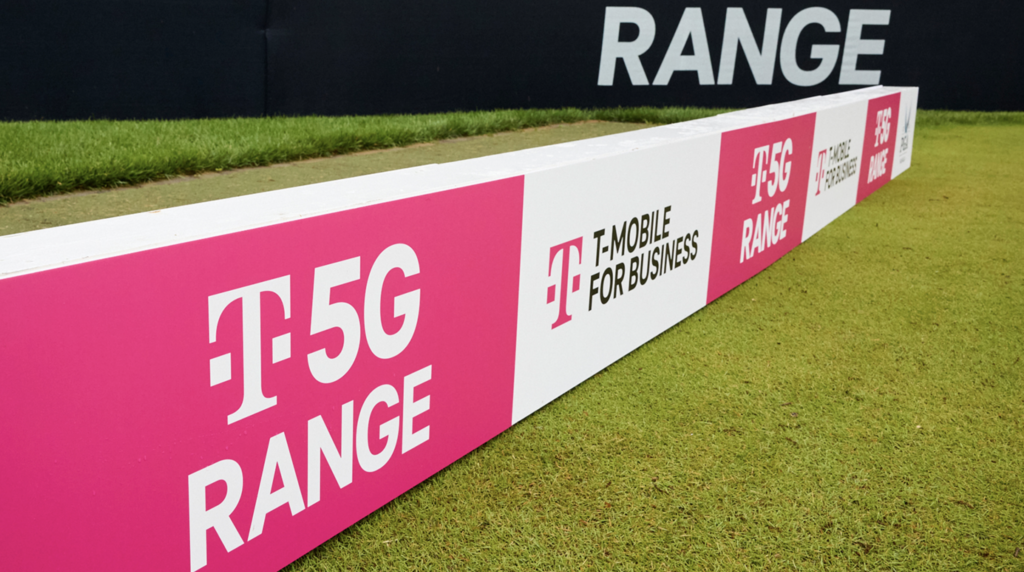
Photographers and content creators will be able to upload photos and videos using a “photojournalism network slice”, said T-Mobile. In both cases, these slices will use “intelligent connectivity to optimize performance for data-intensive tasks like video calls and large file transfers”, it said. Otherwise, it seems like the private 5G network for broadcast video, fan content, and player analytics is the tech centrepiece this week at Aronimink Golf Club. Sixty-odd 5G phones will capture footage from the branded player practice facility (T-Mobile Range) at the event.
T-Mobile stated: “This creates a vibrant, surreal image that can freeze the action at impact, swoop around mid-swing and break down a shot in stunning detail.” Six cameras will be connected on private 5G to the PGA production studios in Frisco, in Texas – to capture footage for TV commentators to discuss. CBS Sports will also broadcast footage from its own cameras via the private 5G network (“and edge control”); these will include fly-by views from drone cameras of players on the practice field, first tee, and 18th green.
As well, it will support delivery of a bunch of app content, including an AI assistant to answer questions and guide fans at the course. It is offering various member perks and customer giveaways as part of the deal. Amy Azzi, vice president of sponsorships at T-Mobile, said: “This is exactly the kind of stage and partnership that shows what T-Mobile does best – showing up for fans in ways that are meaningful, memorable and only possible with America’s best network.”
Terry Clark, chief executive at PGA of America, said: “T-Mobile is helping us raise the bar. Our partnership with T-Mobile gives us the tools to deliver a smoother, more interactive Championship thanks to AI-informed insights, wirelessly deployed content capture, enhanced broadcast features, and immersive enhancements in the [app].”
2 | AI-native RAN scheduler with link adaptation in live 5G-Advanced network
T-Mobile has let Swedish vendor Ericsson into its live network to test its network supplier’s new scheduler with link adaptation technologies. The software uses a neural network running directly on the Ericsson’s RAN hardware to predict changing radio conditions in real time, improving spectral efficiency and boosting downlink data rates to deliver a more consistent customer experience. So far, the trials have seen a “close-to” 10 percent increase in spectral efficiency and “up to” 15 percent better downlink throughput compared to legacy rule-based methods.
Ericsson stated: “These scaled live network results match earlier testing done across limited geographies, demonstrating the solution’s adaptability to diverse environments as the two companies jointly broaden the footprint further. By enabling faster, more intelligent decision-making in the RAN, [the] software ensures reliable performance even in high-demand environments with poor radio frequency conditions. Customers experience smoother streaming, more responsive gaming, and uninterrupted video calls even during peak usage.”
Grant Castle, senior vice president of RAN engineering and emerging tech at T-Mobile, said: “Following our milestone as the first U.S. operator to deploy 5G Advanced nationwide in 2025, we’re continuing to push the boundaries of RAN innovation. Our work with Ericsson on AI-native Scheduler with Link Adaptation demonstrates how real-time, AI-driven optimization can enhance spectral efficiency and throughput while delivering a more consistent experience for customers at scale.”
Ericsson has been busy testing AI-native’ link adaptation with partners in North America. It conducted field trials with Bell Canada at its Ottawa R&D site last year, and claimed a “significant milestone” with AT&T at MWC in Barcelona earlier this year with link adaptation on the carrier’s target cloud RAN stack. The work with T-Mobile is the first live testing. Johan Hultell, head of RAN software in Ericsson’s networks business, said: “By embedding intelligence directly into RAN software, we can deliver real-time performance gains that enhance user experience while helping operators like T-Mobile maximize the value of their spectrum.”

