

Strong growth and raised guidance sit alongside major AI work at Verizon, about to be unveiled with a brand new AI tech stack to drive further network automation and customer (micro-) segmentation to cut costs, improve service, and drive “industrial-scale” telco change.
In sum – what to know:
Records and pivots – Verizon delivered its strongest quarterly metrics in years, while it also adds the finishing touches to a major operational and commercial AI overhaul this summer.
Smarter economics – Apart from cutting 13,000 workers, Verizon is using AI to autonomously solve 85% of network issues and “micro-segment” customers to avoid old telco price wars.
Growth bets ahead – Management expects major savings and productivity gains, plus multi-billion-dollar revenues from AI infrastructure connectivity for cloud and edge computing.
Verizon’s results yesterday were interesting, and also good – by all accounts. But there are two ways to report about them, as always: by combing its news releases and city spreadsheets, and by listening to (scanning a transcript of) its earnings call. They produce different stories, based on historical form and future context. So yesterday Verizon posted its highest quarterly postpaid mobile additions in a decade, its highest quarterly adjusted EPS growth since 2021, and its highest quarterly adjusted EBITDA in its history – beating forecasts and raising guidance. But it also said it is about to unleash a proper telco-AI storm, across both its network operations and its customer relations.
Which means doing more with less, on one hand – per the broad AI agenda about “taking costs out [and] improving productivity”, plus also “delivering value to customers”. Verizon has just axed 13,000 staff, of course. On the other hand, it means delivering better and newer services, as seen in its “customer satisfaction” scores and expanded “value proposition”. Which is the new strategy under chief executive Dan Schulman, as explained on the call: not to buy customers in a price war with peers, but to use AI, as possible, to keep them happy and loyal, and to convince them to take differentiated services at a premium. Which sounds like standard business logic for every telco chief.
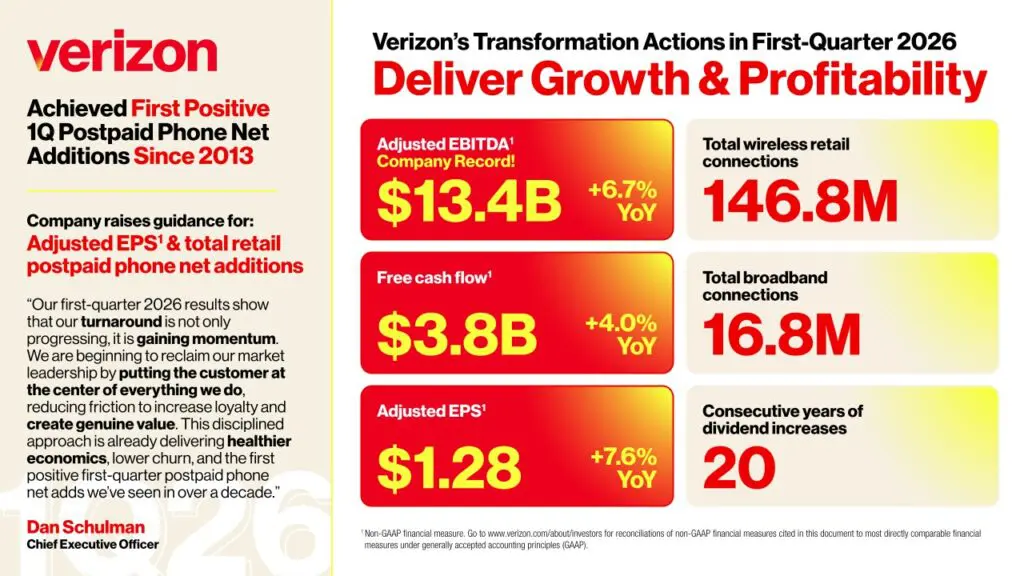
But Verizon, despite the blood letting, has a(nother) good winter-quarter on its books, and a whole AI-summer in its sights. It comes down to AI-enabled “micro-segmentation” of its consumer and enterprise customers, said Schulman – to know what they want, and be able to deliver it. Just about all its financial pointers went upwards in the first quarter: operating revenues by 2.9 percent (to $34.4 billion); net income by 3.3 percent (to $5.1 billion); adjusted EBITDA by 6.7 percent (to $13.4 billion); postpaid net additions by 340,000 (its first first-quarter annual jump since 2013); there’s more besides, as widely reported. It cited “healthier customer economics”.
AI stacks and segmentation
Its revenue figure missed targets because of its January blackout. But the firm has raised guidance for its 2026 EPS from five to six percent, and on most counts. Schulman responded on the call to a question about the “structural changes” to its go-to-market strategy, even just in the consumer sector in the last quarter. “I think all of us, and Verizon for sure, can be much more profitable when we start to micro segment – to really listen to what a customer wants and not just give them a free handset for everything,” he said, and offered an example about resolving a home coverage issue with a femtocell rather than a $1,000 handset upgrade – which doesn’t address the service issue.
“We could have done that at one-third the cost [with a femtocell] and made the customer happy. That’s what’s happening right now. We’re listening to what customers really want. We’re customizing offers to exactly their needs, and we are moving away from just having one tool in our toolbox, becoming much more sophisticated. As we continue to micro segment, we’re going to become much, much better at this.” Indeed, which gets into its real story with AI, unravelling through the summer. Responding to a question from Morgan Stanley, about how AI will “take out more costs across the business”, Schulman said Verizon is racing to be “AI-native”, and not merely “AI-first”.

The company has a new ‘every-customer-has-a-name’ initiative, apparently – about this idea of AI-driven customer “micro-segmentation”, which hinges on a new four-layer AI ‘stack’, developed with Google and Anthropic and other “best-of-breed” AI firms. Briefly, this stack comprises: an “intelligence layer” to format data and layer-in LLMs and SLMs; a middleware “development layer” to “spin-up” agents; a “runtime-engines” layer to deploy agents; and a “control-plane” layer for security, safety, observability, traceability, guardrails, and “those kinds of things”. Verizon will be “substantially complete” with this “entire” AI tech stack by July, said Schulman – and “fully done” by November.
Cloud and edge networking
The commercial angle for its micro-segmentation strategy is plain: interconnect fiber services for hyperscalers, backhaul and longhaul fiber systems, metro edge broadband and mobile access, sliced and private 5G networks. On commercialisation of inter-cloud data-center networking, as the mid-term windfall market in AI connectivity (see Nokia’s results, too), Schulman said on the call Verizon is in “quite deep discussions” with hyperscaler cloud providers, neo-cloud providers, and enterprises to integrate its “fiber, both dark and lit, and our 5G assets to support their AI infrastructure efforts”.
He stated:” “That can include data center connectivity, ability to help them with their training and inference. That is the potential for multi-billions in revenues, quite frankly. We’ll have more specifics on that in the next three to six months. The world is moving towards edge computing, towards data connectivity, and we are in a real good place to play inside that AI infrastructure revolution that’s going on.
On its AI-stack story, he listed certain partners and tools: Google; Anthropic (“we are very close”); the latter’s Project Glasswing to secure critical software; its new Claude Mythos AI model for enterprise workflows; conversational AI platform Sierra; AI voice startup/unicorn) ElevenLabs; fintech company Quadcode. He stated: “We are testing and fine-tuning these models. We are already seeing a 1,280 basis point improvement in customer sat scores year-over-year. These are quite astonishing step-ups in our ability to satisfy our customers.” Verizon has recruited “quite a number of AI savvy individuals”, he added – “more in the last three months than in the last three years”.
But its AI-driven network automation and customer segmentation goes beyond just coding, of course. The company sees opportunities to “increase our delivery by 40-plus percent” – whatever that actually means (doing more with less?). It spends “a ton of money on vendor support”, said Schulman, which it expects to “by over 70 percent” with AI. In the network, 85 percent of “all” Verizon’s issues are now “autonomously resolved” – to the point they are fixed “before customers even see them”. Verizon had “bill-of-material” for network configuration and hardware/software setup that ran to a “million different combinations” – meaning configuration variants to manage, provision, support.
So AI is being used to massively reduce variation – to cut complexity and costs, and simplify new deployments and services. The company has made over $200 million of energy savings by deploying AI in the network, as well. “We are doing things now at industrial scale,” he said. “I’m quite pleased with the amount of progress we’ve made in a short period.” Lots in there, then, like we said.

