


Malaysia’s recent Gross Domestic Product (GDP) performance reflects stability and progress. The next wave of competitiveness, however, will be defined by digital capability, specifically the nation’s ability to build advanced infrastructure, harness Artificial Intelligence (AI), and expand next-generation connectivity.
At the center of this transformation is the structural link between AI and 5G. AI generates economic value through automation, productivity gains, and smarter decision-making. 5G provides the high-speed, low-latency connectivity that allows AI to scale seamlessly across industries, public services, and society.
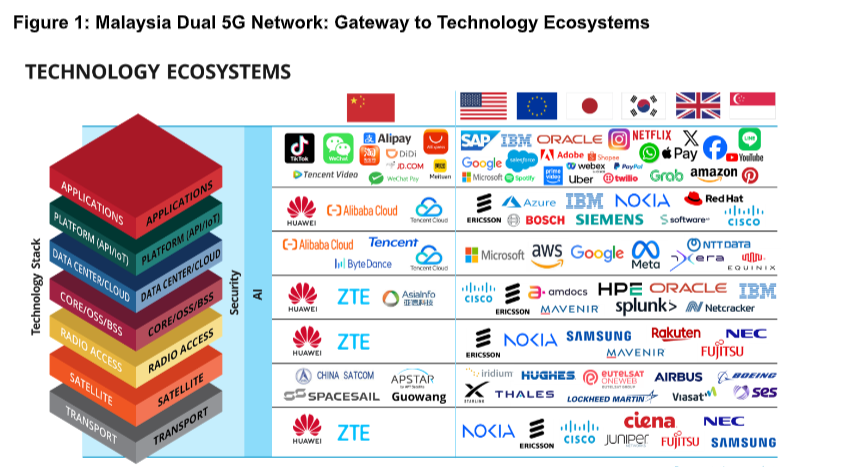
Malaysia’s decision to adopt a dual 5G network model strengthens flexibility, resilience, and long-term economic upside. By fostering competition and ensuring compatibility with both Western-aligned and China-aligned technology stacks, Malaysia broadens its appeal to long-term foreign direct investment. This balanced approach mitigates geopolitical risk for investors, while preserving strategic optionality in the evolution of the country’s digital economy.
Digital adoption to leadership
The Department of Statistics Malaysia recently reported GDP growth of 5.7% year-over-year (YoY), underscoring the country’s shift toward higher-value activities. Manufacturing and services are contributing a growing share of national output, signaling progress beyond resource-driven growth, such as mining and agriculture. Government policy has reinforced this transition through targeted investments in communications infrastructure, knowledge-and creative-based industries, Research and Development (R&D), and innovation-led growth.
A central element of this strategy is recognizing that AI is becoming foundational to Malaysia’s competitiveness. Investments in the sovereign AI cloud and the launch of Malaysia’s own Large Language Model (LLM), ILMU, illustrate a pragmatic approach to AI sovereignty and development. The emphasis is on building domestic capability that supports education, healthcare, and government services, while remaining compatible with global technology platforms and standards.
Malaysia’s regional role
Malaysia’s ability to maintain access to both global and alternative innovation ecosystems, as well as AI and chipsets, further strengthens its investment proposition. In an environment where geopolitical alignment and supply chain considerations increasingly influence capital allocation, this balanced approach provides investors optionality and longer-term certainty.
Foreign investment remains a cornerstone of Malaysia’s growth trajectory. Indeed, in the first nine months of 2025, total Foreign Investments (FI) increased by 47.5% YoY. Strong inflows from the United States, Europe, China, Japan, and regional partners underline continued confidence in the country’s economic direction. Increasingly, Malaysia is being positioned not only as a domestic market, but also as a regional base for serving Southeast Asia’s expanding demand for cloud and AI services.
Large-scale investments by hyperscalers and regional technology firms reflect this position. Data centers, cloud platforms, AI services, and talent development initiatives are being built with regional scale in mind. Demand for AI-enabled services across Southeast Asia is increasing, and Malaysia offers a stable, well-connected environment from which to serve that demand.
5G as economic platform
Malaysia’s nationwide 5G rollout has reached a significant milestone, with 82.4% coverage in populated areas and a rapidly expanding 5G subscriber base. While consumer benefits such as higher speeds and improved quality of service are important, the broader economic value of 5G lies in its role as a multi-purpose connectivity platform. Across manufacturing, logistics, healthcare, transportation, and the public sector, 5G enables new operating models built on automation, real-time data analysis, and remote operations.
These capabilities support productivity gains, operational resilience, and improved service delivery. Based on ABI Research’s analysis of Malaysia’s current infrastructure deployment trajectories, 5G is expected to contribute tens of billions of dollars to Malaysia’s GDP over the next decade, driven primarily by enterprise and public sector adoption.
AI reshapes the network
As AI applications move from experimentation to widespread deployment, they are becoming embedded across workplaces, infrastructure, and public spaces. While end devices are gaining more compute processing capability, most AI workloads continue to depend on cloud and data center resources. This dependency is placing increasing demands on both fixed and mobile networks.
AI-driven services generate higher data volumes and often require low latency, high reliability, and predictable performance. These requirements go beyond the design assumptions of basic mobile broadband. As AI adoption accelerates, networks must be capable of supporting both increasing traffic volumes and more stringent performance requirements.
The transition to 5G has significant economic potential, enabling capabilities such as Ultra-Reliable Low Latency Communications (URLLC), network slicing, and support for new categories of end-user devices and applications. Such capabilities are essential for AI-enabled use cases, including autonomous systems, industrial robotics, real-time analytics, immersive digital services, and mission-critical public sector applications.
ABI Research’s analysis finds that investment in 5G-Advanced could unlock substantial additional GDP growth beyond what is achievable through basic 5G deployment alone.
Multiplier effect of AI and 5G
AI and 5G are synergistic and mutually reinforcing technologies. AI applications increase demand for higher-performance networks, while advanced networks enable more versatile and higher-value AI use cases. Together, they act as an economic multiplier, increasing productivity across sectors, enabling new business models, and improving the efficiency of public services.
With the right investment and supportive policy frameworks in place, the combined impact of AI and 5G could add tens of billions of dollars to Malaysia’s economy by the mid-2030s. Realizing this potential, however, will require a sustained commitment to workforce development, infrastructure upgrades, and close collaboration between government and industry.

Trust, security, data integrity
As digital connectivity deepens, “trust” becomes ever more essential. AI-driven economies rely on secure data flows, robust authentication, and resilient networks capable of withstanding cyberthreats. Embedding security, policy control, and data integrity into national infrastructure is, therefore, foundational. It is about confidence that your partner operates under the rule of law, follows transparent governance, maintains operational autonomy, and acts consistently and impartially regardless of geopolitical pressures. Ultimately, trust rests not only on technology, but on the values and accountability behind it.
For investors and enterprises, confidence in network governance and security directly influences long-term commitment and capital allocation decisions.
Dual 5G network model
Malaysia’s decision to pursue a dual 5G network structure represents a strategically important policy choice. Supporting two infrastructure providers encourages competition, improves coverage and capacity, and reduces dependence on a single technology pathway.
More importantly, this model preserves Malaysia’s ability to align with both Western and China-based innovation ecosystems. In an increasingly fragmented global environment, this flexibility reduces geopolitical exposure for investors and allows multinational firms to operate within their preferred technology and regulatory frameworks, while maintaining a presence in the Malaysian market.
This balanced approach strengthens Malaysia’s position as a neutral and trusted digital hub, enhancing its appeal as a long-term destination for technology and infrastructure investment.
Next phase of digital growth
Malaysia’s digital strategy offers tangible promise. AI represents a vital engine of future economic growth, while 5G and fiber provide the platform that enables AI to scale across the economy and society. 5G has the potential to unlock higher-value use cases, particularly for industry and public services. Maintaining access to both a Western-aligned tech stack and a China-aligned tech stack via the dual 5G network model and digital infrastructure can ensure openness, resilience, and access to all innovation ecosystems, as well as AI and chipsets.
Having these government, enterprise, 5G connectivity, and AI initiatives in place, Malaysia can shift from “digital adopter” to “digital leader” to secure long-term economic value.
This article based on research from ABI Research’s “5G Impact Assessment – Malaysia” report.

