
RCR Wireless
  • News
  • Channels
    • 5G
    • 6G
    • BSS OSS
    • Carriers
    • IoT
    • Network Infrastructure
    • Open RAN
    • Private 5G
    • Telco AI
    • Telco Cloud
    • Test & Measurement
  • Resources
    • Reports
    • Webinars
    • White papers
    • AI Fundamentals
    • Analyst Angle
    • Editorial Calendar
    • Fundamentals
      • 5G NR Release 17
      • AI
        • Telco AI in 2025
    • Podcasts
      • Let’s Get Digital with Carrie Charles
      • Wireless Connectivity to Enable Industry 4.0 for the Middleprise
      • Well Technically…
      • Will 5G Change the World
      • Accelerating Industry 4.0 Digitalization
  • AI Infrastructure
  • Programs
  • Events
  • RCRtv
  • Advertise
  • Subscribe
Sunday, July 5, 2026
RCR Wireless
  • News
  • Channels
    • 5G
    • 6G
    • BSS OSS
    • Carriers
    • IoT
    • Network Infrastructure
    • Open RAN
    • Private 5G
    • Telco AI
    • Telco Cloud
    • Test & Measurement
  • Resources
    • Reports
    • Webinars
    • White papers
    • AI Fundamentals
    • Analyst Angle
    • Editorial Calendar
    • Fundamentals
      • 5G NR Release 17
      • AI
        • Telco AI in 2025
    • Podcasts
      • Let’s Get Digital with Carrie Charles
      • Wireless Connectivity to Enable Industry 4.0 for the Middleprise
      • Well Technically…
      • Will 5G Change the World
      • Accelerating Industry 4.0 Digitalization
  • AI Infrastructure
  • Programs
  • Events
  • RCRtv
  • Advertise
  • Subscribe
Add RCR Wireless as a preferred source on Google
  • Qualcomm 6G Insights
  • Huawei Content Hub
  • Qualcomm – 6G Vision
  • OSS/BSS Channel
RCR Wireless
RCR Wireless
  • Advanced Mimo
  • Mobile mmWave
  • 5G Positioning
  • Green Networks
  • Metaverse
  • Automotive
  • Industrial and Wide-area IoT
Copyright 2021 - All Right Reserved
Home - How Vecta Labs is using AI for interference hunting
FundamentalsTest and Measurement

How Vecta Labs is using AI for interference hunting

by Kelly Hill September 18, 2024
written by Kelly Hill September 18, 2024 Share
LinkedinEmail
Share 0LinkedinEmail
Vecta Labs AI RAN testing
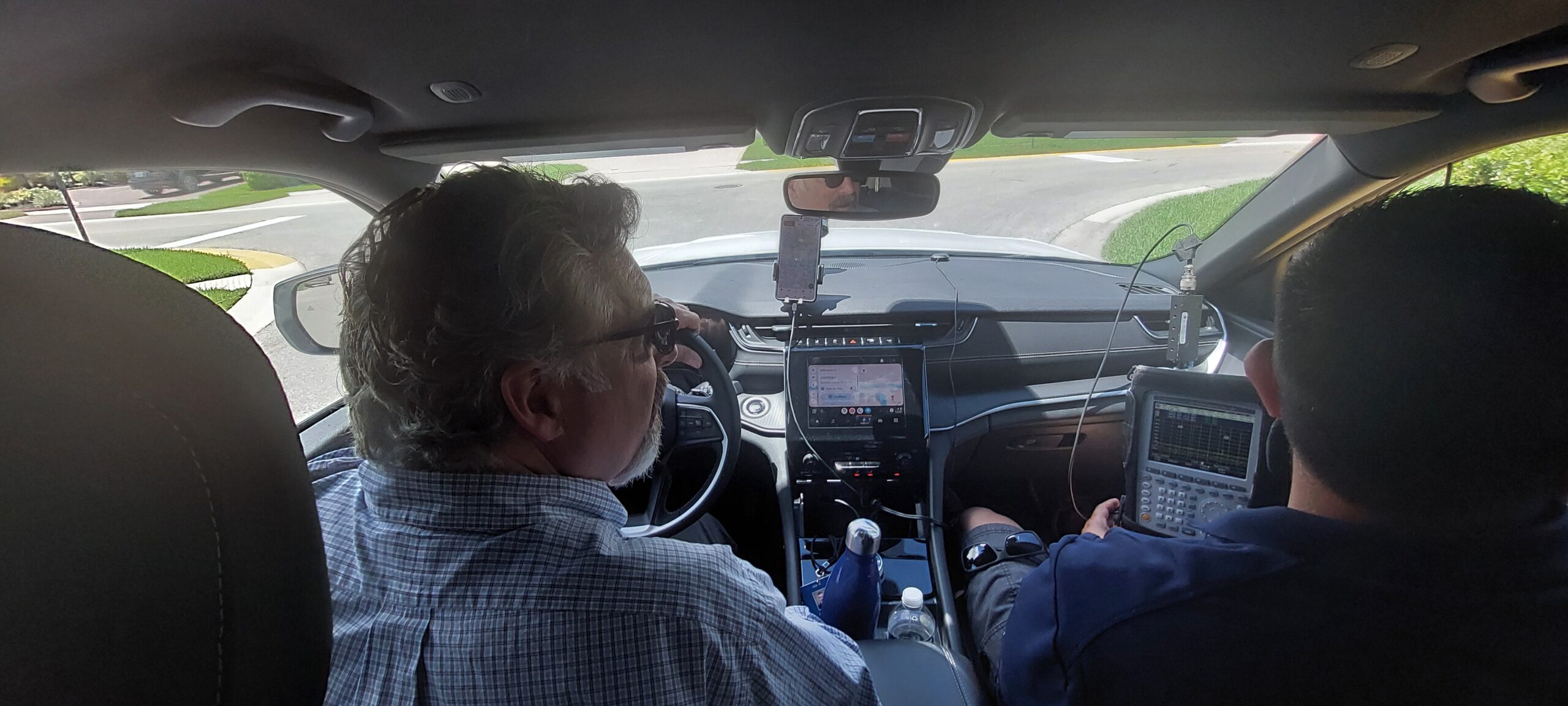
Vecta Labs' team conducting testing in the field. Image: Vecta Labs
200

As mobile network operators operate under increasingly strict capital and operating budgets, they are not only seeking greater efficiencies, they are looking at smarter tools for highly manual and expensive processes.

Vecta Labs is one of a number of companies that is applying artificial intelligence to solving problems in the Radio Access Network. Vecta recently finished a successful trial of AI-driven RF interference hunting in Miami, FL with a Tier 1 operator. The company’s RF Seeker service is meant to enable operators to put radio frequency novices to work and effectively locate RF interference sources.

Jonathon Labadie, who heads up business development and sales for Vecta in the Americas, said that across the telecom industry, “we’re in positions of almost forcing non-RF people to be RF people. …. It’s very rough, very challenging and that was something [our founders were] trying to be honest about and create a tool that could address that particular challenge: To have something that you could put in the hands of a novice, essentially, and it would get you to the front door of where the interference was.”

The company, founded in 2014 by telecom veterans from multiple antenna companies including Argus and Kaelus, specializes in manufacturing and testing mobile radio frequency devices including antennas, as well as in resolving passive intermodulation (PIM) issues. Vecta said that it has spent three years developing the machine-learning engine that is the brains of its RF Seeker offering, based on extensive data collection and precise algorithms plus “rigorous testing” to refine the AI interference hunting solution, which it said adapts to various RF interference patterns.

Liam O’Neill, an interference specialist with Vecta Labs, offered the perspective of a 25-year telecom veteran, on the complicated work of interference hunting with traditional tools. “A novice interference hunters is usually overwhelmed by looking at a spectrum analyzer. They’re going to see all kind of activity going on, and almost all of the activity is legitimate,” he explained. “They can get easily misled, and start barking up the wrong tree, thinking that something they’re looking at is interference, when it actually isn’t. What this tool does is, the AI component of it is able to differentiate between what is normal traffic on the channel that it’s looking at, and what is .. the actual interference signal. So it makes it much easier for a novice who’s using this tool to drive around with this thing set up in their vehicle and find the source of interference, without getting misled and just going down the wrong path.”

Vecta Lab’s AI interference hunting is focused on external interference sources on licensed channels. A small box plugs into a vehicle outlet, with a mounted antenna for the roof and a GPS antenna for the dash, plus a tablet for an interface. The solution provides a map, and as the user drives, markers pop up on that map and as the driver gets closer, the colors change from gray to red to indicate moving closer to the suspected interference source.

“As you drive around, the more data points are recorded and it starts to predict where it sees the interfering signal on the map. The most data it has, the more confidence it has in that location,” O’Neill explained. “So you just keeping driving toward that location, drive around it, and then it’s going to say, yep, this is where the signal seems to be coming from.”

The AI interference hunting software was developed in-house by Vecta Labs and trained to identify normal network traffic activity in 4G LTE and 5G channels, as well as to identify activity that wasn’t legitimate channel activity—i.e., interfering signals. It was designed for use in FDD frequencies, but was used in TDD spectrum in the Miami scenario and “actually worked quite well on that,” O’Neill said.

“One of the things that we discovered in Florida is that it worked in all of the different frequency bands that we tried to use it on. I was impressed—and I’m a skeptic when it comes to these kinds of things,” he added.

In Miami, Vecta worked with a carrier partner to get a list of sites that had interference issues, which stretched across Miami, Fort Lauderdale and even Naples. The company did the usual research on them that an operator would do before heading to the field, to narrow down where to start looking for interference—which its solution was able to locate in each case, to the building or address-level. “Of course, once you track down the source to a particular building, you then have to get out and get your spectrum analyzer and go on foot for the last hundred yards, knock on the door and get access and all that sort of thing,” O’Neill acknowledged. “But the tool got us to the door, pretty much, in each case.”

The interference hunting is a service, rather than a solution for sale, Labadie emphasized, with the goal of Vecta Labs being able to reduce the time that it takes to solve such problems. What would normally take a novice several weeks, is now able to be done in days, he said. And it’s a relatively inexpensive option compared to full-blown spectrum analyzers and experienced engineers in the field.

“What we’re refining here is the skillset that Liam has, that we honestly can’t replace with a human at all. I struggle to think we’ll ever be able to replace anybody like Liam ever, no matter the amount of technology that we have,” said Labadie. “I think we’re just being honest about the scenario—there aren’t many people like Liam in the world anymore.”

O’Neill himself chimed in with: “In the United States, you have people like me who do this, but in some other countries around the world, emerging economies where they have cell networks everyplace. But many of these countries have nobody that’s able to troubleshoot this kind of thing. And a tool like this could be really useful to them. You send them the tool, you can do the research from anywhere. … If you have access to their network, you can figure out, this is where we need to drive. And then you send them the module and have them power it up and drive around that area. And you could do that to 20 different cases that they have in their network, then once you have those 20 addresses of the front door to all those interference sources, then you send somebody there and they go just to those exact locations. That’s where the efficiency comes in.”

For more insights and examples of artificial intelligence being applied in network testing and assurance, check out the recent RCR Wireless News webinar featuring AT&T and Spirent Communications, and look for our upcoming special report to be published this week.


You Might Also Like
  • Real-world network emulation is critical for 5G deployments (Reader Forum)
  • Complexity, convergence, AI and the demand for trust are reshaping telecom testing
  • Test And Measurement Market Pulse Report
  • Anterix: ‘Terrific’ results from NTN testing with Lynk Global
  • Opensignal on fixed broadband: Cable upload speeds jump, FWA improves
  • What is AI-RRM in Wi-Fi 7?
Share 0 LinkedinEmail
Avatar of Kelly Hill
Kelly Hill

Kelly Hill reports on network test and measurement, AI infrastructure and regulatory issues, including spectrum, for RCR Wireless News. She began covering the wireless industry in 2005, focusing on carriers and MVNOs, then took a few years’ hiatus and returned to RCR Wireless News to write about heterogeneous networks (remember those?) and network infrastructure. Kelly is an Ohio native with a masters degree in journalism from the University of California, Berkeley, where she focused on science writing and multimedia. She has written for the San Francisco Chronicle, The Oregonian and The Canton Repository. She lives in northern Virginia, not far from Data Center Alley.

previous post
Free Mobile claims first 5G SA network in France
next post
AT&T to pay $13 million to settle cloud breach

White Papers

  • CSG White Paper: Telco AI Enabler: Mediation’s Defining Role

  • Enea White Paper: Scalable Database Design for 5G and Beyond

  • Supermicro and NVIDIA Whitepaper: Powering sovereign AI at scale

  • VIAVI Whitepaper: RAN scenario generators and their critical role for future-proofing AI-native RAN in Advanced 5G and 6G networks

  • Emerson/NI White Paper: 2026 Technology Trends Impacting the Wireless Communications Industry

Editorial Reports

  • Report: Scaling Optical Networks For The Hyperscale And AI Era

  • Test And Measurement Market Pulse Report

  • Editorial Report: Securing telecom infrastructure for the quantum era

Webinars

  • Webinar: Rethinking the RAN as AI, cloud and openness converge

  • Webinar: Scale-Up, Scale-Out, Scale-Across – Building AI-Era Network Fabrics

  • Webinar: NTN in motion – evolving standards, expanding services

  • Webinar: Noise-Figure Measurements with RFmx and PXI VSTs

  • Qualcomm Webinar – Building the 6G Standard: Key developments to know

Since 1982, RCR Wireless News has been providing wireless and mobile industry news, insights, and analysis to mobile and wireless industry professionals, decision makers, policy makers, analysts and investors.

Facebook Twitter Youtube Linkedin Envelope Rss

Useful Links

  • Subscribe
  • About RCR Wireless News
  • Contact Us
  • Advertise
  • Editorial Calendar
  • Archive
  • RSS
  • Wireless News Archive
  • Subscribe
  • About RCR Wireless News
  • Contact Us
  • Advertise
  • Editorial Calendar
  • Archive
  • RSS
  • Wireless News Archive

Edtior's Picks

Samsung’s AI RAN optimizer boosts KDDI 5G speeds up to 52% in live...
Indosat outlines AI Grid vision as 5G modernization targets nationwide AI-ready network
Wednesday | Telco agents and smash hits (Editorial Diary)

Latest Articles

Samsung’s AI RAN optimizer boosts KDDI 5G speeds up to 52% in live trial
Indosat outlines AI Grid vision as 5G modernization targets nationwide AI-ready network
Wednesday | Telco agents and smash hits (Editorial Diary)
Trust you can see – the convergence of voice, messaging, and identity (Reader Forum)

© 2026 RCR Wireless News All Right Reserved. Developed by Eight Hats.

Cookie Policy | Privacy Policy

RCR Wireless
  • News
  • Channels
    • 5G
    • 6G
    • BSS OSS
    • Carriers
    • IoT
    • Network Infrastructure
    • Open RAN
    • Private 5G
    • Telco AI
    • Telco Cloud
    • Test & Measurement
  • Resources
    • Reports
    • Webinars
    • White papers
    • AI Fundamentals
    • Analyst Angle
    • Editorial Calendar
    • Fundamentals
      • 5G NR Release 17
      • AI
        • Telco AI in 2025
    • Podcasts
      • Let’s Get Digital with Carrie Charles
      • Wireless Connectivity to Enable Industry 4.0 for the Middleprise
      • Well Technically…
      • Will 5G Change the World
      • Accelerating Industry 4.0 Digitalization
  • AI Infrastructure
  • Programs
  • Events
  • RCRtv
  • Advertise
  • Subscribe
RCR Wireless
  • News
  • Channels
    • 5G
    • 6G
    • BSS OSS
    • Carriers
    • IoT
    • Network Infrastructure
    • Open RAN
    • Private 5G
    • Telco AI
    • Telco Cloud
    • Test & Measurement
  • Resources
    • Reports
    • Webinars
    • White papers
    • AI Fundamentals
    • Analyst Angle
    • Editorial Calendar
    • Fundamentals
      • 5G NR Release 17
      • AI
        • Telco AI in 2025
    • Podcasts
      • Let’s Get Digital with Carrie Charles
      • Wireless Connectivity to Enable Industry 4.0 for the Middleprise
      • Well Technically…
      • Will 5G Change the World
      • Accelerating Industry 4.0 Digitalization
  • AI Infrastructure
  • Programs
  • Events
  • RCRtv
  • Advertise
  • Subscribe
@2020 - All Right Reserved. Designed and Developed by PenciDesign
