

RCR Wireless
  • News
  • Channels
    • 5G
    • 6G
    • BSS OSS
    • Carriers
    • IoT
    • Network Infrastructure
    • Open RAN
    • Private 5G
    • Telco AI
    • Telco Cloud
    • Test & Measurement
  • Resources
    • Reports
    • Webinars
    • White papers
    • AI Fundamentals
    • Analyst Angle
    • Editorial Calendar
    • Fundamentals
      • 5G NR Release 17
      • AI
        • Telco AI in 2025
    • Podcasts
      • Let’s Get Digital with Carrie Charles
      • Wireless Connectivity to Enable Industry 4.0 for the Middleprise
      • Well Technically…
      • Will 5G Change the World
      • Accelerating Industry 4.0 Digitalization
  • AI Infrastructure
  • Programs
  • Events
  • RCRtv
  • Advertise
  • Subscribe
Tuesday, July 7, 2026
RCR Wireless
  • News
  • Channels
    • 5G
    • 6G
    • BSS OSS
    • Carriers
    • IoT
    • Network Infrastructure
    • Open RAN
    • Private 5G
    • Telco AI
    • Telco Cloud
    • Test & Measurement
  • Resources
    • Reports
    • Webinars
    • White papers
    • AI Fundamentals
    • Analyst Angle
    • Editorial Calendar
    • Fundamentals
      • 5G NR Release 17
      • AI
        • Telco AI in 2025
    • Podcasts
      • Let’s Get Digital with Carrie Charles
      • Wireless Connectivity to Enable Industry 4.0 for the Middleprise
      • Well Technically…
      • Will 5G Change the World
      • Accelerating Industry 4.0 Digitalization
  • AI Infrastructure
  • Programs
  • Events
  • RCRtv
  • Advertise
  • Subscribe
Add RCR Wireless as a preferred source on Google
  • Qualcomm 6G Insights
  • Huawei Content Hub
  • Qualcomm – 6G Vision
  • OSS/BSS Channel
RCR Wireless
RCR Wireless
  • Advanced Mimo
  • Mobile mmWave
  • 5G Positioning
  • Green Networks
  • Metaverse
  • Automotive
  • Industrial and Wide-area IoT
Copyright 2021 - All Right Reserved
Home - Who disaggregated my RAN? Part 3: Open RAN and fronthaul: The last mile
Open RANReader Forum

Who disaggregated my RAN? Part 3: Open RAN and fronthaul: The last mile

by Ganesh Shenbagaraman June 15, 2020
written by Ganesh Shenbagaraman June 15, 2020 Share
LinkedinEmail
Share 0LinkedinEmail
Open RAN
Image courtesy of Radisys.
159

As we saw in the last article in this blog series, the disaggregation of the RAN has opened up a number of new and exciting opportunities for a larger ecosystem to grow and thrive. But nowhere has the momentum been felt more than in the last mile, specifically with regard to Fronthaul and with the Radio itself.

Traditional fronthaul technologies 

Most of the current deployments of LTE macro cell sites consist of base station equipment located at the bottom of a tower and the radio or Remote Radio Head (RRH) located at the top. The base station, or Base Band Unit (BBU), and RRH are typically connected through a high bandwidth fiber connection – what we call fronthaul. 
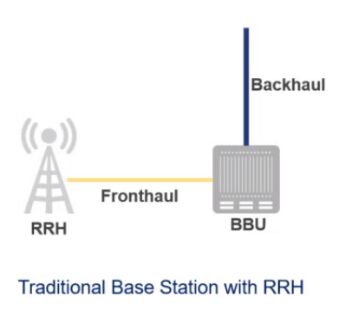
image1 1

Figure 1: Traditional Fronthaul

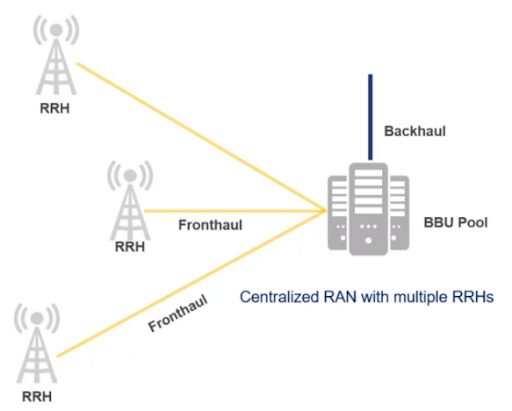
As we have seen, the traditional RAN evolved into a Centralized RAN (C-RAN). In C-RAN deployments, the base station is located a few miles away from the radios and is linked to the RRH by an optical fiber based fronthaul.
unnamed 2 1

Figure 2: Centralized (C-RAN) Fronthaul

A few protocol standards enabled this fronthaul transport to carry data between the base stations and the remote radio heads. These standards include: 

  • Common Public Radio Interface (CPRI) 
  • Open Base Station Architecture Initiative (OBSAI)
  • Open Radio Equipment Interface (ETSI-ORI)

CPRI emerged as the most popular option for LTE and is the standard we think about most often when discussing fronthaul. The standard was developed by vendors in the optical technology space, and as it matured, it became the de facto standard for fronthaul. CPRI allowed for a great deal of customization, and traditional RAN vendors began to deploy their solutions made with variations on the CPRI standard. 

CPRI was widely prevalent, but the amount of proprietary customization led to interoperability issues. Ultimately this created a greater lock-in situation for operators and has become one of the major driving forces toward an open, disaggregated RAN. 

In addition to the interoperability problem, the fiber bandwidth required to transport LTE data rates using CPRI transport was huge. Since fiber is expensive, the inefficiency of CPRI transport became a deployment issue. Bandwidth became a large challenge with LTE, and with the evolution of 5G and the further increases in data rates, many operators are realizing that CPRI has become unsuitable for their fronthaul needs.

5G fronthaul options

Most 5G applications require low-latency, making the fronthaul bandwidth issue an important factor. Depending on the deployment configurations, 5G can deliver 10x to 100x data rates more than LTE. 5G base stations are capable of delivering 10+ Gpbs data rates whereas an LTE base station is capable of delivering <1 Gbps. As a result, operators need a new open protocol that can deliver these data rates.

In 5G deployments, there are 2 transport options that are available for implementation of fronthaul for DUs and RUs: eCPRI and RoE. 
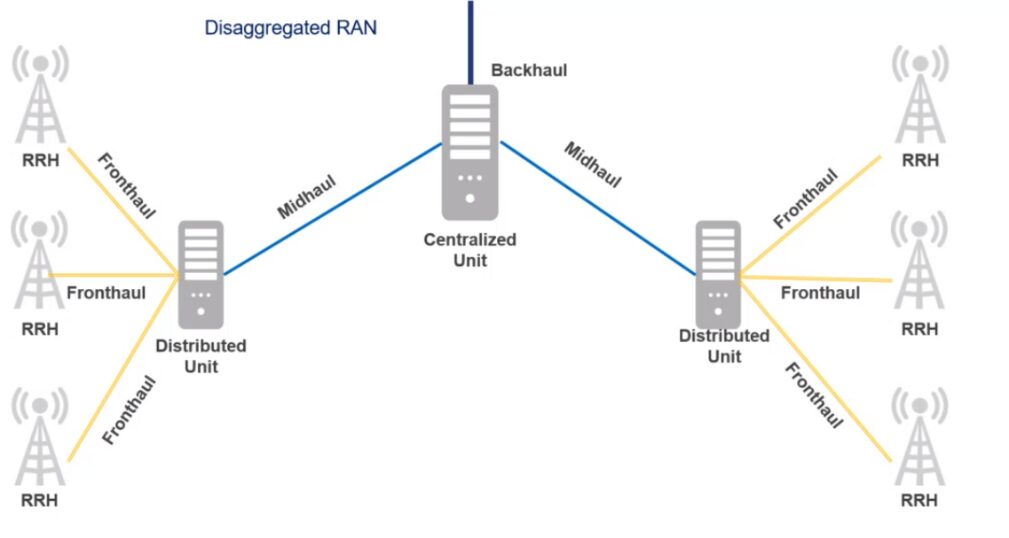
image5

Figure 3: Disaggregated RAN: Fronthaul, Midhaul and Backhaul

eCPRI (Enhanced CPRI):  eCPRI is a packet-based fronthaul protocol defined by the CPRI Forum for handling 5G data rates. This protocol delivers higher data rates for 5G by using compression techniques for data transfer for optimized fronthaul. This efficiency, coupled with CPRI’s dominance in LTE and 4G fronthaul, has led eCPRI to become the more popular protocol. More details can be found here.

RoE (Radio over Ethernet):  RoE is a protocol standardized by the IEEE 1914.3 working group. This protocol defines the encapsulation and mappings of radio protocols over Ethernet frames. Vendors are currently implementing RoE and a number of operators are encouraging the adoption of the RoE protocol for their 5G deployments.

There was still some work to be done even after the availability of these two transport options. The O-RAN Alliance addressed the problem of fronthaul for 4G and 5G deployments in a very comprehensive manner. The specification provided a RAN split option (7.2x) that moved some of the PHY layer functionalities into the radio. This standard supports both eCPRI and RoE transport options.

O-RAN fronthaul: This open standard details all of the signaling formats and control messages needed for multivendor DU and RU equipment to interoperate. It supports both eCPRI and RoE transport mechanisms and it defines fronthaul for both 4G and 5G. The standard has been in development since 2017, with work on the standard beginning in the xRAN Forum and then continued by the O-RAN Alliance. The latest version of this specification is Release 3 which is now available on O-RAN alliance website (https://www.o-ran.org/specifications).

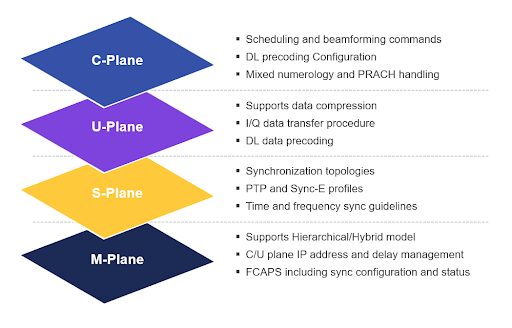
The O-RAN fronthaul specification anticipates all of the various scenarios regarding how a base station will interact with the radio, what the underlying 5G demands will be, time synchronization issues between two endpoints, and it make it deployment ready for operators. By addressing these various issues, the O-RAN standard is ensuring interoperability between base station and radio vendors, and we are already seeing commercial deployments using the O-RAN Fronthaul specification. O-RAN Fronthaul defines multiple planes of operations, including: 

  • Control Plane (C-Plane): Messages define the scheduling, coordination needed for transferring data, including aspects of beamforming for 5G.
  • User Plane (U-Plane): Messages for efficient data transfer within the strict time limits of 5G numerologies.
  • Sync Plane (S-Plane): Addresses the timing and synchronization aspects between the DU and RU.
  • Management Plane (M-plane): Defines the messages to manage the radio unit.
unnamed 1 1

Figure 4: O-RAN Fronthaul Planes and their Functions

This standardized fronthaul interface is a big step for the industry in ensuring interoperability and multivendor DU and RU solutions in deployment.

O-RU products enabled by O-RAN fronthaul

The O-RAN Alliance standard for fronthaul has enabled new players in the RU market and provided operators with more innovative choices and cost optimized radios. For example, TIP announced the Evenstar program which enables OEMs and operators to bring down the cost of RAN deployments.

Recently, Radisys partnered with Intel, Analog Devices (ADI) and Comcores to deliver an open reference design for O-RU. We published a whitepaper, Delivering an Open Radio Unit for Outdoor Macro Cell Deployments, on this design. This reference design is also available as a working demo for 5G DU and RU connected end to end. We are sure that this reference design is going to enable deployable RUs at affordable cost.
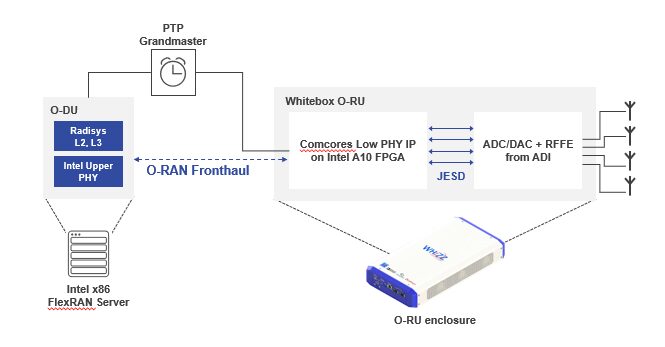
image3

Figure 5: Radisys system integration of Whitebox O-RU

It is not an exaggeration to say the open fronthaul and O-RU are the epicenter of the Open RAN revolution. The last mile is promoting openness and is attracting operators concerned by the need for standards which drive greater interoperability while reducing the bandwidth demands needed for low-latency applications. 

As the Open RAN revolution continues, there are exciting times for 5G ahead! 

In the next part of my series, I’ll look at how intelligence is built into Open RAN architecture. The Open RAN is both disaggregated and smart.


You Might Also Like
  • Trust you can see – the convergence of voice, messaging, and identity (Reader Forum)
  • Subsea resilience needs to move beyond cable count – here’s why (Reader Forum)
  • Real-world network emulation is critical for 5G deployments (Reader Forum)
  • Why autonomous networks don’t mature uniformly (Reader Forum)
  • Interoperability is key to unlock satellite D2D for all Americans (Reader Forum)
  • Dumb pipes no more – telcos have the AI opportunity of the decade (Reader Forum)

Table of Contents

  • Traditional fronthaul technologies 
  • 5G fronthaul options
  • O-RU products enabled by O-RAN fronthaul
Share 0 LinkedinEmail
Ganesh Shenbagaraman

Ganesh Shenbagaraman is Vice President Engineering at Radisys driving 4G and 5G wireless product development and Open RAN ecosystem partnership. He represents Radisys in industry forums like O-RAN, Small Cell Forum and TIP. Ganesh is a co-chair of O-RAN working group focusing on base station stack reference design.

previous post
The Sunday Brief: Summer 2020 edition–three up-and-comers
next post
16-fiber MPO provides an attractive path to 400 GbE (Reader Forum)

White Papers

  • Enea White Paper: Why Intelligent AAA is the Swiss Army Knife of Telecom

  • CSG White Paper: Telco AI Enabler: Mediation’s Defining Role

  • Enea White Paper: Scalable Database Design for 5G and Beyond

  • Supermicro and NVIDIA Whitepaper: Powering sovereign AI at scale

  • VIAVI Whitepaper: RAN scenario generators and their critical role for future-proofing AI-native RAN in Advanced 5G and 6G networks

Editorial Reports

  • Report: Scaling Optical Networks For The Hyperscale And AI Era

  • Test And Measurement Market Pulse Report

  • Editorial Report: Securing telecom infrastructure for the quantum era

Webinars

  • Webinar: Rethinking the RAN as AI, cloud and openness converge

  • Webinar: Scale-Up, Scale-Out, Scale-Across – Building AI-Era Network Fabrics

  • Webinar: NTN in motion – evolving standards, expanding services

  • Webinar: Noise-Figure Measurements with RFmx and PXI VSTs

  • Qualcomm Webinar – Building the 6G Standard: Key developments to know

Since 1982, RCR Wireless News has been providing wireless and mobile industry news, insights, and analysis to mobile and wireless industry professionals, decision makers, policy makers, analysts and investors.

Facebook Twitter Youtube Linkedin Envelope Rss

Useful Links

  • Subscribe
  • About RCR Wireless News
  • Contact Us
  • Advertise
  • Editorial Calendar
  • Archive
  • RSS
  • Wireless News Archive
  • Subscribe
  • About RCR Wireless News
  • Contact Us
  • Advertise
  • Editorial Calendar
  • Archive
  • RSS
  • Wireless News Archive

Edtior's Picks

What defines network performance in 5G and beyond? A CTO Perspective
Elisa says AI automation has cut network incidents by over 80%
“We’re going after the operator channel” – Druid bets on simplicity to scale...

Latest Articles

What defines network performance in 5G and beyond? A CTO Perspective
Elisa says AI automation has cut network incidents by over 80%
“We’re going after the operator channel” – Druid bets on simplicity to scale private 5G
Enea White Paper: Why Intelligent AAA is the Swiss Army Knife of Telecom

© 2026 RCR Wireless News All Right Reserved. Developed by Eight Hats.

Cookie Policy | Privacy Policy

RCR Wireless
  • News
  • Channels
    • 5G
    • 6G
    • BSS OSS
    • Carriers
    • IoT
    • Network Infrastructure
    • Open RAN
    • Private 5G
    • Telco AI
    • Telco Cloud
    • Test & Measurement
  • Resources
    • Reports
    • Webinars
    • White papers
    • AI Fundamentals
    • Analyst Angle
    • Editorial Calendar
    • Fundamentals
      • 5G NR Release 17
      • AI
        • Telco AI in 2025
    • Podcasts
      • Let’s Get Digital with Carrie Charles
      • Wireless Connectivity to Enable Industry 4.0 for the Middleprise
      • Well Technically…
      • Will 5G Change the World
      • Accelerating Industry 4.0 Digitalization
  • AI Infrastructure
  • Programs
  • Events
  • RCRtv
  • Advertise
  • Subscribe
RCR Wireless
  • News
  • Channels
    • 5G
    • 6G
    • BSS OSS
    • Carriers
    • IoT
    • Network Infrastructure
    • Open RAN
    • Private 5G
    • Telco AI
    • Telco Cloud
    • Test & Measurement
  • Resources
    • Reports
    • Webinars
    • White papers
    • AI Fundamentals
    • Analyst Angle
    • Editorial Calendar
    • Fundamentals
      • 5G NR Release 17
      • AI
        • Telco AI in 2025
    • Podcasts
      • Let’s Get Digital with Carrie Charles
      • Wireless Connectivity to Enable Industry 4.0 for the Middleprise
      • Well Technically…
      • Will 5G Change the World
      • Accelerating Industry 4.0 Digitalization
  • AI Infrastructure
  • Programs
  • Events
  • RCRtv
  • Advertise
  • Subscribe
@2020 - All Right Reserved. Designed and Developed by PenciDesign

