

T-Mobile US’ latest “Un-carrier” marketing moves includes offering a free Apple iPhone 5S to trial the carrier’s network, a dip into the burgeoning mobile music scene, and expansion of its voice over LTE and so-called “wideband” LTE service.
Test Drive
The carrier said that beginning June 23, customers can sign up for its Test Drive program, which will result in an Apple iPhone 5S being delivered to their door that they can then use free for a week. Once that week is up, customers are required to drop off the device at a T-Mobile US retail store where they can then sign-up for service or just walk away.
The program does require customers to provide a credit card number that will incur a $700 deposit on the iPhone, which will be refunded if the device is returned in new condition. T-Mobile US said it would charge a $100 damage fee if the device comes back “with a cracked screen, damaged screen display, water damage, active Find My iPhone feature or can’t be powered on,” while the full $700 will be charged if the device is not returned.

The program is aside from T-Mobile US’ already in place 14-day return policy, which requires a customer to first sign up for service and turn off their old service should they be porting a phone number into T-Mobile US.
Music move
Jumping on the streaming music bandwagon, T-Mobile US announced a partnership with Rhapsody to offer its UnRadio Internet radio service for free to T-Mobile US customers that are signed up for its unlimited data service. Customers on a capped data plan can access the service for $4 per month.
The UnRadio platform offers commercial-free access to more than 20 million songs, with the ability for customers to skip past as many tracks as they want. The service also allows customers to access live streaming content from thousands of commercial radio stations around the world, and tap into Rhapsody’s TrackMatch service that can identify a song being played from a different outlet.

In terms of supporting the broader streaming music ecosystem, T-Mobile US said it would no longer count cellular data used to tap into services offered by Pandora, Rhapsody, IHeartRadio, iTunes Radio, Slacker, Spotify, and the soon-to-launch services from Samsung and SFX against a customer’s data bucket. T-Mobile US’ current data bucket policy is to throttle data speeds down to 2G or 3G speeds once a customer reaches their data allotment instead of cutting off service.
T-Mobile US earlier this year adjusted the pricing on its unlimited data service from $20 to $30 per month, while doubling its “free” data access from 500 megabytes to one gigabyte.
The addition of the Rhapsody service could prove a compelling case for customers to step up their data bucket and help drive incremental revenues for T-Mobile US. The carrier has seen its postpaid service average revenue per user fall nearly 8% year-over-year as customers migrate to less expensive rate plans. But, when factoring in the monthly installment price consumers were paying for the mobile device connected with those plans, recurring revenues had increased nearly 4% year-over-year to $59.54 per month.
Sprint in late April announced a partnership that allows direct access to Spotify’s streaming music. The program allows customers signed up for the carrier’s Framily rate plans to access six months of free service, while non-Framily plan customers will have access to three months of free service. Pricing after the initial trial will be at $10 per month for non-Framily customers; $8 per month for 18 months for Framily plans with up to five lines of service; or $5 per month for 18 months for Framily plans with between six and 10 lines of service. After the 18 month period, pricing will shift to $10 per month.
AT&T announced a similar deal with Beats, offering its customers a free trial of Beats Music, which converts to a subscription after 3 months.
VoLTE expansion
The carrier said it had expanded its VoLTE service to 15 total “markets,” following up on the initial launch of services in Seattle last month. The new markets include: Atlanta; Austin, Dallas and Houston, Texas; Boston; Chicago; Long Island and New York, N.Y.; Los Angeles and San Francisco; Minneapolis, Philadelphia; Washington, D.C.; and the entire state of New Jersey. The focus on a number of large markets helped T-Mobile US quickly pump up its total VoLTE coverage to 107 million potential customers.
T-Mobile US CTO Neville Ray also touted that the VoLTE offering provides a 23.85 kilobit per second voice codec rate for the HD Voice-enabled service, as well as faster call set-up times than a traditional circuit-switched voice call. The VoLTE service also gained device support from Samsung’s latest Galaxy S5 smartphone, which joins the previously enabled LG G Flex, Samsung Galaxy Note 3 and Galaxy Light smartphones. Customers on both ends of a call will need to be in a VoLTE market and using a compatible device to actually tap into the service.
More spectrum for LTE
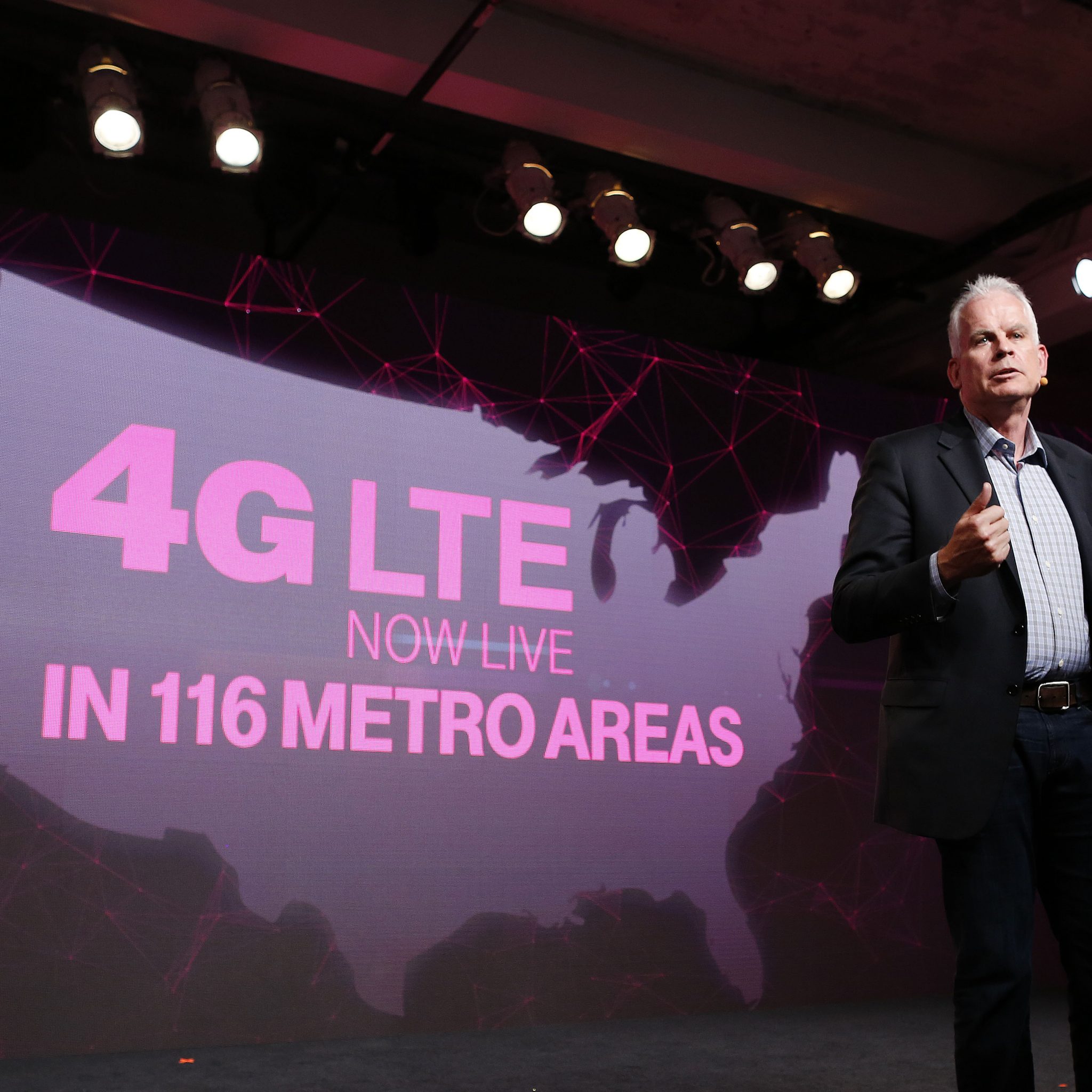
Ray also said the carrier had increased spectrum support for its LTE service, with T-Mobile US now throwing at least 30 megahertz of total spectrum at the network in 16 markets. That spectrum is in the 1.7/2.1 GHz band, which is the basis for the carrier’s nationwide LTE network that Ray added was set to cover 230 million pops by the end of the month.
T-Mobile US claims the increased spectrum support boost theoretical network download speeds up to “nearly 150 [megabits per second,” though that number is likely not ever to be seen outside of a lab.
Reports earlier this week indicated that T-Mobile US was on the hunt to purchase 700 MHz licenses from smaller rivals in an attempt to boost its holdings in that important spectrum band. The report adds that such deals could require eventual divestitures should regulators approve the oft-rumored Sprint/T-Mobile US tie up.
Verizon Wireless last month rolled out its XLTE brand to tout the addition of up to 20 megahertz of 1.7/2.1 GHz spectrum to bolster the initial 20 megahertz of spectrum in the 700 MHz band powering its LTE service. Verizon Wireless’ LTE network covers more than 300 million potential customers.
Sprint is looking to make a similar network boost through its Spark program, which will see the carrier combine spectrum across its 800 MHz, 1.9 GHz and 2.5 GHz bands to produce network speeds in excess of 50 megabits per second. The Federal Communications Commission recently approved an order allowing for a greater amount of spectrum aggregation in the 2.5 GHz band that was proposed by Sprint. Initial rules had limited total channel width in that band capped at 10 megahertz in order to prevent possible interference issues. However, the FCC noted that following public comments, it would allow for larger channels to be used in order to support higher-speed mobile broadband services.
Earlier this year, Ray said T-Mobile US would begin tapping into its recently acquired 700 MHz spectrum assets to further bolster the capacity and reach of its LTE service. Those spectrum licenses cover approximately 158 million potential customers, with T-Mobile US stating it plans to cover approximately 250 million pops with LTE services by year end.
T-Mobile US’ LTE network is also set to begin receiving support from the carrier’s 1.9 GHz spectrum that powers its 2G and 3G network, with the carrier working on re-farming some of that spectrum to support the LTE service. T-Mobile US’ legacy network currently covers approximately 280 million pops.
Bored? Why not follow me on Twitter
T-Mobile US latest ‘un-carrier’ moves: free service trial, music, expanded VoLTE, more spectrum
139

previous post
