

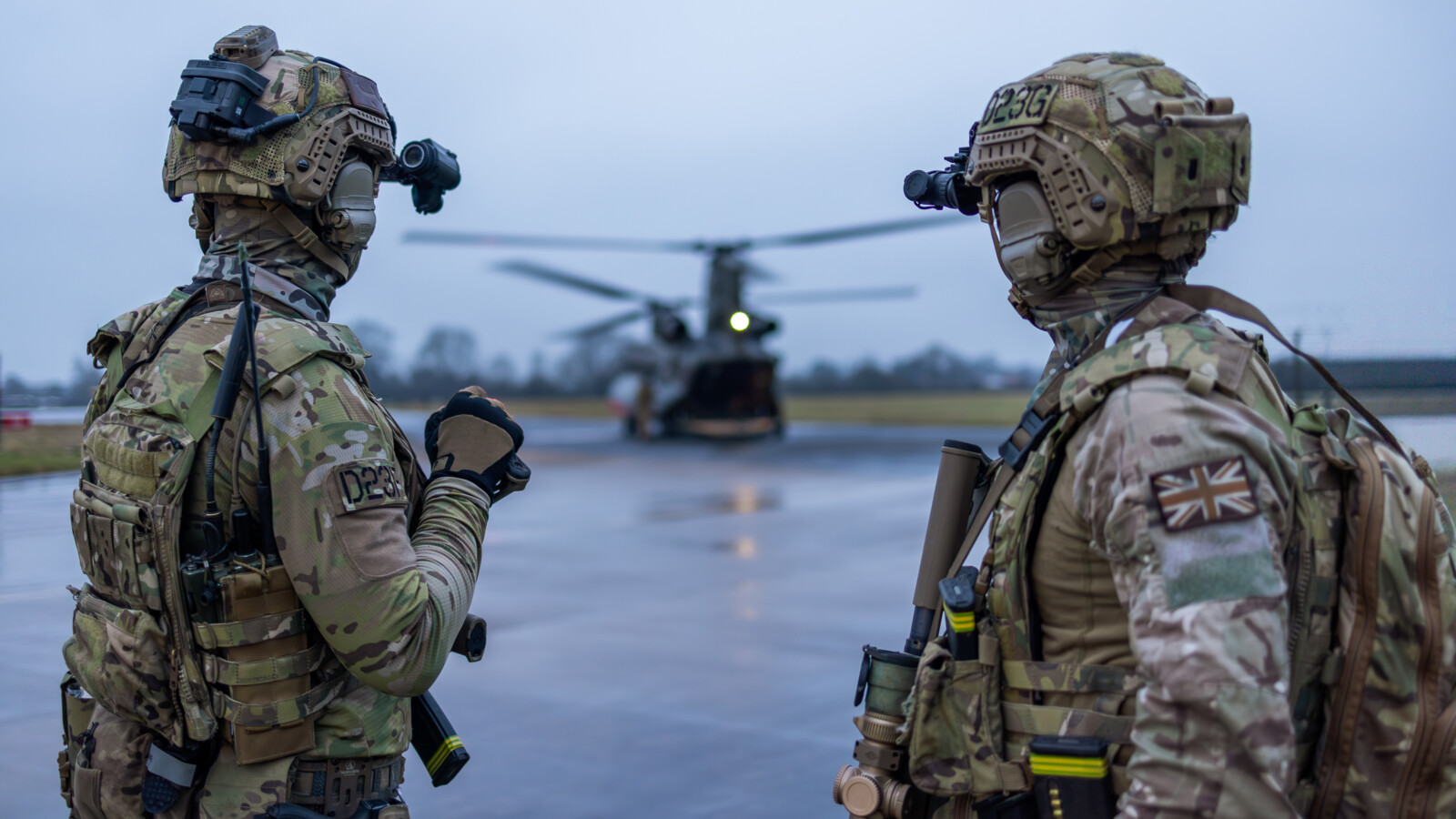
Ericsson has a direct role in the UK military’s £8 billion tactical comms overhaul, highlighting the growing importance of private 5G, drones, and AI in battlefield engagements; the win also exposes the Swedish firm’s contrasting strategy to rival Nokia.
In sum – what to know:
Defense deal – Ericsson has been selected to supply services and components under the MoD’s RM6393 framework, positioning it to supply and integrate tactical 5G systems through 2034.
Critical comms – The framework supports Project Morpheus and prioritizes resilient battlefield comms, combining private 5G, satellite, and mesh networks to support personnel, vehicles, drones.
Versus Nokia – Rival 5G vendor Nokia is not on the list; Ericsson is selling directly into military procurement channels, while Nokia is working through defence primes, integrators, and specialists.
Ericsson, among many others, has been selected for the UK’s £8 billion overhaul of its tactical comms systems – to support all branches of the British Armed Forces. The UK government’s new framework for Tactical Communication Systems (RM6393) is a procurement vehicle for military-grade tech, and focuses on (private) 5G, plus AI and drones. It covers an eight-year period to June 2034, and splits into three lots – for services, systems, and components. Ericsson has been picked among a cohort of suppliers in lots one and three (services and components).
Nokia, it might be noted, is nowhere to be seen on the new supply roster – although Nokia is involved in parallel UK military deployments and might be included within the RM6393 scope via third-party contractors, like other 5G vendors. It also might argue that its strategy is different – as discussed below. The framework will also reopen at two intervals during its eight-year lifespan, timed variously for the three lots. Either way, Ericsson’s appointment is a feather in the cap for direct 5G suppliers to the Ministry of Defence (MoD) and public sector agencies in the UK.
Nadine Allen, head of Ericsson in the UK, commented “Modern defence requires a new level of connectivity, where data-driven capabilities are essential for operational success. We are proud to bring our global leadership in 5G and mission-critical networks to support the UK’s defence modernisation. This framework allows us to work directly with the MOD to deliver secure, resilient, and future-proof communications that will serve as the foundation for the UK’s digital defence capabilities for years to come.”
Approved suppliers
Ericsson will supply 5G solutions and services to connect personnel, sensors, vehicles, and weapons in battlefield environments. Well over 70 suppliers have been selected in total – 55, 67, and 74 for the three lots respectively (with plentiful crossover between). UK telco BT won a position on lot two (systems), including (presumably) for 5G slicing for military facilities, backbone fiber support for private 5G, systems integration of vendor kit, plus just on form (BT is a legacy partner for the MoD and UK emergency services). No other tier-one UK operator has won direct positions.
Meanwhile, Finnish vendor KNL, part of Norwegian telco Telenor Group, has been appointed to supply high-frequency (HF) radio systems. The UK arm of global integrator CDW has been awarded places across all three categories; private UK-based integrator Exponential-e has been selected in two. Dozens of other defense primes, tech corporations, and specialists have also secured berths, including: Airbus, BAE, Babcock, Elbit, and CGI IT; Computacenter, Centerprise, and Entserv (DXC); Radionor, Blacktree, Blu Wireless, DTC, and Drumgrange.
Defense spending
The RM6393 framework aligns with the UK government’s new Defence Investment Plan (DIP), which injects an extra £15 billion to boost the total defense budget to £298 billion over the next four years, and seeks to scale UK defense spending to 2.7 percent of GDP by 2029. Its timing also addresses a perceived “2030 threat window”, by when NATO reckons adversaries like Russia might be ready to challenge the alliance. The plan is presented as a fix to bypass sluggish procurement cycles, and gives the MoD an off-the-shelf mechanism to buy mission-critical comms.
As well, the strategy considers operational lessons from Ukraine, where modern combat has proved that electronic warfare, signal jamming, and cyberattacks can ‘blind’ and disrupt a military force. As such, the RM6393 framework prioritizes resilient multi-domain connectivity. The pitch is that vendors like Ericsson with flexible private 5G propositions and KNL with shortwave radio systems for higher 3-30 MHz frequency bands can collectively deliver portable and composable networks that reroute data if other cellular and satellite systems are jammed.
Sovereign industry
It represents one of the first major defense vehicles built under the Procurement Act 2023, and works as a test case for how the UK spends its defense budget. Historically, contracts locked the MoD into a handful of big contractors for decades; the new framework will be reopened in 2029 to accommodate tech startups with breakthroughs in drone automation and signal encryption – more or less as the tech advances. It also plays to the European sovereignty drive, which includes rebuilding domestic defense manufacturing rather than relying on global supply chains.
The UK defense review mandates that British companies, and also SMEs, are prioritized; the RM6393 lot-structure is so that specialists can sell directly to the MoD without going via big (and predatory) international primes. The framework, itself, is effectively about standalone-grade private 5G (5G SA), in one form or another – plus the tech it supports (drones, notably, plus other AI-related military apps) and to make it better (AI, invariably). But it slots into its flagship scheme, Project Morpheus, replacing the legacy Bowman system, to overhaul core battlefield comms.
Backup networks
Ericsson’s tactical 5G nodes and KNL’s high-frequency radios must plug into the UK’s new Morpheus architecture – so frontline soldiers can route data from local drone feeds, say, over 5G to the battlefield network. Similarly, the MoD runs parallel systems in alternative bands. It uses the Skynet satellite network alongside high-frequency failover to bounce signals off the Earth’s ionosphere (‘ionospheric refraction’ or ‘skywave propagation’, apparently) to connect across continents – in case its standard terrestrial and satellite systems are compromised.
On the battlefield, mobile ad-hoc network (MANET) mesh systems (from approved equipment vendors like Silvus Technologies and Persistent Systems) make every vehicle, drone, and soldier into a signal router, effectively, and provide ‘bubble’ coverage for convoys, feeding back into the Morpheus system. By running parallel frameworks, the MoD avoids getting locked into a single supplier or a single technology. By opening up procurement, with RM6393, it can purchase and plug-in the latest breakthrough tech – as available and as required.
Network models
For private 5G – as supplied directly by Ericsson, and indirectly via Ericsson and others – deployment models include tactical ‘network-in-a-box’ solutions (‘deployable 5G’), to go on a truck or even in a backpack and create a localised ‘bubble of coverage for authorised drones, sensors, and soldiers – operational in half an hour with zero cabling, geared around an isolated private core, and arguably the most critical form of 5G for frontline combat. Other modes include private 5G networks for maritime usage and hybrid systems for permanent fixtures.
The MoD and NATO have just tested Ericsson’s 5G SA cores (also with Vodafone) to create localised 5G coverage for naval fleets, using radio signals on the vessels as wireless backhaul to daisy-chain connectivity from ship to ship and air-gap the public internet. Hybrid-private 5G SA slicing, using a public core and local radios, such as from BT, is being rolled out for military bases, logistics hubs, and training facilities within the UK – where separate networks are too expensive. The Nokia comparison is interesting – if only because RCR has been banging its head against it.
Direct channels
Ericsson’s RM6393 win gives it a front-row seat to pitch its entire 5G portfolio directly to the MoD and wider UK public sector for the next eight years. The lot-three components accreditation allows it to supply physical network equipment, including base stations and ruggedized cores; the lot-one services deal allows it to bid on the design, integration, and deployment support required to integrate those components into military IT infrastructure. It means it can be the hardware manufacturer and the systems architect, instead of just relying on integrators.
Whereas Nokia appears to be required to go via third-party channel partners – which might suit it, of course. When it announced it would sell its Enterprise Campus Edge (ECE) division at the end of last year, its complaint about the ‘campus’-end of the private 5G market was that there was too-much expensive integration, and that it would rather focus on wider-area “mission-critical” private 5G deployments in the utilities, railways, public safety, and (also) defense sectors. But the defense industry, like most sectors, is a varied field.
Correct cores
At least within the scope of the battlefield, much of the market requires right-sized core systems – which Nokia is jettisoning with the sale of its (market leading) ECE unit. Yes, it can still sell ruggedized small-cell versions of its AirScale radios with micro-sized trolley-case 5G cores – such as from Irish specialist Druid Software, talking up mix-and-match combo solutions, or indeed from ECE, under new stewardship. But the opposite argument, which Ericsson and others would make, is that mission-critical comms should not be hooked up to “Frankenstein” systems.
Historically, government agencies prefer ‘one-throat-to-choke’ set-ups as well. But there should be no question about Nokia’s interests in supplying 5G for defense purposes. It still has indirect routes as a RAN supplier into the UK military via the RM6393 framework, and it has other options besides. Notably, the purchase of defense contractor Fenix Group by Nokia’s defense business in 2024 is interesting. The US outfit’s portable Banshee network-in-a-box was built as a campus-style system for the US Department of Defense.
Rival strategies
When the deal went through, it was understood to be aligned with the DAC system – where one had the edge software stack, and RAN extension, the other had military-grade vehicle integration and defense channels. That vision, if it ever was one, is probably dead. But the Banshee unit has an embedded computer that still hosts a Fenix-made 4G/5G core, running on bare-metal hardware. Fenix Group assets are part of the Nokia Defense, which is part of its Mobile Networks group – which can pitch the Banshee system for tactical use to RM6393 integrators.
Nokia has a deal with European defense firm KNDS to integrate the Banshee solution directly into armored combat vehicles, for example. It has a similar arrangement with Kongsberg for the Norwegian firm to make use of its “leadership in commercial 4G, 5G, and private wireless”. The press note talks about drones and sensors – and future 6G network sensing (ISAC) – and their role together in European Defense Fund initiatives like 5G COMPAD and the Federated Advanced Cyber Physical Test Range (FACT) program. The Banshee system is part of their discussions.
Integrator deals
Besides, Nokia Defense has just signed with European defense-AI lab NestAI, in which Nokia has invested €100 million (with Finnish state-owned investment company Tesi), to combine Nokia’s “deployable 5G” (private 5G) with NestAI’s battlefield-comms to help European military command and control, and support autonomous systems and reduce reliance on fixed comms. Nokia Federal Solutions, the US-facing arm of Nokia Defense, is working with Lockheed Martin to launch a “modular” and “plug‑and‑play” 5G for US and allied forces “at the point of need”.
Which sounds like a late defense of Nokia’s defense strategy; it is and it isn’t. The point is to discuss the role of private 5G in defense in all its forms, and how Ericsson and Nokia have different strategies. Nokia’s decision to sell its ECE unit is a calculated margin play, aligned with its ‘supercycle’ narrative about big-box shifting to national operators running mobile and fixed systems for the new AI economy. Selling small, bespoke ‘campus’ networks to individual factories and ports, even in volume to defense agencies, is fragmented and expensive to support.
Parallel stories
And it might be argued that Nokia is outsourcing the friction and waste that goes with bidding on bureaucratic frameworks like RM6393, while integrating its mostly-RAN private-networks portfolio into defense giants like KNDS and Lockheed Martin, and maybe even plugging the gap for smaller-scale core systems with Fenix and Druid. But Ericsson will do those things, too (which we should have spent more time discussing), and it now has an active pre-certified route into the UK defense sector, for starters, and deeper control over battlefield network architecture.


