

Ericsson saw 6% organic growth in Q1 2026, but slumped 10% in real terms with currency swings, divestment costs, and higher AI chip prices – causing it to miss targets. Network sales in EMEA and APAC made up for a mixed show in the Americas; enterprise 5G and API sales were steady; the firm’s longer-game AI tactics remain the same.
In sum – what to know:
Underlying growth – Organic sales rose 6% year-on-year, but a SEK 7.8 billion currency impact pushed reported revenue down 10%, dragging all three business segments into headline declines.
Profit pressures – Net income fell 79% to SEK 887 million, missing earnings expectations by a wide margin, as higher semiconductor input costs, restructuring charges, and FX effects hit earnings.
Regions, industries – EMEA and Asia posted double-digit organic growth; North America weakened on year-ago highs; enterprise grew 4% organically led by its Global Communications Platform.
Ericsson claimed organic sales growth of six percent in the first quarter of 2026, versus a year ago, including growth in all its segments. In real terms, the picture was different: reported sales were SEK 49.3 billion in the quarter, down 10 percent as a headline figure against the same period in 2025 (SEK 55.025 billion). The decline was entirely down to a SEK 7.8 billion foreign echange (FX) “currency impact”, it seems – effectively forcing sales at its networks division (SEK 32.9 billion) down by eight percent (seven percent higher as an organic figure), sales in cloud software and services (SEK 11.8 billion) down by nine percent (four percent higher), and sales to enterprises (SEK 4.2 billion) down by a 30 percent (also four percent higher).
The latter was hit by a SEK 1.1 billion divestment charge related to the SEK 9.9 billion sale of US call-routing and numbering firm Iconectiv in August last year (2025). Either way, the firm made less money, and missed targets – by 75 percent on its earnings per share ($0.0285 versus a forecast of $0.1152) and five percent on its revenue ($5.21 billion versus $5.48 billion); it shares were down by almost four percent in pre-market trading. Börje Ekholm, president and chief executive at the firm, cited “increasing input costs, especially in semiconductors, caused in part by AI demand”. Which is the obvious AI headline from the report.
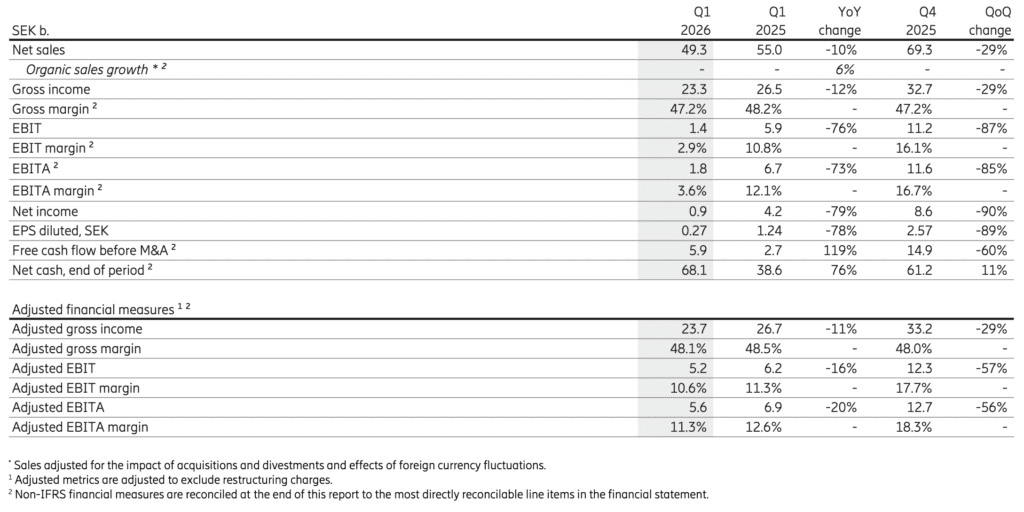
Gross income was down, at SEK 23.7 billion – a fall of 12 percent as a reported figure, and 11 percent, adjusted for business sundries and one-offs – and net income plummeted by 79 percent to just SEK 887 million, versus SEK 4.217 billion a year ago. The latter was down to “restructuring charges and currency impacts”, it said. Gross margin was about flat, down marginally in its networks division (mostly RAN hardware) and up marginally in its cloud software and services unit (core networks, OSS/BSS, orchestration, cloud platforms, managed services) – at 48.1 percent for the period, versus 48.5 percent a year ago.
Ekholm pointed to “continued resilience in a dynamic environment”, and “healthy gross margins and strong cash flow”. He added: “Our multi-year investments in building a resilient, diversified, supply chain have enabled us to deliver consistently for customers amidst geopolitical and macroeconomic uncertainties.” He predicted a “flattish RAN market”, and “strengthened positions in mission critical and enterprise” to “grow faster than the mobile networks market”. More on the enterprise picture, below. Ericsson had 87,521 employed on March 31, compared with 88,826 on December 31 (2025), it said. The regional picture has skewed away from the US.
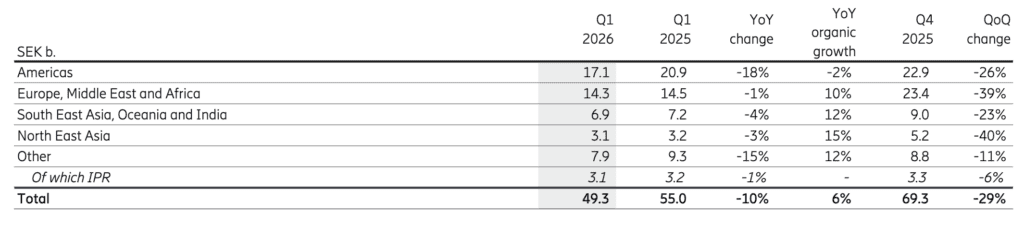
Organic sales in the Americas decreased by two percent year-on-year – “strong” in Latin America and “lower” in North America, with the latter decline mostly down to “accelerated network investments in the prior-year period”, plus tariff uncertainty and “short-term” reallocation of carrier spend after mobile “market consolidation” (the merger of Sprint and T-Mobile, T-Mobile’s acquisition of UScellular, the Dish/EchoStar/Boost collapse, the hoovering-up of spectrum from smaller players by AT&T and T-Mobile).
Sales in EMEA grew by 10 percent, meanwhile; Ericsson flagged 5G projects in the MEA region, plus the new upgrade work with Virgin Media O2 (VMO2) in the UK (to become its primary RAN partner, powering the majority of its nationwide mobile network”, it said again – as a knock to Nokia, the other, rather-reduced, winner of the VMO2 5G SA carve-up). Sales in the broad Asia region were up by 12 percent (South East, plus Oceania and India) and 15 percent (North East, including China, Japan, Taiwan).
Meanwhile, a quick look at the enterprise picture – because RCR has been following it, and wrote about it in the context of the Swedish group’s broader strategy this week…
This article is continued here.

