

What you should know:
- Spectrum readiness is crucial for U.S. 6G leadership: The OBBB Act mandates the identification and auctioning of 800 MHz of licensed spectrum by 2034, but at least 600 MHz must be ready for full-power mobile deployments by 2029 for the U.S. to keep pace with global markets that already have earmarked spectrum for 6G.
The One Big Beautiful Bill (OBBB) Act, which became law earlier this year, sets out a clear spectrum roadmap to enable U.S. 6G leadership. The OBBB Act recognizes that full power mobile spectrum is key to enabling meaningful nationwide deployments by U.S. mobile network operators (MNOs). While the OBBB Act requires identifying and auctioning 800 MHz of licensed mobile spectrum by 2034, the spectrum must be ready for deployment well before then. U.S. 6G leadership depends on it.
For the U.S. to keep pace with other major world markets that have earmarked specific spectrum for 6G, at least 600 MHz of full-power mobile mid-band spectrum must be opened for initial 6G deployments across America before the end of this decade. The 6G Standard will be completed in early 2029, and standardized 6G equipment will be available later that year.
Mobile spectrum is the lifeblood of innovation, powering advanced connectivity, economic growth and national security. Its availability determines how quickly new technologies are developed and deployed. 6G will deliver transformative societal benefits and drive new industries, job creation and productivity gains, while enabling breakthroughs in healthcare, transportation and public safety. Timely spectrum access is key to unlocking these innovations and maintaining U.S. competitiveness on the global stage.
Each U.S. government agency with wireless operations in the bands identified in the OBBB Act must collaborate with NTIA, the FCC and the wireless industry to determine the most effective means of opening 600 MHz for full power mobile deployments in 2029. Qualcomm and its mobile industry partners are ready to work with all impacted spectrum stakeholders to make this happen. Relatedly, Qualcomm and its partners are supporting NTIA’s efforts to facilitate spectrum availability for early stage 6G demos by the wireless industry at the 2028 Summer Olympics in Los Angeles. This LA-focused spectrum effort can help inform the challenge to open 6G spectrum more broadly in 2029.
6G will deliver transformative societal benefits and drive new industries, job creation and productivity gains, while enabling breakthroughs in healthcare, transportation and public safety.
Qualcomm is a world-leading mobile technology innovator
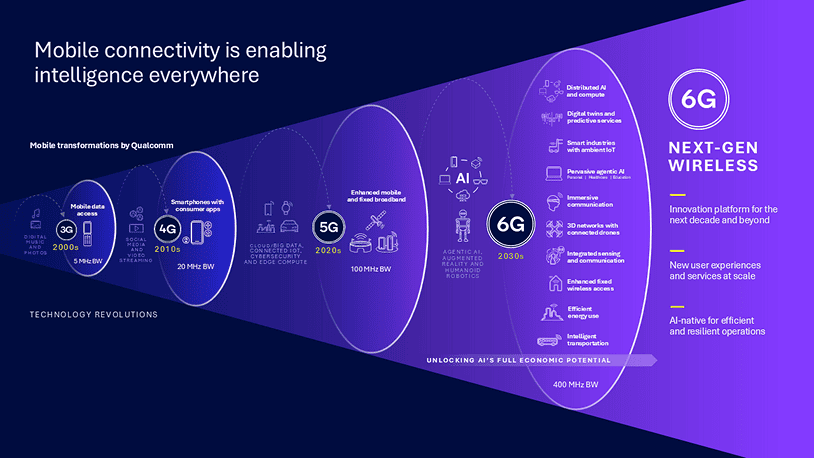
For the past four decades, Qualcomm has been a leading mobile technology innovator and wireless system developer, with R&D investments that exceed $100 billion. As shown below, Qualcomm developed foundational mobile communications innovations that enabled the U.S. to lead the world in 3G, 4G and now, 5G. 3G brought the internet to mobile devices, 4G fueled the app-driven economy and 5G is delivering mobile broadband to homes and businesses — enabling direct competition to wireline broadband providers — and seamlessly connecting a continuously increasing number of consumer and IoT devices.
With each successive mobile technology generation, Qualcomm expands its mobile technology expertise. Today, this expertise extends beyond advanced wireless connectivity to high-performance, low-power compute within data centers and for on-device AI. 6G will combine these tools — high-performance compute with advanced wireless connectivity — to enable mobile communications KPI improvements in latency, coverage, power efficiency, reliability, security and spectral efficiency.
6G will use AI to deliver both evolutionary and revolutionary mobile advancements
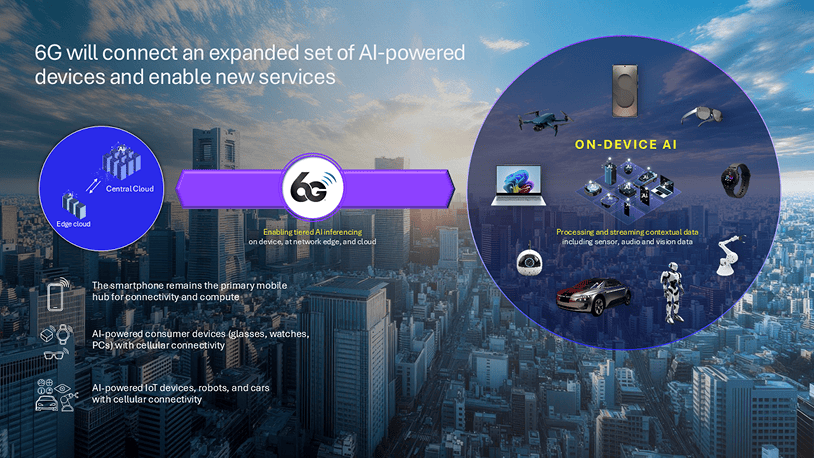
6G will be AI-native, deeply integrating the technology into the end-to-end network to provide step-level improvements in coverage and performance, including in remote areas and deep indoors. 6G also will take advantage of an ecosystem of devices running AI inference on-device — smartphones, XR eye-ware, earbuds, watches, sensors, laptops, vehicles, robots and drones, as depicted below. Hybrid AI technology — seamlessly integrating cloud-based AI with edge/on-device AI — will be a foundational component of 6G and ensure AI applications and services scale efficiently.
6G will support digital twins using real-time, context-rich RF signals, sensors, audio and visual data and provide new capabilities such as Integrated Sensing and Communications (“ISAC”). The integration of ISAC into wide bandwidth 6G operations represents a significant advancement that supports novel and important use cases like medical monitoring, public safety sensing of unwanted activity around critical infrastructure sites and assessing factory equipment performance in real time. ISAC takes advantage of the fact that 6G will operate in contiguous channels up to 400 MHz wide, as sensing with wider bandwidth signals provides the accuracy required for the foregoing use cases.
6G will operate in channels up to 400 MHz-wide
6G will use wide channels to efficiently support the ever-increasing mobile data demands that are expected to accelerate as AI applications become mainstream. In addition to AI, XR applications, video and gaming are the main drivers of increasing mobile data demands. Each successive mobile technology generation — from 3G to 4G to 5G and now, 6G — operates with wider channel sizes than the previous generation, as is shown in the first diagram above. Successful 6G deployments will use contiguous channel bandwidths up to 400 MHz wide.
Spectrum analyses should involve all spectrum stakeholders and be expanded
The OBBB Act requires the study of wide channels that will be key for successful 6G deployments. It allocates $50M to NTIA to analyze opening the 2.7-2.9 GHz, 4.4-4.9 GHz and 7.25-7.4 GHz bands for full-power mobile services. To be successful over the long term, NTIA needs to involve all spectrum stakeholders now and expand its studies to include mid-band spectrum above 7.4 GHz because mobile data demands will continue to grow and require additional spectrum. If sharing a particular band is not feasible, the FCC and NTIA should consider using auction proceeds to fund relocating incumbents, who may be able to update their equipment and operate more effectively in less spectrum.
At least 600 MHz of 6G spectrum must be opened by 2029 and 600 MHz more will be needed by 2034
While at least 600 MHz of spectrum should be made ready for initial U.S. 6G deployments later this decade, additional full-power mobile spectrum below 10 GHz — an additional 600 MHz — will need to be opened before 2035 to support the second wave of 6G deployments. For this reason, the U.S. government needs to assess its present and future spectrum uses now to more effectively plot a path to opening at least 1200 MHz for full-power mobile use by 2034 (i.e., 600 MHz in 2029 and 600 MHz by 2034) to ensure the U.S. leads on 6G deployments throughout the upcoming decade. Qualcomm and its mobile industry partners stand ready to work with all impacted spectrum stakeholders to make this happen.
Want to learn more?
Check out our new 6G content hub
Sign up for our wireless technologies newsletter to stay up to date
Table of Contents

