

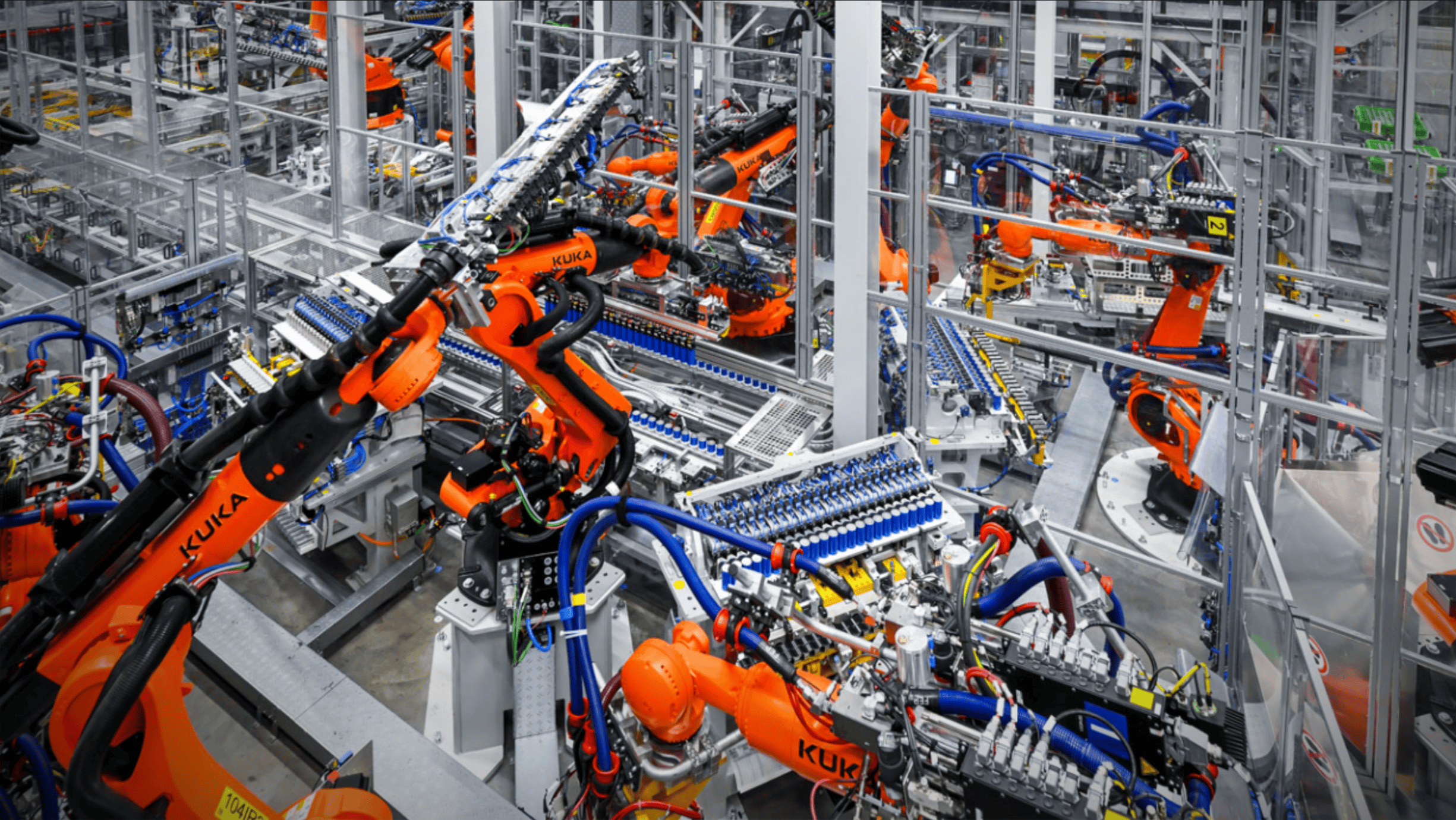
BMW has opened a new AI car factory in Debrecen, Hungary – its “most innovative” production site anywhere, and the first fully fossil-free facility in its global network. It integrates BMW’s in-house AIQX quality platform, autonomous transport systems, and real-time data analytics; production of the all-electric BMW iX3 starts this month.
In sum – what to know:
Quality control – AIQX platform uses cameras, sensors, and cloud analytics to detect defects in real time.
Smart robots – including autonomous tugger trains; digital twins to optimise logistics, assembly, and layout.
Tech benchmark – Debrecen sets new standard for BMW’s AI model to be lean, green, and fully digitalised.
From a company-wide strategy about AI at one German automotive giant to a factory-wide implementation of it at another; BMW has just opened the doors at a new AI car factory in Hungary, billed as the “most innovative” site in its entire 30–strong global network of production facilities, with production to start in a couple of weeks (late October). It follows (in RCR coverage, at least) from country-mate Volkswagen’s ‘no-process-without-AI’ musings about how to spend €1 billion on AI to make back €4 billion in total group savings. But BMW’s strategy is laser focused, and ready to roll: one site, in the Hungarian university town of Debrecen, bursting with all sorts of AI trickery, it seems.
Its opening, attended by Hungarian prime minister Viktor Orbán, plus other government higher-ups, alongside the BMW board, marks the beginning of a “new era” for the whole firm, said BMW. This is in part because of the car it will produce: the fully-electric BMW iX3, the first in (“spearhead of”) its Neue Klasse of vehicles, which hosts design and tech innovations that will “shape the brand’s entire model program in the future”. By the end of 2027, its “technologies” will be integrated into 40 new models (“and model updates”), said BMW. Test vehicles have been rolling off the line since last November; assembly-line functions properly ramp-up in March. It is now ready to go.
But it is about the site itself, as well – one of Hungary’s “largest greenfield investments”, which will be home to 2,000 staff, nearly 1,000 robots, as well as an adjacent EV battery plant. It is “fully digitally connected”, said BMW (with no mention of private 5G, anywhere), and uses only renewable power (“during normal operation”; another first, it said). Plus there is AI – presumably some camera vision, integrating machine learning – on the production line. “A wide range of quality checks can be performed digitally whilst still on the production line,” it said. Again, the new factory in Debrecen is the first in the BMW network, it seems; the same AI is to be implemented at other sites, subsequently, starting with BMW’s “home plant” in Munich.

BMW’s AI “centrepiece”, variously deployed at its smartest plants, like Dingolfing and Regensburg, is its in-house cloud platform, Artificial Intelligence Quality Next (AIQX), developed for acoustic sensors, microphones, and cameras along the conveyor line to run automated quality checks – capturing data about each vehicle’s position, componentry, and finishes, analysed for anomalies on a trained model in a cloud-back-end, and returned as alarms for staff about missing or misassembled parts, and other defects in the assembly and bodywork .
BMW stated: “Looking ahead, vehicles on the line will also play an active role as connected participants in the industrial IoT ecosystem, analysing themselves and flagging anomalies in real time.” In other words, the vehicles themselves will join this factory internet-of-things to report on their own progress. The site follows the company’s so-called ‘iFACTORY’ principles for the future of car manufacturing, focused on making production more efficient, sustainable, and flexible. The group has filed new patents for certain of the new site’s systems and processes, it said.
Its press shop uses the same tools and presses as all its plans (so “capacities can be optimally utilised”); its body shop is based on digital simulation and pre-validation (“to define an ideal value stream and optimally place robots”); its paint shop (“which uses a lot of energy”) will see major energy savings versus other plans “(about 12,000 tonnes of CO₂e per year”, it said); its on-site battery plant is the first of five to produce its latest (Gen6) high-voltage EV batteries, also geared with “intelligent production processes with the help of AI” to bring efficiencies in terms of transportation (its “local for local” principle) and production itself.
The assembly line is AI assisted, as discussed above; but it is also takes advantage of the “finger structure” of the whole site, described as an “optimised version” of the layout at its Leipzig plant, which allows 80 percent of all parts to be delivered directly to the right point in the assembly line. It stated: “High-voltage batteries are brought directly from production to installation points by autonomous tugger trains, while ‘smart transport robots’ deliver smaller components, also autonomously. The depth of digitalisation in logistics is unprecedented, with internal and external databases now fully linked and a great many analysis tasks that were previously manual now becoming automated.”

So smart design, as much as smart tech. BMW added: “Well-structured and analysed information is available at any time – at the push of a button.” It takes from other plants, too: the press shop is modelled on the systems used at its factories in Spartanburg in the US and Swindon in the UK (“with their know-how and technologies further refined for Debrecen”); the assembly line takes “many ideas and proven structures”, including the conveyor system, from Leipzig, across the border (opened 2005), and Shenyang (Plant Lydia, opened 2022) in China.
As mentioned higher-up, as well as in the cars-as-things comment, the vehicle architecture of the Neue Klasse series also opens new possibilities. This includes a simpler modular assembly (“fewer connecting elements” and fewer plugs, screws, clips), simpler installation of certain parts (a more ergonomic wiring harness, a more compact cockpit), and much less wiring of parts – about 600 fewer metres per vehicle, meaning 30 percent less weight. Cockpit pre-assembly is next to the main line, so it can be installed directly and quickly in the vehicle “just a few metres ahead”. All of which – the new tech, the new layout, the new vehicle – make the plant more productive and efficient.
About a quarter of the plant’s annual power will be supplied by a 50‑hectare photovoltaic system on the site (“one of the largest in Hungary”). Surplus solar energy, such as that generated on non-working days, is stored in a 1,800 m³ thermal storage system with a capacity of 130 MWh. Production of the BMW iX3 will generate a total of about 80kg CO₂e, which covers emissions from the Debrecen plant, as well as in-house parts production at other group facilities. This is a reduction of about two-thirds compared to production of existing BMW models, BMW said. It means total CO₂e emissions per vehicle, including the battery, will be reduced by about 90 percent – to about 34kg CO₂e.

Oliver Zipse, chairman of the board at BMW, said: “In our global production network, our new plant in Debrecen is a pioneer: it is our first fully-electric plant, the first production site to operate entirely without fossil fuels – and the first to build vehicles for the Neue Klasse. This makes our plant in Debrecen a decisive factor in the BMW Group’s future success. The opening also sends a strong signal: we are expanding our footprint on our home continent and reaffirming our commitment to Europe as a strong and competitive location for industry.”
Hans-Peter Kemser, head of the plant at Debrecen, said: “We have faced the challenge of building a completely new vehicle in a brand-new plant from the start – and doing it as lean and efficiently as possible. We have simplified processes, reduced complexity, digitally secured every single work step, and consistently used the know-how in our global network. This plant is the result: efficient in production, innovative in processes, and flexible in the integration of additional models.”
Milan Nedeljković, Member of the Board of Management of BMW AG, Production, said: “We have planned and built our new plant in Debrecen entirely according to our iFACTORY target vision. Digital from the very beginning, the plant offers a new dimension of efficient production while dispensing with fossil fuels.”

