
While there may be many ways to launch a 6G network, the 5G experience suggests that picking the fastest route may not be the most prudent choice in the long run.
Welcome to the second installment of 6G Foundry, where we dive deeper into the important considerations when migrating from 5G to 6G. Drawing from the lessons learned during the 4G to 5G evolution, it’s clear that prioritizing a 6G Standalone solution will accelerate new revenue opportunities and the delivery of innovative services. Additionally, we explore the significance of spectrum sharing, infrastructure reuse and different approaches for ensuring a smooth and cost-effective migration. How should operators then migrate from their 5G networks to 6G? Read on to find out.
Learning from 5G deployments and 4G to 5G migration
4G to 5G migration. As shown in Figure 1, 3GPP considered two families of solutions that divided into seven new options (in addition to the existing LTE architecture). Five of the options were eventually standardized based on operator inputs but only two of them have been commercially deployed. The fragmentation of the ecosystem and resulting market confusion should be avoided for the 5G to 6G migration. The limited resources of network operators, infrastructure vendors and technology providers could be applied more effectively while satisfying the evolved needs of the 3GPP ecosystem.
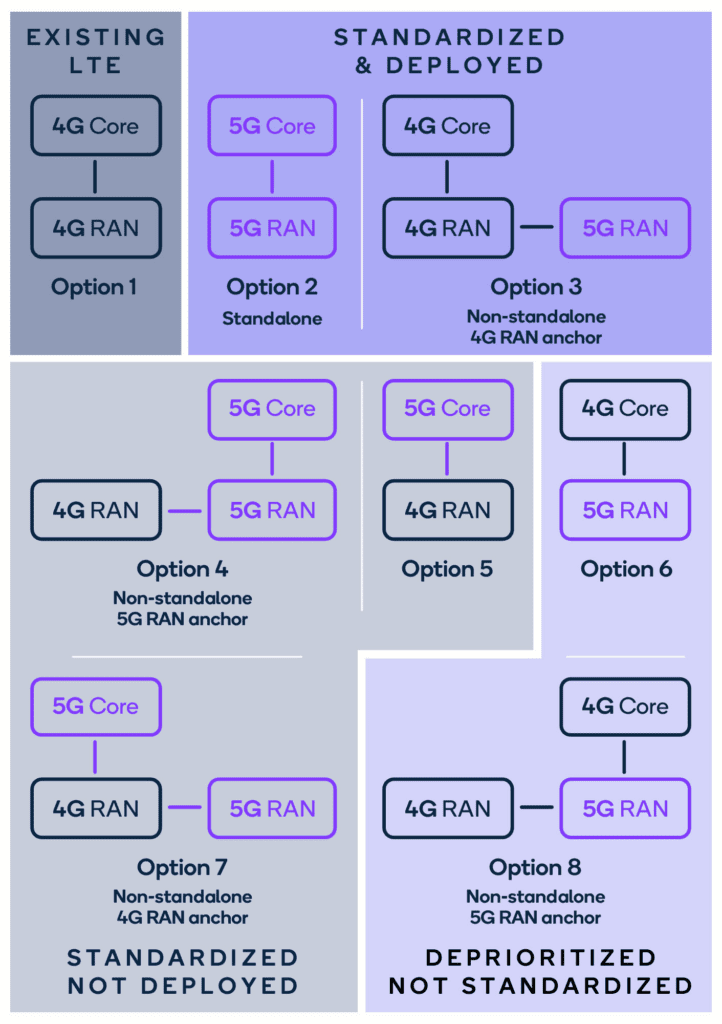
Figure 1. 4G to 5G migration options.
For the migration from 4G to 5G, there were two main families of options for 5G: Standalone (SA) and Non-Standalone (NSA). As shown in Option 3, 5G NSA relied on the existing 4G RAN and core to anchor the new 5G Radio Access Network (RAN) connection and was considered the best choice for accelerating the commercialization of 5G based on the operator needs at the time. 5G NSA enabled operators to leverage their existing 4G networks as a coverage layer to provide a stable user experience, while making it possible for them to launch a subset of 5G services as the 5G RAN was being deployed and before the 5G core network became available. As a stepping stone, the new 5G RAN was designed to be forward-compatible with the later addition of a 5G core network, enabling a smooth network migration to 5G SA in the future, for end-to-end services like network slicing as one example. While 5G SA (as shown in Option 2) was standardized just six months after 5G NSA, and in Release 15 itself, operator momentum for the adoption of 5G SA came much later and still has a way to go.
While NSA accelerated initial 5G deployments, the existence of two deployment options (NSA and SA) for operators to adopt 5G has caused some division in the operator ecosystem, resulting in varying levels of progress towards 5G SA. The strong preference for initial deployments with 5G NSA has caused a postponement in implementing important elements that rely on a 5G SA network, including many of the features from the subsequent 3GPP releases (i.e., Release 16 and beyond).
Drawing from the 4G to 5G transition experience, decisions related to migrating from 5G to 6G are therefore likely to influence the implementation and ease of deployment of 6G features across several releases of the 3GPP standard. Consequently, based on the lessons learned from 5G, if accelerating 6G deployments is no longer the highest priority, then a preferable long-term strategy for the ecosystem’s evolution may be to first deliver a 6G SA solution. Additionally, by limiting the amount of interworking required with a legacy generation, a standalone 6G RAN and core network should be the primary design to benefit from the latest and future advances in cloud, artificial intelligence (AI) and other technology enablers to maximize the platform capabilities and revenue opportunities for new use cases and verticals.
Accelerating 6G adoption with impressive early experiences
The opportunity to adopt advancements in technology and platforms has driven 3GPP standardization efforts for each new generation of mobile connectivity. The goal has been to enhance performance with each generation across key metrics:
- Higher user-perceived throughput enables new user experiences across new use cases.
- Higher network capacity — with the addition of new spectrum and by improving spectral efficiency — maximizes the return to operators for their spectrum investments.
- Lower end-to-end latency enables new use cases that require a more responsive network.
Just as 4G services outperformed 3G at launch, 5G services launched with devices that could combine 4G and 5G network capacities through dual connectivity to outperform 4G. Unsurprisingly, users have come to expect tangible improvements with each generation of wireless technology, particularly in user-perceived throughput.
6G standalone is anticipated to enhance latency, reliability and introduce novel monetizable services leveraging AI/Machine Learning and Radio Frequency (RF) sensing. However, for most deployments, it is unlikely that enough new spectrum will be allocated on day one of 6G operations for 6G to exceed 5G capabilities independently across the network’s coverage area — the key factor for the user. Therefore, it is by leveraging 5G deployments that 6G services can utilize enough spectrum to fulfill user expectations for higher throughput, as well as meet the higher-throughput requirements of advanced services and emerging use cases. As a result, as with 4G to 5G migration, legacy generations and the spectrum they occupy will continue to play a crucial role in both the deployment of 6G and the enhancement of the 6G user experience.
Prioritizing spectrum sharing between generations for a smooth migration
An additional factor to consider is that when the time comes to deploy 6G, operators will likely have a mix of 5G SA and NSA deployments. While 6G rollouts will include new spectrum, they will probably leverage existing 5G bands from the beginning as well. To ensure a smooth transition to 6G using existing 5G bands, it is crucial to be able to dynamically utilize 5G bands for 6G wide-area rollouts without disrupting existing 5G services. As before, solutions will rely on aggregating spectrum across 5G and 6G (e.g., sub-6 GHz with upper mid-band) to achieve the overall throughput required to meet user expectations. How operators deploy a new generation across their new and existing spectrum assets from the perspective of the device and the network then becomes key to enabling a smooth generation transition.
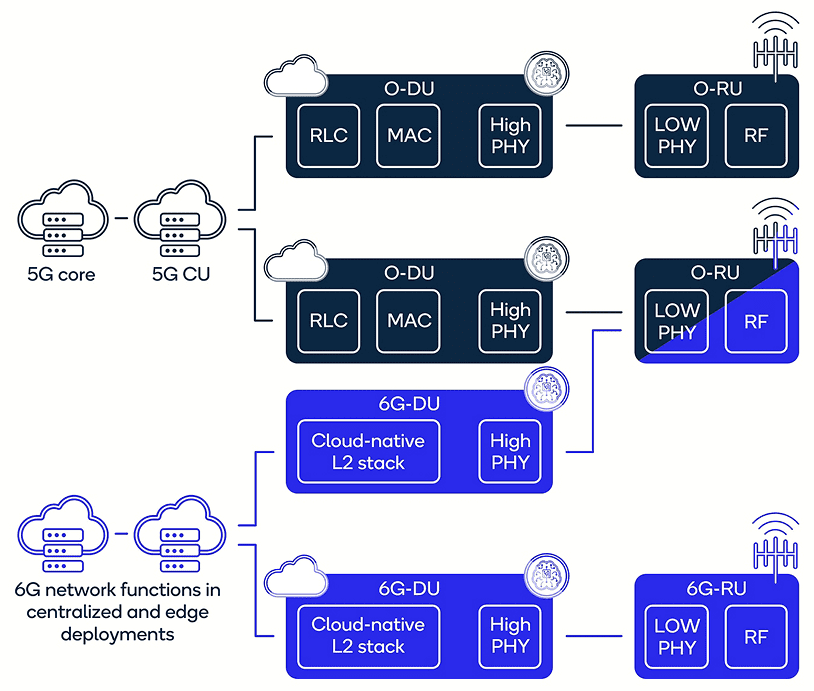
Figure 2. Hardware pooling for introducing 6G using 5G O-RAN radio units (RUs).
Prioritizing infrastructure reuse and extensibility for network evolution
Many network operators have been making substantial investments in their 5G networks and would like to see a longer return-on-investment (ROI) period for their efforts. In fact, a guiding principle adopted by the Next Generation Mobile Networks Alliance in their 6G position statement is that 6G must not inherently trigger a hardware refresh of 5G RAN infrastructure. Migration pathways from 5G to 6G should accommodate strategies to reuse as much infrastructure as possible, including software, hardware and RF systems, to reduce deployment costs.
For example, operators may want Radio Units (RUs) in existing 5G bands to be reusable for 6G, and for RUs in bands common to 5G and 6G to share fronthaul interfaces. Hardware pools should be able to multiplex resources to support 5G and 6G deployments and accommodate new elements for 6G evolution, such as compute resources and specialized RF baseband. Cloud platforms should provide the scale needed to host simultaneous 5G and 6G services while delivering operator services common to the different generation networks, such as IMS voice, for example. Deployment costs can be further reduced by limiting the impacts to legacy networks, (e.g., by not requiring 5G to interwork with 6G as was required for NSA).
A complementary approach: Multi-RAT Spectrum Sharing and Dual-Stack
Based on the above considerations, MRSS and Dual-Stack are our solutions for migrating from 5G to 6G that jointly address diverse deployment requirements. Together, they provide complementary approaches based on best practices for spectrum and infrastructure migration.
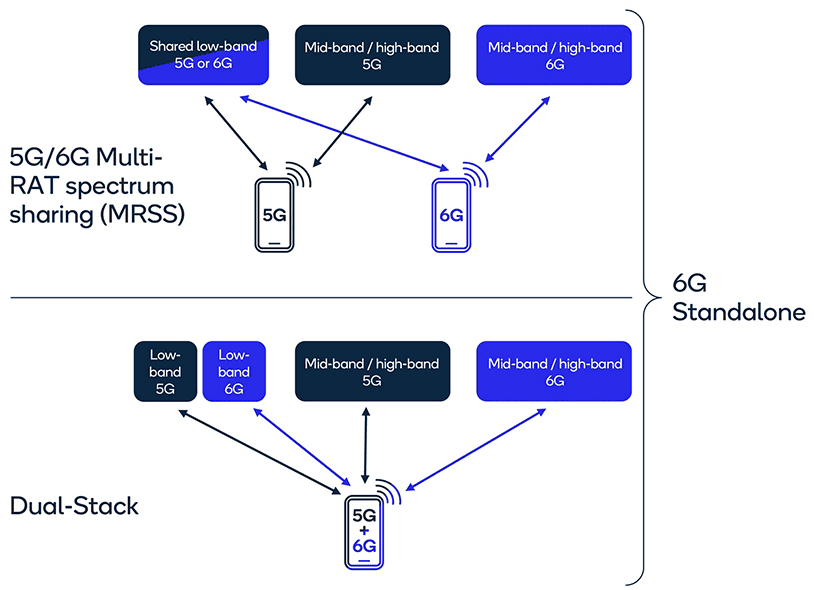
Figure 3. Complementary approaches to reusing 5G spectrum for 6G.
Achieving wide-area 6G coverage with MRSS
Implementing MRSS in existing 5G bands (using a CP-OFDMA-compatible waveform) can facilitate an efficient rollout of 6G wide-area networks. Additionally, employing MRSS in sub-1 GHz bands can enhance the robustness of 6G by providing access to a reliable low-band anchor with extensive coverage. This, in turn, can complement the new higher frequency bands of 6G, which offer high capacity. Consequently, combining MRSS with inter-band aggregation can significantly improve the overall coverage of 6G-only networks.
Improving user experiences with a dual-stack in areas where MRSS is not (fully) deployed
Early in the deployment of 6G, there could be areas where 6G-only operation is not yet sufficient because MRSS is not deployed or only enabled for a subset of the available bands. For improving user experiences in such areas, dual-stack devices could connect to 5G and 6G simultaneously with independent transceivers that enable the device to operate concurrently and independently on the two radio access networks. Implementing a 5G+6G dual-stack device means the complexity of interworking between 5G and 6G is managed at the device where concurrent operation is possible and thus simplifies the introduction of the new 6G technology for the operator while simultaneously improving user experiences by combining network capacities for 5G and 6G for devices that need it. The resulting user experience is analogous to that of a dual-SIM dual-active (DSDA) device user with dual data connections. This provides the most economical path to deploying a standalone 6G network for the range of benefits described above. Dual-Stack can easily reuse the extensive coverage of mature 4G and 5G networks, as well as their existing services like voice, extending their ROI period. It also allows aggregation across spectrum bands without affecting legacy networks and continues the generational increase in the total spectral bandwidth devices can access.
Since a dual-stack separates 6G and legacy RANs with two independent connectivity stacks, there is no need for coordination between those RANs. Applications may aggregate the two connections (e.g., to increase throughput or reliability). Alternatively, operator policies for the device may be used to control how services are accessed. User experiences can be further improved by enabling coordination at the core.
Making the right choices for the future success of 6G
Early choices for 5G to 6G migration could have a lasting impact on the adoption of future 6G features, the continued evolution of 6G networks and the ROI period of existing 5G networks. 6G standalone solutions should be prioritized to benefit from the agility that cloud-native network platforms enable. Furthermore, complementary approaches like MRSS and Dual-Stack can enhance user experiences and provide wide-area accessibility in the 6G standalone network from day one. By embracing these strategies, operators would be best positioned to meet user expectations from 6G while minimizing costs and disruptions to legacy networks.
6G networks should be able to evolve to support future 6G features and new use cases. Consensus over a 6G standalone foundation would empower a consolidated ecosystem to deliver a higher return on the effort and investment needed to deploy 6G.
Table of Contents