

Huawei and China Telecom have deployed a 5G-A network at Datang Everbright City, a busy tourist attraction in Xi’an in China, using three-component carrier aggregation (3CC) tech
In sum – what to know:
5G-A at scale – Huawei and China Telecom Shaanxi have deployed a three-component carrier aggregation (3CC) 5G-A network at Xi’an’s Datang Everbright City, supporting tens of thousands of concurrent users while delivering multi-gigabit connectivity.
AI tourism platform – Huawei and Shaanxi Culture Industry Investment Group (SCG) are using the BoGuan multimodal large language model to power AI travel services, cultural heritage applications, and digital content creation.
Infrastructure working together – The showcase demonstrates how high-capacity mobile networks and AI platforms can be combined to support new digital services for visitors and cultural institutions.
XI’AN — Chinese vendor Huawei is using the city of Xi’an as a showcase for how next-generation mobile infrastructure and artificial intelligence can work together to support new digital tourism services, with a commercial 5G-Advanced (5G-A) deployment and an industry-specific large language model (LLM) already serving visitors across one of China’s most popular cultural destinations.
During a media tour attended by RCR Wireless News last week, Huawei, together with China Telecom Shaanxi and Shaanxi Culture Industry Investment Group (SCG), demonstrated how high-performance mobile connectivity and AI applications are being integrated to support cultural tourism, heritage preservation, and digital content creation.
The infrastructure centerpiece is the 5G-A network deployed at Datang Everbright City, one of Xi’an’s busiest tourist attractions. Huawei and China Telecom Shaanxi have built the network using three-component carrier aggregation (3CC) technology, delivering peak downlink speeds of 3.5 Gbps and uplink speeds of 600 Mbps—around ten times faster than conventional 5G networks, according to the companies.
Unlike many high-capacity deployments, the project was designed for a dense historic tourism district where preserving the urban landscape was a key requirement. According to Huawei, the deployment combines macro and micro base stations while minimizing the visual impact of network equipment across the attraction.
To respond to the needs of the Datang Everbright City, China Telecom Shaanxi has upgraded the attraction’s network. Within the area, 46 NR network sites have been deployed, including 31 5G-A sites, 219 cells, and 179 RRU devices. This creates a continuous coverage centered around 5G-A, synergized and supplemented by 5G technology, according to Huawei.
Huawei also said that large-uplink 5G-A enhances livestreaming experiences with a peak uplink rate of 900 Mbps. This boosts tourism livestreaming and stimulates consumption at tourist attractions, according to the Chinese vendor.
The network is intended to address the heavy traffic generated by large visitor volumes. Huawei said the site can experience more than 200,000 visitors during peak periods, requiring consistent capacity for video uploads, livestreaming, and other bandwidth-intensive applications.
The connectivity platform is paired with BoGuan, a multimodal LLM jointly developed by SCG and Huawei. Introduced in 2025, BoGuan is designed specifically for cultural tourism and heritage preservation, using intelligent computing infrastructure and a specialized dataset to generate multimodal content related to cultural assets.
According to Huawei, the model is trained on more than 1.2 PB of data, including 31 million images, 4.4 million minutes of video, 2.18 million minutes of audio, 510 three-dimensional models, and 960 million pieces of structured text.
Rather than functioning as a general-purpose chatbot, BoGuan is being applied to a range of tourism-specific services. One example is an AI travel companion integrated into the Go-Shaanxi application, allowing visitors to build and adjust itineraries, receive recommendations, and access information about attractions through natural language interactions. Huawei said the service had reached more than four million users by March this year.
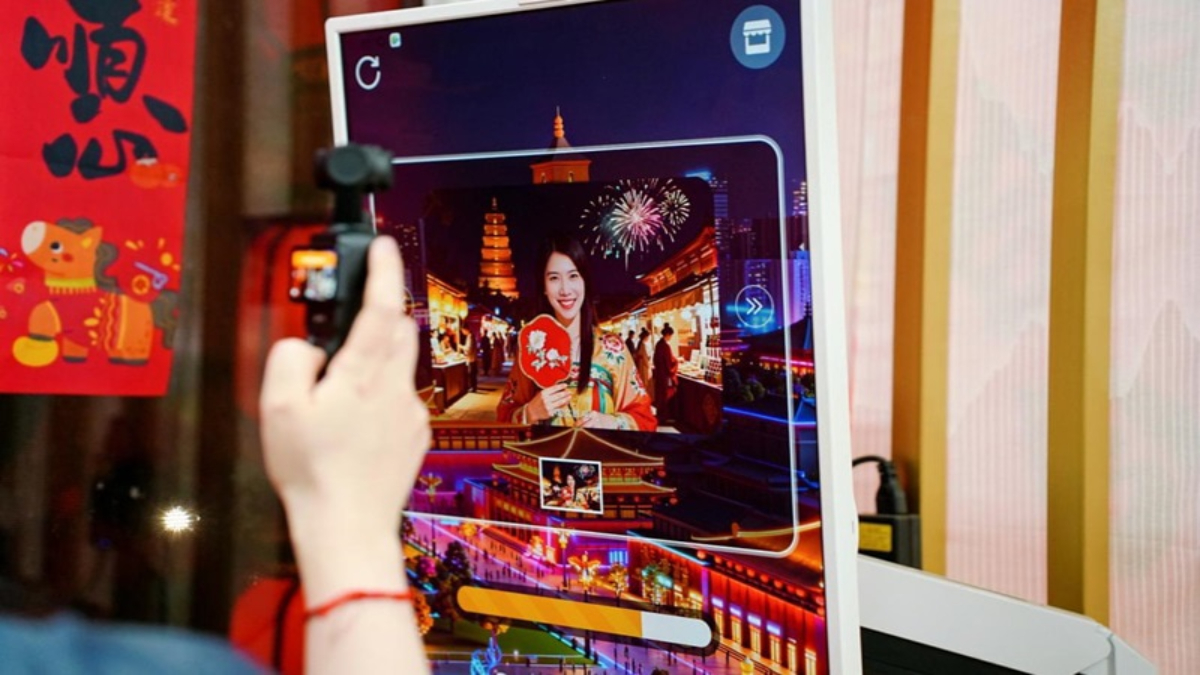
Another application is the Zhiying Camera mini program, which combines user photographs with AI-generated historical scenes, allowing visitors to create personalized images based on Xi’an’s historical settings. Huawei said the model is also supporting digital preservation of traditional crafts, creation of digital intellectual property, museum-related content generation, and production of short dramas centered on local culture.
SCG also presented examples of how BoGuan is being used to preserve intangible cultural heritage. According to the company, artisans can use the model to accelerate elements of the creative process while maintaining traditional craftsmanship. The platform has also been used to create digital cultural characters and related products based on local historical themes.
For Huawei, the Xi’an deployment illustrates how communications infrastructure and AI platforms can complement one another. High-capacity 5G-A connectivity enables applications that rely on real-time uploads, interactive services and high-definition media, while the AI platform provides the intelligence layer for tourism-focused digital services.
Edric Chu, general manager of Huawei’s Shaanxi office, said, “Artificial intelligence is not simply a stack of technologies. It has become a key enabler that can activate thousands of years of cultural heritage, reshape travel experiences, and inject new momentum into the industry. Moving forward, Huawei will continue working with our partners to enhance cultural heritage preservation with digital and intelligent technologies, and stimulate development within the cultural tourism industry.”

