Note, this article is taken from a new editorial report from Enterprise IoT Insights, Hybrid Low-Power IoT – How The IoT Industry Is Balancing Function And Efficiency. The report is available here, or by clicking on the image at the bottom of the page. It is continued online from here.
Semtech, which owns and licences the LoRa technology for LPWA applications, says the hybrid IoT trend is real for a number of enterprise sectors. Its viewpoint reflects, arguably, the position of LoRa, and of the derivative LoRaWAN standard, somewhere between Sigfox and LTE-M at the lower and higher ends of the LPWA market in terms of functionality – offering the low-power profile of the former with some of the bi-directional mobility of the latter.
As such, it more easily bridges the divide between single- and multi-mode IoT. “There are still lots of cases for utilities where it’s only LoRaWAN,” says Marc Pégulu, vice president of IoT in Semtech’s wireless and sensing group. “In other segments, LoRa/LoRaWAN is very often associated with these short-range technologies – for sensing of whatever kind, whether connectivity or telemetry.” Connectivity or telemetry; these are the reasons to double-up, it seems.

Pegulu – practically zero ‘collaboration’ in utilities
What percentage of Semtech chips are being connected inside hybrid IoT solutions? Pégulu does not really want to be drawn, but, when pushed, he puts his finger in the air to give a sense of the direction of travel. “It’s probably 90 percent single-connectivity LoRaWAN in the utilities space, and almost the reverse in the smart-home market, where you almost always have a short-range technology alongside – probably in 80 percent of cases.”
It is interesting to contrast with the line from Transforma Insights, that the metering end of the utilities market, at least, is one of the few growth segments for multi-RAT IoT solutions. Pégulu does not see it this way. The utilities sector is the original enterprise venue for LoRa/LoRaWAN. “It is where we started, and where we remain really big,” he says. “And there just isn’t very much collaboration between connectivity technologies there.”
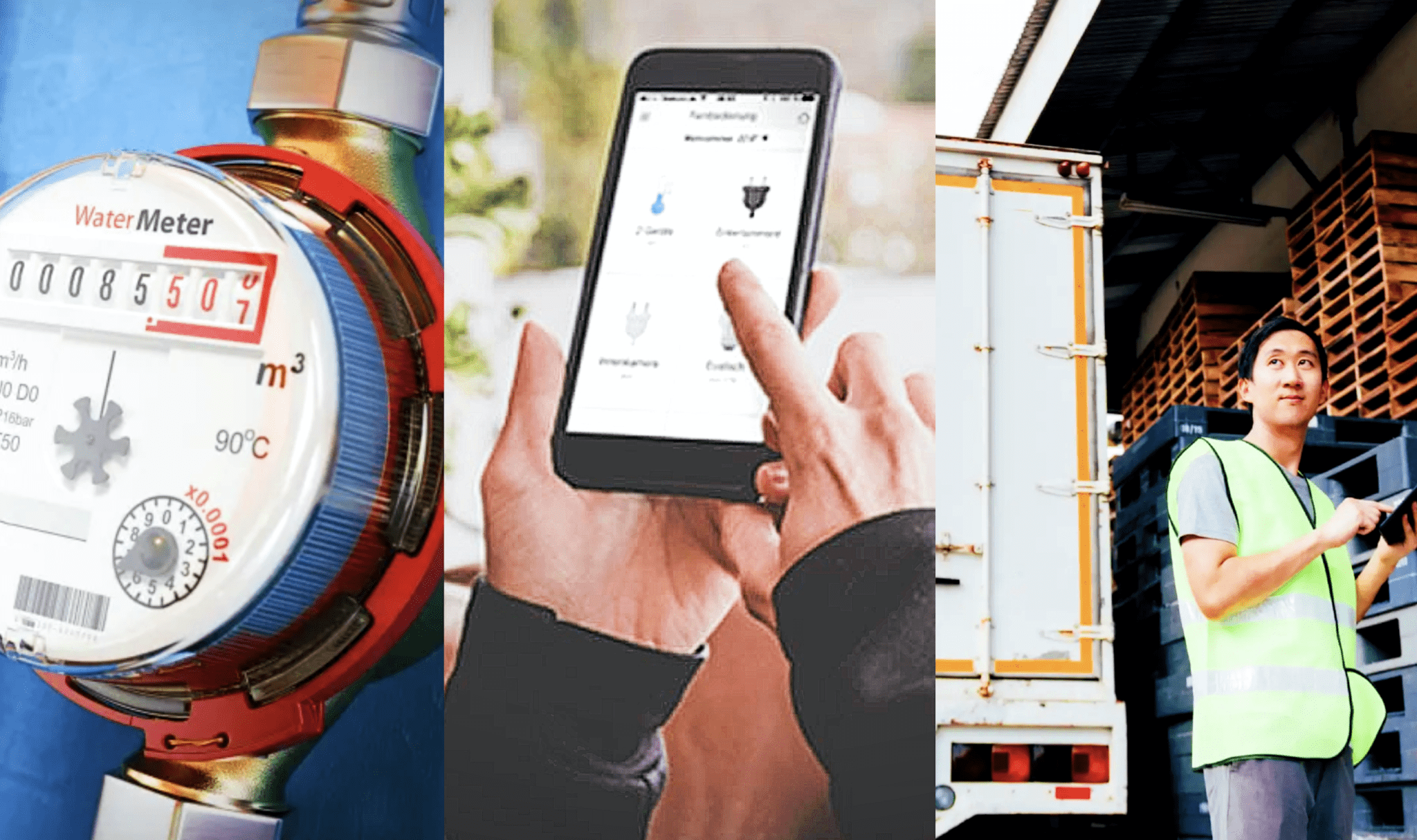
He goes on: “You only really find it with legacy systems, for FSK (frequency shift keying) system support. Some customers are implementing a dual stack to support proprietary FSK in addition to LoRaWAN. But the collaboration stops there.” Of course, LoRaWAN tends to feature in private LPWA installations, to connect battery-powered meters in municipal networks, industrial premises, and sundry rural outposts; the classic case is with remote water meters.
Until recently – until last year, when Amazon opted for a proprietary version of LoRa for its Sidewalk community system, and LoRaWAN operator Helium started to incentivise down-home network building with blockchain crypto tokens – Semtech was not in the ‘smart home’ at all. Which might explain its view of the utilities space as a single-mode discipline – and Transforma’s view of it as essentially a Wi-Fi-plus hangout, crossing into homes.
But LoRa and LoRaWAN are there now, says Semtech; in conversation, it lists ‘smart-home’ third in a quickfire rundown of its biggest-sized customer segments – and second, the same as Transforma Insights, as a venue for hybrid IoT. Pégulu comments: “We have seen quite an appeal from the smart home market to add LPWA technology to connect hard-to-reach devices and solve the complexity of wireless networking in the home.”
People do not want to ‘manage’ home networks, of course. Even rebooting a Wi-Fi system pushes the pain barrier in the consumer/public realm. Plus, IoT sensors, unlike smartphones and laptops, tend to be fixed down; they cannot – and would not, anyway – be moved in-range of wireless coverage. They have to work, without intervention, and local-area Wi-Fi in the home does not serve, typically – for critical IoT coverage or reliability.
But the Sidewalk and Helium initiatives are bringing LPWA networks into the home, to solve these headaches. Pégulu says: “There is a willingness to create community-based IoT networks, which need long-range connectivity. So smart-home is a perfect segment for us, and a natural habitat to pair short range [in-house] technologies with LPWA networks for out-of-reach devices in attics and gardens.”
Wi-Fi and Bluetooth are the key short-range familiars in residential buildings; Bluetooth and Zigbee are commonly deployed for local-area network (LAN) mesh setups in commercial offices. But Sidewalk and Helium are also knitting LAN connectivity into outdoor community networks, for public-sector monitoring and private-sector tracking apps. Pégulu says: “[These community] LPWA networks are being used, as well, to connect mobility units that move about [outside].”
SEGMENT CROSSOVER
And so, with a skip and a jump, from smart meters and smart homes, we cross into the asset management space, comprising condition monitoring and asset tracking. This is Semtech’s “second big market”, it says, wedged between these other two in terms of connection volumes, and a key growth sector (in its experience) for hybrid IoT. “We see short- and long-range IoT technologies combining in both those disciplines,” remarks Pégulu.
He suggests, finger in the air again, that 50 percent of LoRa devices deployed for asset management incorporate a short-range IoT technology alongside; but the number is trending upwards, he says. “Short-range IoT is used for two purposes – for the configuration or activation of devices, and sometimes for geolocation in track-and-trace applications. In these cases, LoRa/LoRaWAN works as the pipe to feed the data to a local server or public cloud.”
It is informative, again, to compare comments from others. “The beauty of LPWA technologies is they provide wide-area coverage in places where there is no access to power. Short-range technologies are inherently dependent on access to power. So if you’re going to multi-mode an LPWA device you probably wouldn’t do it with a short range technology, outside of the use cases I’ve mentioned,” says Matt Hatton, founding partner at Transforma Insights.
We are back in the smart home, surrounded by metering devices and consumer gadgetry, connected and interconnected with Wi-Fi and Bluetooth. We should stay awhile, and hear Hatton out. He sees the trend away from hybrid IoT as a consequence of the early tendency to bundle LPWA tech into the mix, either to guard against legacy 2G/3G cellular switch-offs, or for last-gasp redundancy in case of cellular outages – “just because it’s so cheap.”
But he concludes, as well, this inclination is outmoded. The first scenario is “not cost effective” – and presumably not necessary, as well, on the grounds LTE-M, in particular, is originally designed and progressively available as a 4G/5G replacement for legacy 2G/3G M2M systems. The second scenario, where the likes of Sigfox (notably, with Securitas in Spain) is offering cellular backup in security alarms, in case of ‘jamming’, is just “not widely [deployed]”.

Hatton – trend for hybrid IoT is not reflected in figures
Hatton comments: “Firstly there is a tendency to shed unnecessary technologies in order to keep costs to a minimum. For early-deployed high-value use cases, the relative marginal cost of including an extra technology was minimal. For those IoT use cases that only became viable as costs came down, clearly the trend is towards including only the technologies that are absolutely necessary, for fear of making the whole thing unprofitable.”
The argument goes again that volume-growth in the IoT market, and certainly in outdoor tracking, will come from pairing-back and making-cheaper. Asked which industries are seeing the most crossover, Hatton responds: “Consumer and energy… For other cases, [there is] not much.” But, again, Sigfox’s bankruptcy proceedings suggest the IoT market has reached the bottom already, and that massive IoT is a myth – or at least that it remains a slog.
The argument, as ever, is value must be created on top with telemetry data; that just selling dirt-cheap airtime does not add up. Pégulu talks about different solutions for different industries and different enterprises; they have to be made bespoke, he says, at least by industry-segment. “If you stay horizontal, and try to serve everyone the same way, then you end up serving no one. If you don’t understand your customers, then you don’t get it.”
Where is the most crossover? The question goes, this time, to Henri Bong, co-chief and co-founder at Singapore-based IoT production house UnaBiz. “Logistics and supply chain,” he replies. A different answer, then. Which applications? “Asset tracking,” he says. He explains: “[Hybrid IoT] is not a trend but a must-have… especially for companies that require ubiquitous and uninterrupted data streams from their sensors. Of course, it also requires the use case data to be more valuable than the combined connectivity costs.”
Hatton sees this, of course, even if he does not consider hybrid IoT to be a trend in terms of market volumes. “The use of multiple technologies typically brings some demonstrable value,” he says. In combination, lower costs, reduced power, and higher reliability (second-line redundancy) can be achieved by bundling LPWA tech with standard cellular, he says; periodic data dumps can be achieved by bundling them the other way.
But both ways, the LPWA technology does the donkey work. Hatton comments: “LPWA technologies are typically used as the ‘main’ connectivity, giving longer battery life. But in a lot of cases they do not allow for some necessary high bandwidth data transfers – for firmware updates, for instance. So the device will switch to LTE, for instance, to handle a multi-megabyte firmware update, and then go back to the LPWA technology for regular operation.”
Note, this article is taken from a new editorial report from Enterprise IoT Insights, Hybrid Low-Power IoT – How The IoT Industry Is Balancing Function And Efficiency. The report is available here, or by clicking on the image below. It is continued online from here.