

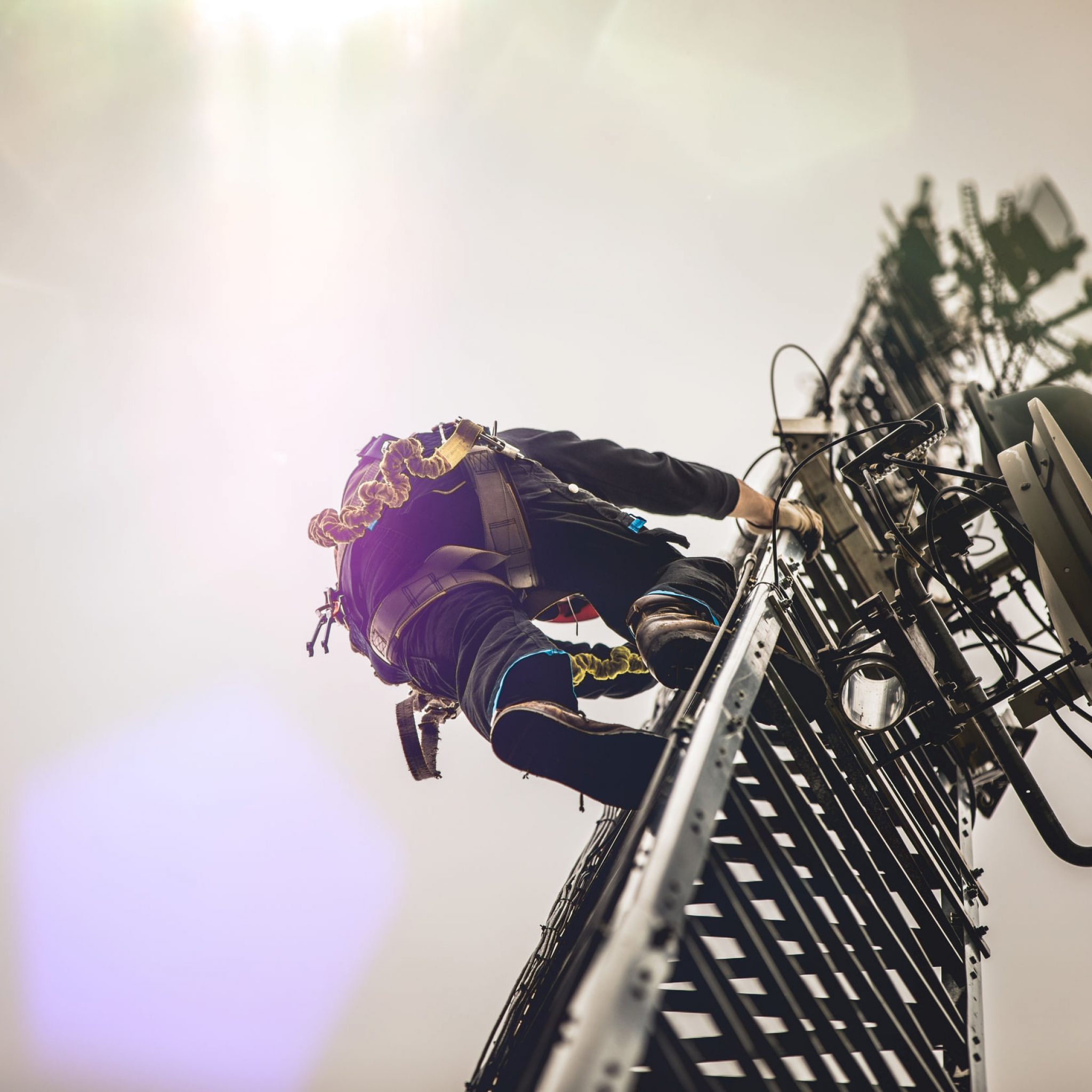
As the telecom industry grapples with a skilled worker crunch, South Dakota’s Southeast Technical College offers one example of a comprehensive training program that has been put together as a result of conversations with partners in the industry and refined to meet both workers’ and employers’ needs.
Southeast Tech serves the southeast quadrant of South Dakota, including the Sioux Falls area where it is based.
As Dr. Benjamin Valdez, Southeast Tech’s VP of academic affairs puts it, the program began as a result of casual conversations with a local telecommunications construction firm, Vikor Teleconstruction. Todd Thorin, who is director of safety and training at Vikor (formerly Sioux Falls Tower) employer, stopped in to the campus while the company was doing some work nearby — Vikor’s Sioux Falls office is less than three miles away and the company frequently does local and regional network deployments, including 5G small cells for Verizon — and started asking questions about its programs and whether the technical college might be able to provide training for telecom workers.
“The conversation went from us providing training, to Vikor and Southeast Tech partnering to deliver a training program to serve the teleconstruction community and its needs with the extension of 5G,” Valdez recalled. Very quickly, those conversations became part of a national conversation around meeting broadband workforce needs in a 5G world. Southeast Tech came to the attention of Senator John Thune (R-SD), who at the time was serving as chairman of the Senate subcommittee on communications, technology, and innovation and has repeatedly co-sponsored bills related to telecom workforce development, including as recently as February of this year.
Conversations with Thune led to conversations with other senators interested in supporting tech workforce development, industry groups including the National Association of Tower Erectors (NATE) and with the Federal Communications Commission, which Valdez said held several open houses on the Southeast Tech campus to discuss the expansion of 5G and the network needs of rural America.
As for Southeast Tech’s progam itself, it initially launched solely to focus on providing students a path to earn the Telecommunications Tower Technician (TTT) certification that would enable them to learn how to safely climb towers and do basic installation of network equipment. The classroom portion of the certification is held at Southeast Tech (or, since the pandemic, online) and hands-on climbing and other skills are taught at Vikor’s specialized facility, by Vikor employees who are already certified and teach on evenings and weekends, Valdez said. But Valdez said that even though the program was well-received in that form and produced several graduates who immediately went to work using those the certifications, further conversations with industry showed that there was a greater need than the very safety-focused TTT1 and TTT2 certifications. The TTT1 and TTT2 progams were just a matter of weeks — but because they were certifications rather than diplomas/full academic programs, students weren’t eligible for most financial aid. That limited the program to students who could pay out of pocket, or who had been sponsored by an employer. AT&T stepped in and funded some full scholarships as well.
So Southeast Tech retooled the program, which now includes the TTT certifications focused on tower climbing, safety and physical installation of gear, but also allows students to choose a track focused on tower construction and related skills; or electrical systems and related skills to powering the tower and the gear on it. It’s now a one-year diploma program — which allows students to apply for regular financial aid for the approximately $7,500 cost, and will hopefully help the program draw more interest and participation.
“We’ve actually rewritten our entire program, to where the TTT is still the focal point, but students can then earn an actual diploma — a one-year diploma — and they can specialize in either the construction methodology and construction techniques, [or] they can specialize in the electrical systems side,” Valdez said, adding that this makes them more broadly skilled and more valuable to their employers. In addition, Valdez said, graduates some out with not just the TTT certification but an OSHA 30 certification; they can also choose to embed emergency medical technician training from another Southeast Tech track that would allow them to get licensed as an EMT. Valdez said that Southeast Tech was told that when operating in rural areas, having someone on-site with EMT skills, who can help treat or at least stabilize someone who is injured, is a valuable resource.
“We’re trying to really meet the needs of the workforce and ensure that students have that ability to really be successful as the move into their careers and into industry,” Valdez said. “Any time you have an employee who is more well-rounded, they’re going to become more valuable to the organization and the organization can use them as a multi-faceted employee versus a one-track employee. Being able to provide that really is what our goal is.”
Plus, building in multiple skill-sets to the program, from medical response to electrical systems to construction, means that graduates have multiple potential career paths or fall-backs in an industry that can be highly seasonal or boom-and-bust depending on the network life cycle. “That’s what we really strive for, to be as creative as possible so that if something doesn’t work out, [students] have something else to fall back on,” Valdez added. “We’re always looking with all of our programs to build little things in so that students have multiple pathways, they’re just not locked in and that’s the end.”
There have been a number of challenges that Southeast Tech has navigated in trying to make the program work for both students and employers. Making the program a diploma rather than just a TTT certification was one. Finding the type of student who is well-suited to the program — and to working at height — is another.
“Students seem to be extremely interested in the program. The challenge is finding that individual that has the stamina to climb a tower and be up that high in high winds and freezing rain and snow,” Valdez said. “We’ve had a lot of students come in and when they actually tour the facility … they’ve had a lot of second thoughts, you know, ‘climbing up that high just really is not my forte.'” He said that Southeast Tech is working with Vikor and AT&T to add small-cell installation training to the program, possibly later this year or early next year — and the fact that working with small cells happens at lower heights or from bucket trucks could entice more people to the field.
Employers, he said, are “excited about what our students can do as they come out. That’s just less training that they have to do, it allows them to get them focused on their own procedures, versus the telecommunications end or climbing towers or safety,” Valdez said. “They’re already certified and ready to hit that ground running. Vikor and several other construction companies have said the graduates are going to allow them to take on more work and actually do more, because they’re not having to try and figure out how they’re going to train people. So I think on both sides it’s been received very well.”
While Southeast Tech has drawn from industry conversations and some of the few examples of similar programs — Valdez says that Southeast spoke several times with peers from Aiken Technical College in South Carolina, another one of the few academic institutions that offers a program specifically for telecom workers — the program is still evolving. He hopes that the program, when it begins enrollment again in the fall, with build on its early success as well as new lessons learned, and provide a broad range of skills to prepare both men and women to enter the telecom workforce.
“We’re kind of, you could say, building this airplane as we’re flying through the air,” Valdez said, adding that Southeast Tech hopes to continue learning and modifying the program to meet changes in the industry and building something that appeals to students. “It’s challenging in education when you’re building programs — especially like this, where it’s a new industry, a new field [that has] never really relied on higher education for a workforce.”

