

In the past 5 to 10 years, there have been several novel if not downright quirky communication solutions trying to address the needs of rural connectivity, especially in emerging markets. These have ranged from tethered and free-floating balloons to circling solar-powered high-altitude aircraft, but the reality is that mobile telcos need tried and tested solutions that can be deployed in communities today. According to the United Nations, almost half of the world’s population (44.3%) live in rural areas. The unrealized goal of complete rural connectivity can be attributed to two main factors:
- Financial challenges that mobile telcos face in rolling out last-mile connectivity
- On-grid electrical infrastructure gap between rural and urban communities
The Mobile Broadband Multiplier Effect
The World Bank report, Exploring the relationship between broadband and economic growth, established that a 10% increase in broadband penetration boosts Gross Domestic Product growth by 1.38% in emerging markets. In rural areas, it is uneconomic to deploy fixed-line broadband, so mobile broadband is significantly easier to deploy. Mobile Internet connectivity is an economic multiplier that can transform rural communities.
In these challenging times of the COVID-19 pandemic, mobile connectivity can support distance education, healthcare, and the economy. The rationale for supporting mobile broadband infrastructure in rural communities is underscored by studies by governments and non-government organizations:
- Internet access provides quality education for rural communities. According to the ONE Campaign, quality education can save 2,800 lives each day in poorer regions. Furthermore, Internet access empowers women and girls by giving them a platform to voice their opinions and secure an education. In Pakistan, highly literate women earned 95% more than illiterate women.
- The World Health Organization estimates that 4.2 million more medical workers are required to achieve a suitable level of medical coverage in Africa. Instead of training more medical workers, cellular connectivity can improve medical assistance by making current medical workers more available by deploying mobile clinics.
- A connected community enables cashless transactions. An outstanding example of mobile money is M-Pesa, a mobile phone-based microfinancing service for Safaricom. As of March 2020, 98.8% of Kenyans were M-Pesa users, with 173,000 agents facilitating payments.
- Cellular mobile helps citizens liaise with their government more effectively. Examples include two-way emergency messaging, supporting birth declarations, tax filings, etc.
Optimizing Rural Cell Site Solutions
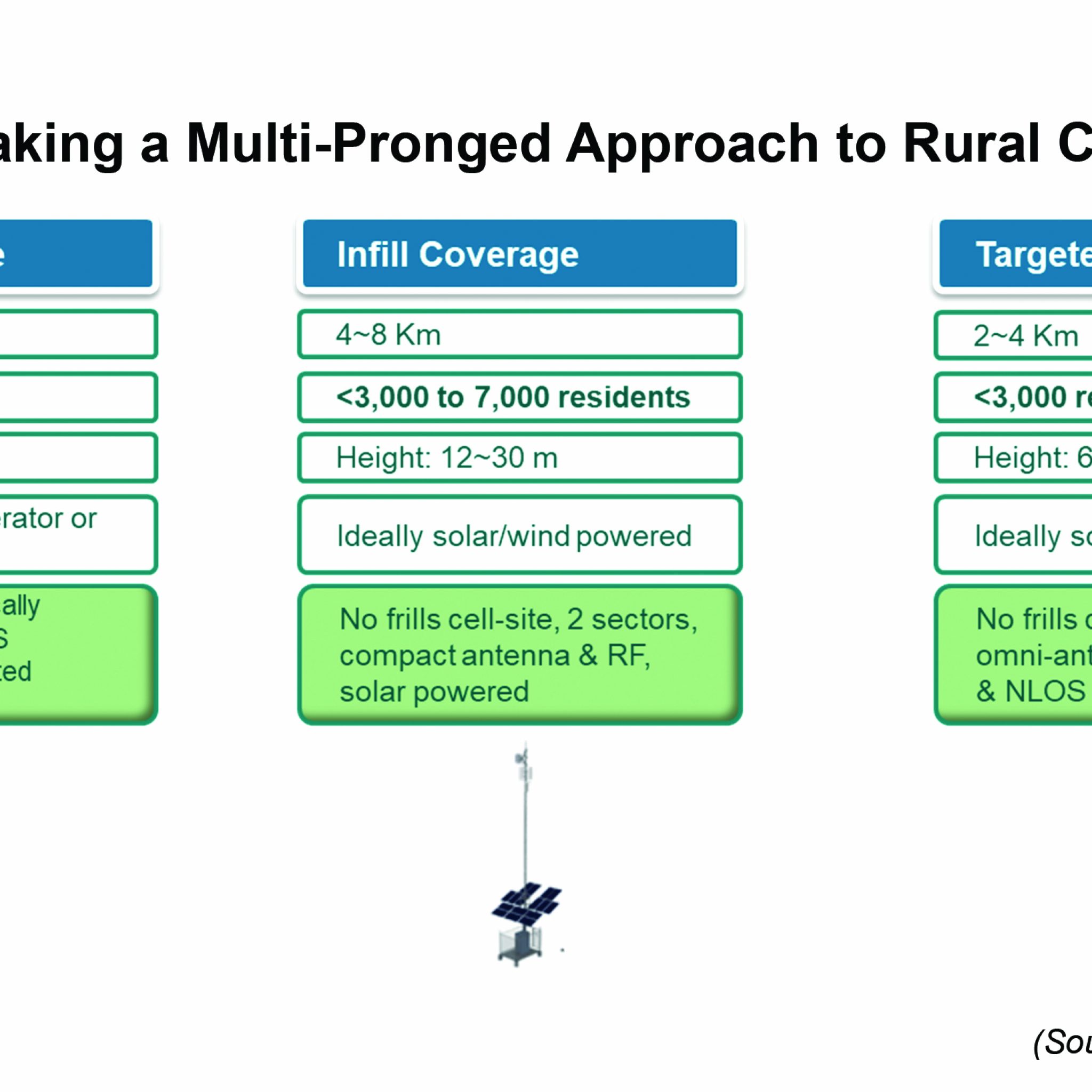
Rural communities require a variety of cell site solutions to address their needs. The traditional macro cell site is generally deployed by operators for wide coverage scenarios, but they also need low-cost cell site infrastructure for optimized coverage. Small cells can provide “infill” and “targeted” coverage in communities with 3,000 or fewer residents (see Figure 1).

The good news is that competition between infrastructure vendors is yielding results. All the major vendors have developed increasingly cost-effective solutions, but what are the key criteria? ABI Research’s Mobile Cellular Deployment Solutions for Rural Cell Sites report (AN-5226) provides the following criteria for rural connectivity:
- Fully Support Mobile Broadband Connectivity: Mobile broadband is vital for rural societal and economic development, therefore “pure” 2G cannot satisfy the requirement. 3G or 4G is the only viable option. A single radio supporting “2G & 3G” or “2G & 4G” would reduce costs and provide the required mobile voice and broadband data services.
- Reasonable Transmit Power: High transmit power (e.g., 40 Watt (W)/60 W) could provide better coverage, but the resultant power consumption would lead to higher energy costs. In many countries, the reality is that the rural cell site needs to be solar-powered due to the lack of reliable electricity. Higher power consumption means solar energy costs also multiply. The investment in additional solar equipment is often greater than the cost of the actual base station equipment. Therefore, high transmit power-based base stations are mainly used for wide area coverage where on-grid electricity is available. For more localized, cost-constrained coverage, lower-powered, 10 W per carrier, or 10 W per channel, powered base stations can strike an effective balance between coverage and cost for targeted coverage scenarios.
- Easy to Deploy and Low-Cost Long-Distance Backhaul: Fiber-optic is out of the question and microwave links have their limitations. While satellite links are not affected by the terrain, traffic is limited due to high Operating Expenditure. Mobile telcos need a low-cost backhaul solution, so using LTE Relay equipment to manage traffic will go a considerable way to meeting the mobile telco’s rural backhaul needs. LTE Relay uses the operators’ existing cellular band resources and supports Non-Line of Sight transmissions. Therefore, operators do not need to invest in additional backhaul spectrum resources for rural communities.
Huawei claims it has made additional progress with LTE Relay technologies. RuralStar Pro is based on the International Telecommunication Union’s Integrated Access and Backhaul (IAB) concept, which has relay capability and integrates the LTE Relay and small cell connectivity components into a single unit that is easier to manage and install. This innovative approach ensures that the transmission distance can potentially reach 40 Kilometers.
- Lower Power Consumption & Simple to Deploy Power Supply: As mentioned earlier, many rural cell sites are severely constrained in their access to power. Diesel Generators (DGs) may be an option for macro cell sites, but they are not economically viable for small cell sites where the cost of fuel can represent 40% to 50% of the projected Total Cost of Ownership. Furthermore, DGs are prone to theft. The latest cell site solutions rely on solar power. The number of solar panels installed directly impacts the overall equipment, infrastructure, and installation costs. Reducing the overall power consumption of the base station equipment is essential for reducing the number of solar panels required. Huawei’s latest iteration of its rural cell site solutions, the RuralStar Pro, integrates the Baseband Unit (BBU), the Remote Radio Unit (RRU), and the LTE Relay into one IAB radio unit. Aggregate power consumption is kept to 120 W, needing only two solar panels.
- Prevent Theft and Vandalism: Theft and vandalism can be a significant issue for telcos. It is important that on-site lithium batteries operate at higher voltages (48 Volts) than regular civilian-powered appliances and use security code-based modules that can disable the battery to help deter theft. SMS-based notification procedures can also warn mobile telcos about potential theft of solar panels or other cell site equipment. Adding fences increases site costs, so all electrical boxes should be installed high on the cell site pole to make theft more difficult. Nuts and bolts with customized, anti-theft design can make it challenging for thieves to remove with common maintenance tools.
- Simple and Cost-Effective Cell Site Set-up: Experienced field engineers are often in short supply, and the cost of site visits is high. If the skill requirements for field engineers could be lowered, or configuration and commissioning completed remotely, delivery costs can be reduced. One of the more time-consuming elements of deployment is the cell site’s foundation. Some of the more innovative deployments ABI Research has witnessed include the adoption of pre-fabricated, steel frame foundations that can be buried 2 meters underground and the earth works are then filled in and compacted to ensure a robust foundation for the 6 to 18-meter cell site poles. Using these more optimized deployment solutions enables reducing cell site set-up to 2 to 3 days and could help generate a Return on Investment of 2 years or less.
Summary Conclusions
There is considerable pent-up demand for cost-effective rural cell site deployment. Over the years, there have been a number of alternative connectivity solutions, but the harsh reality is that it has only been these ground-based, cell site solutions that can deliver reliable coverage and guaranteed bandwidth that supports greater adoption of cellular services by the local community. They have been able to harness the latest innovations in cellular radio engineering and the novel use of materials and components.
Over the next 5 to 10 years, ABI Research expects sustained investment in rural cellular Radio Access Network (RAN) infrastructure. The Compound Annual Growth Rate for these targeted and infill type small cells across all rural regions will be higher than for macro base stations, with the global number of rural small cells installed estimated to reach 544,000 by 2024.

Rural connectivity faces several engineering, logistical, and economic challenges. In many emerging markets, the disposable income of end users constrains the available investment by mobile telcos. The Average Revenue per User (ARPU) in Nigeria, India, and Indonesia is US$3.35, US$2.15, and US$2.64 per month, respectively. These very low ARPUs mean that mobile telcos have a razor thin TCO budget. Many national and international bodies offer grants and subsidies, but not enough to solve operators’ financial constraints.
Technological innovation and product optimization can go a long way to solving the rural broadband connectivity gap and achieving a virtuous investment cycle that benefits rural communities. The innovative use of cell site foundation strategies, efficient solar power usage, innovative LTE Relay backhaul to save OPEX, and advanced integrated design strategies, such as IAB, will help make mobile rural broadband connectivity a reality.

