


RCR Wireless
  • News
  • Channels
    • 5G
    • 6G
    • BSS OSS
    • Carriers
    • IoT
    • Network Infrastructure
    • Open RAN
    • Private 5G
    • Telco AI
    • Telco Cloud
    • Test & Measurement
  • Resources
    • Reports
    • Webinars
    • White papers
    • AI Fundamentals
    • Analyst Angle
    • Editorial Calendar
    • Fundamentals
      • 5G NR Release 17
      • AI
        • Telco AI in 2025
    • Podcasts
      • Let’s Get Digital with Carrie Charles
      • Wireless Connectivity to Enable Industry 4.0 for the Middleprise
      • Well Technically…
      • Will 5G Change the World
      • Accelerating Industry 4.0 Digitalization
  • AI Infrastructure
  • Programs
  • Events
  • RCRtv
  • Advertise
  • Subscribe
Monday, July 13, 2026
RCR Wireless
  • News
  • Channels
    • 5G
    • 6G
    • BSS OSS
    • Carriers
    • IoT
    • Network Infrastructure
    • Open RAN
    • Private 5G
    • Telco AI
    • Telco Cloud
    • Test & Measurement
  • Resources
    • Reports
    • Webinars
    • White papers
    • AI Fundamentals
    • Analyst Angle
    • Editorial Calendar
    • Fundamentals
      • 5G NR Release 17
      • AI
        • Telco AI in 2025
    • Podcasts
      • Let’s Get Digital with Carrie Charles
      • Wireless Connectivity to Enable Industry 4.0 for the Middleprise
      • Well Technically…
      • Will 5G Change the World
      • Accelerating Industry 4.0 Digitalization
  • AI Infrastructure
  • Programs
  • Events
  • RCRtv
  • Advertise
  • Subscribe
Add RCR Wireless as a preferred source on Google
  • Qualcomm 6G Insights
  • Huawei Content Hub
  • Qualcomm – 6G Vision
  • OSS/BSS Channel
  • RCRTech Roundtable: AI Infrastructure
RCR Wireless
RCR Wireless
  • Advanced Mimo
  • Mobile mmWave
  • 5G Positioning
  • Green Networks
  • Metaverse
  • Automotive
  • Industrial and Wide-area IoT
Copyright 2021 - All Right Reserved
Home - The business case for LEO satellite constellations: Walking a tightrope to success (Analyst Angle)
Analyst Angle

The business case for LEO satellite constellations: Walking a tightrope to success (Analyst Angle)

by Sean Kinney, Principal Analyst March 19, 2021
written by Sean Kinney, Principal Analyst March 19, 2021 Share
LinkedinEmail
Share 0LinkedinEmail
satellites
Image courtesy of 123.RF.
258

It is rare for a technology or service to evoke extreme opinions as LEO satellite constellations do. On the one hand, some would say that no constellation has managed to avoid bankruptcy. On the other hand, some believe that LEO satellites will eliminate the global digital divide. What I aim to highlight here is that the business case for LEO satellite constellations is not doomed to failure. However, it is a delicate business case that should not be burdened by unrealistic expectations. It is possible for LEO satellites to succeed; but doing so would require careful design, planning and patience. 

The five critical elements to LEO success

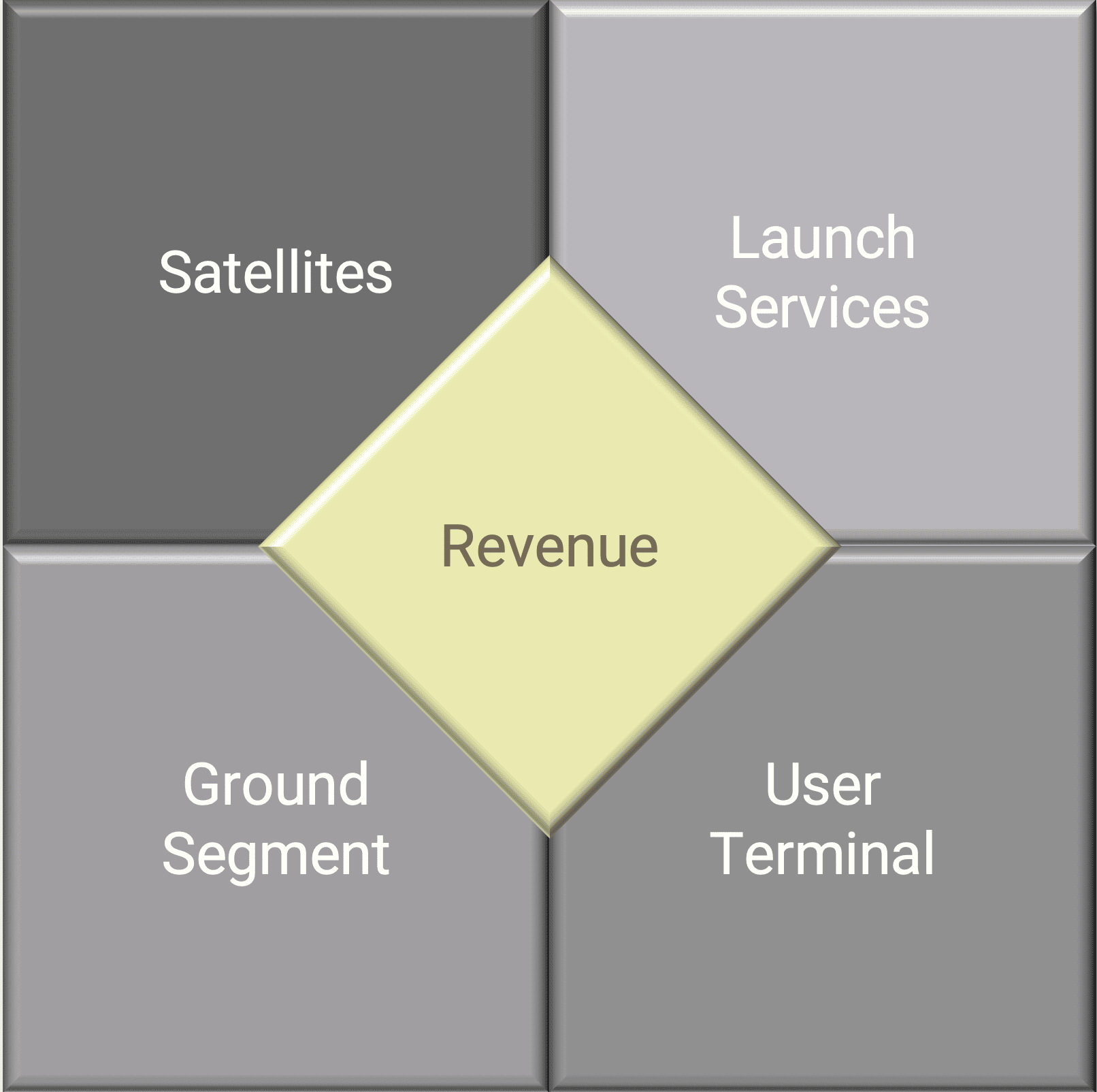
There are five key elements to the LEO business case. Four of these elements are on the cost side: the costs of satellites, launch, ground stations and user terminals. The fifth element is the number of subscribers that will drive revenue. These elements are interrelated with additional factors that govern their interdependency such as spectrum assets, performance metrics and quality of service.

The predictable costs

Satellite and launch costs, which are rather predictable, make for a sizable part of the total capex amounting to over 50% over the lifetime of the constellation. Large constellations with thousands of satellites, such as SpaceX and Kuiper, target a streamlined production process and bring the cost per satellite to below $1 m with around 100 units per month in production. Given a satellite lifecycle between 5-7 years and a business lifecycle of 20+ years, the number of manufactured satellites is at least 3-4x the size of the constellation. This underpins the potential economies of scale in satellite production and highlights the merits of long operational life for satellites. 

The cost of launch has decreased to under $2,000/kg. The cost of launch for a LEO communication satellite weighing a couple of hundred kilos, amounts to around 50% of the cost of the satellite. However, constellations such as SpaceX and Kuiper have their own launch vehicles which could subsidize a part of the launch costs. In effect, these operators have reasonably good control to minimize the predictable capex. 

The less predictable costs

The costs of ground stations and the user terminals are the wild cards. The first – cost of ground stations – is dependent on the service markets. This is where it becomes tricky as geographic expansion has to be considered carefully. Initiating a service in a new country could require new, in-country ground stations, irrespective of the potential subscriber base. Reducing the number of ground stations by introducing inter-satellite links (ISL) adds weight and power requirements, and increases cost. This leads to a delicate trade-off that is best optimized in the context of the use case, such as consumer access, enterprise backhaul, and/or mobile services.

The second – the cost of the user terminals – is primarily driven by volume. Constellations targeting consumer applications would typically use a form of electronically steerable antennas. This makes service adoption critical since the price of ASICs that enable beam steering depends on volume. This is also where we see rather optimistic and unrealistic forecasts reaching into the few hundred of dollars, tracking a cost curve similar to that of smartphones. However, given that a user terminal transmits a few watts of power, and given the potential number of subscribers supported by the network to meet service requirements, it would not be possible to achieve such a low terminal cost. In fact, a cost curve tracking wireless small cells is the more appropriate model. This would place the cost of a user terminal in the $1,000 range, for most practical numbers of supported subscribers.

The revenue levers

While a LEO constellation covers the globe, only a fraction of satellites would be actively servicing subscribers at any instance. Estimates for the utilization factor range between 4% to 25%. Utilization plays a pivotal role in determining the success of a constellation. It also represents a key weakness in the LEO concept: meeting the capacity requirement of a certain location on earth requires proportionally larger constellation to fulfill the demand. Consequently, LEO constellations perform best when the user-base is widely spread across the globe. The international aspect of LEO constellations is absolutely critical to their success.

Winning is possible

In our analysis, a LEO satellite with about 2 GHz of downlink user spectrum could support between 3,000 – 20,000 subscribers depending on the desired performance (e.g. 100 Mbps; 100 GB/month). A 4,000-satellite constellation designed for 100 Mbps service could support between 3 million to 20 million subscribers. Could these numbers lead to a successful business case? 

The answer is a qualified yes, provided certain conditions are met pertaining to the parameters mentioned above. Our Monte Carlo simulations of LEO constellation techno-economic models, show a long time to breakeven typically around 7 years. They also show that the odds of downside in profitability are high with a cap on upside potential.  Overall, the long-term scope of the business model raises uncertainties related to future earnings and costs. 

Winning needs patience

The mechanics of the business case for LEO constellations require investors to be very patient. It is not sufficient to have deep pockets, but the ability to stick with the plan over the long term is critical.  This requires a unique set of investors with long-term view and commitment. It could also help explain why no LEO constellation escaped from bankruptcy. Finally, as SPACs became a major vehicle for fundraising, one needs to question how these vehicles are aligned with the requirements of the LEO business case. 
LEO Satellite Business Case 2
The business case for LEO satellite constellations: Walking a tightrope to success (Analyst Angle) 7

You Might Also Like
  • Netgear’s quiet reinvention as a B2B and SaaS company (Analyst Angle)
  • Fifteen years on, how did that 1,000x mobile broadband forecast fare? (Analyst Angle)
  • Why consolidation will reshape MDU connectivity (part 3/3) – Analyst Angle
  • Why consolidation will reshape MDU connectivity (part 2/3) – Analyst Angle
  • Consolidation is reshaping MDU connectivity (part 1/3) – Analyst Angle
  • HPE Discover 2026 – the full-stack agentic enterprise (Analyst Angle)

Table of Contents

  • The five critical elements to LEO success
  • The predictable costs
  • The less predictable costs
  • The revenue levers
  • Winning is possible
  • Winning needs patience
Share 0 LinkedinEmail
Sean Kinney
Sean Kinney, Principal Analyst

Sean focuses on multiple subject areas including 5G, 6G, Open RAN, hybrid cloud, edge computing, and Industry 4.0. Prior to his work at RCR, Sean studied journalism and literature at the University of Mississippi then spent six years based in Key West, Florida, working as a reporter for the Miami Herald Media Company. He currently lives in Fayetteville, Arkansas.

previous post
Telstra preps NB-IoT sensor network to give Australian farmers a jump on the weather
next post
75F secures additional funding to boost building automation solutions

White Papers

  • Enea White Paper: Why Intelligent AAA is the Swiss Army Knife of Telecom

  • CSG White Paper: Telco AI Enabler: Mediation’s Defining Role

  • Enea White Paper: Scalable Database Design for 5G and Beyond

  • Supermicro and NVIDIA Whitepaper: Powering sovereign AI at scale

  • VIAVI Whitepaper: RAN scenario generators and their critical role for future-proofing AI-native RAN in Advanced 5G and 6G networks

Editorial Reports

  • Report: Scaling Optical Networks For The Hyperscale And AI Era

  • Test And Measurement Market Pulse Report

  • Editorial Report: Securing telecom infrastructure for the quantum era

Webinars

  • Webinar: Building 6G — aligning technology, policy and purpose

  • SIMCom Webinar: Scaling your next deployment – from plastic to provisioning

  • Webinar: Rethinking the RAN as AI, cloud and openness converge

  • Webinar: Scale-Up, Scale-Out, Scale-Across – Building AI-Era Network Fabrics

  • Webinar: NTN in motion – evolving standards, expanding services

Since 1982, RCR Wireless News has been providing wireless and mobile industry news, insights, and analysis to mobile and wireless industry professionals, decision makers, policy makers, analysts and investors.

Facebook Twitter Youtube Linkedin Envelope Rss

Useful Links

  • Subscribe
  • About RCR Wireless News
  • Contact Us
  • Advertise
  • Editorial Calendar
  • Archive
  • RSS
  • Wireless News Archive
  • Subscribe
  • About RCR Wireless News
  • Contact Us
  • Advertise
  • Editorial Calendar
  • Archive
  • RSS
  • Wireless News Archive

Edtior's Picks

Netgear’s quiet reinvention as a B2B and SaaS company (Analyst Angle)
Friday (telco diary) | Telco reset, RAN reboot, P5G reality check
Operators are seeking greater control of NTN: GSMA Intelligence

Latest Articles

Netgear’s quiet reinvention as a B2B and SaaS company (Analyst Angle)
Friday (telco diary) | Telco reset, RAN reboot, P5G reality check
Operators are seeking greater control of NTN: GSMA Intelligence
Webinar: Building 6G — aligning technology, policy and purpose

© 2026 RCR Wireless News All Right Reserved. Developed by Eight Hats.

Cookie Policy | Privacy Policy

RCR Wireless
  • News
  • Channels
    • 5G
    • 6G
    • BSS OSS
    • Carriers
    • IoT
    • Network Infrastructure
    • Open RAN
    • Private 5G
    • Telco AI
    • Telco Cloud
    • Test & Measurement
  • Resources
    • Reports
    • Webinars
    • White papers
    • AI Fundamentals
    • Analyst Angle
    • Editorial Calendar
    • Fundamentals
      • 5G NR Release 17
      • AI
        • Telco AI in 2025
    • Podcasts
      • Let’s Get Digital with Carrie Charles
      • Wireless Connectivity to Enable Industry 4.0 for the Middleprise
      • Well Technically…
      • Will 5G Change the World
      • Accelerating Industry 4.0 Digitalization
  • AI Infrastructure
  • Programs
  • Events
  • RCRtv
  • Advertise
  • Subscribe
RCR Wireless
  • News
  • Channels
    • 5G
    • 6G
    • BSS OSS
    • Carriers
    • IoT
    • Network Infrastructure
    • Open RAN
    • Private 5G
    • Telco AI
    • Telco Cloud
    • Test & Measurement
  • Resources
    • Reports
    • Webinars
    • White papers
    • AI Fundamentals
    • Analyst Angle
    • Editorial Calendar
    • Fundamentals
      • 5G NR Release 17
      • AI
        • Telco AI in 2025
    • Podcasts
      • Let’s Get Digital with Carrie Charles
      • Wireless Connectivity to Enable Industry 4.0 for the Middleprise
      • Well Technically…
      • Will 5G Change the World
      • Accelerating Industry 4.0 Digitalization
  • AI Infrastructure
  • Programs
  • Events
  • RCRtv
  • Advertise
  • Subscribe
@2020 - All Right Reserved. Designed and Developed by PenciDesign
