

RCR Wireless
  • News
  • Channels
    • 5G
    • 6G
    • BSS OSS
    • Carriers
    • IoT
    • Network Infrastructure
    • Open RAN
    • Private 5G
    • Telco AI
    • Telco Cloud
    • Test & Measurement
  • Resources
    • Reports
    • Webinars
    • White papers
    • AI Fundamentals
    • Analyst Angle
    • Editorial Calendar
    • Fundamentals
      • 5G NR Release 17
      • AI
        • Telco AI in 2025
    • Podcasts
      • Let’s Get Digital with Carrie Charles
      • Wireless Connectivity to Enable Industry 4.0 for the Middleprise
      • Well Technically…
      • Will 5G Change the World
      • Accelerating Industry 4.0 Digitalization
  • AI Infrastructure
  • Programs
  • Events
  • RCRtv
  • Advertise
  • Subscribe
Tuesday, July 7, 2026
RCR Wireless
  • News
  • Channels
    • 5G
    • 6G
    • BSS OSS
    • Carriers
    • IoT
    • Network Infrastructure
    • Open RAN
    • Private 5G
    • Telco AI
    • Telco Cloud
    • Test & Measurement
  • Resources
    • Reports
    • Webinars
    • White papers
    • AI Fundamentals
    • Analyst Angle
    • Editorial Calendar
    • Fundamentals
      • 5G NR Release 17
      • AI
        • Telco AI in 2025
    • Podcasts
      • Let’s Get Digital with Carrie Charles
      • Wireless Connectivity to Enable Industry 4.0 for the Middleprise
      • Well Technically…
      • Will 5G Change the World
      • Accelerating Industry 4.0 Digitalization
  • AI Infrastructure
  • Programs
  • Events
  • RCRtv
  • Advertise
  • Subscribe
Add RCR Wireless as a preferred source on Google
  • Qualcomm 6G Insights
  • Huawei Content Hub
  • Qualcomm – 6G Vision
  • OSS/BSS Channel
RCR Wireless
RCR Wireless
  • Advanced Mimo
  • Mobile mmWave
  • 5G Positioning
  • Green Networks
  • Metaverse
  • Automotive
  • Industrial and Wide-area IoT
Copyright 2021 - All Right Reserved
Home - IAB with self-interference cancellation–no hassle way to expand 5G coverage (Analyst Angle)
5GAnalyst Angle

IAB with self-interference cancellation–no hassle way to expand 5G coverage (Analyst Angle)

by Prakash Sangam October 5, 2020
written by Prakash Sangam October 5, 2020 Share
LinkedinEmail
Share 0LinkedinEmail
IAB
214

Many 5G operators are quickly realizing that Integrated Access Backhauls (IABs) are an ideal solution to expand 5G coverage. This is even more important for operators such as Verizon and AT&T, who are primarily utilizing millimeter Wave (mmWave) bands for 5G. As I explained in my earlier articles, traditional techniques only allow half-duplex IAB operation, which severely limits its usability. The SeLf Interference Cancellation (SLIC) technique enables the full-duplex IAB operation and offers full capacity and efficiency. In essence, it just not IABs, but IABs with SLIC are the most efficient, and hassle-free way to expand 5G mmWave coverage. 

Side note: If you would like to learn more about IABs, and how to deploy hyperdense mmWave networks, please check out the other articles in the IABs article series.

What is self-interference, and why is it a challenge?

The traditional configuration for deploying IABs is half-duplex, where the donor and access (user) links timeshare the same spectrum, thus significantly reducing the efficiency. The full-duplex mode, where both the links are ON at the same time, is not possible as the links interfere with each other—the transmitter of one link feeding into the receiver of the other. This “self-interference” makes both the links unusable and the IAB dysfunctional. 

So, let’s look at how to address this self-interference. As shown in the figure, IAB has two sets of antennas, one for the donor link, and another for the access link. The best option to reduce self-interference is to isolate both the antennas/links. Based on the years of work on the cousins of IABs—repeaters, and relays—we know that for the full-duplex mode to work, this isolation needs to be 110 – 120 dB. 
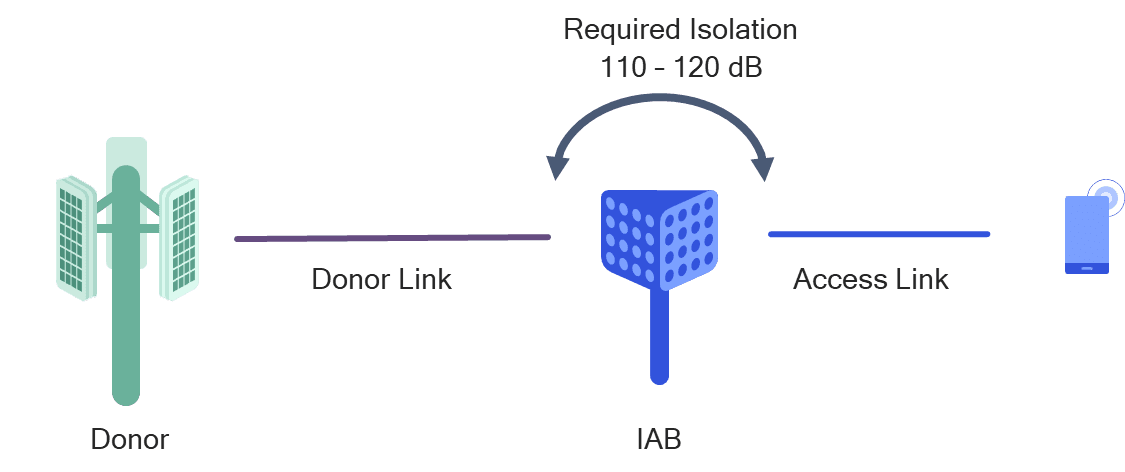
image1

Locating the donor and access antennas far apart from each other or separating them with a solid obstruction could yield significant isolation. However, since we would like to keep the IAB unit small and compact, with integrated antennas, there is a limit to how much separation you could achieve this way. 

The mmWave bands have many advantages over sub-6GHz bands in achieving such isolation. Their antennas are small, so isolating them is relatively easy. Since they also have a smaller coverage footprint, the interference they spew into the other link is relatively smaller. That is why I think IABs are ideal for mmWave bands. If you would like to know more about this, check out the earlier articles.  

The lab and field testing done by a leading player Kumu networks indicates that for mmWave IABs, the isolation that can be achieved by intelligent antennas separation is as high as 70 dB. That means the remaining 40-50 dB has to come from some other means. That is where the SLIC comes into play. 

How does SLIC work?  

To explain interference cancellation in simple words, you create a signal that is directly opposite to the interfering signal and inject that into the receiver. This opposite signal negates the interference leaving behind only the desired signal. 

The interference cancellation can be implemented either in the analog domain or the digital one. Each is implemented at different sections of the IAB. Analog SLIC is typically done at the RF Front End (RFFE) subsystem, and the digital SLIC is implemented in or around the modem subsystem.

Side note: If you would like to know more technical details on self-interference cancellation, please check this  YouTube video.

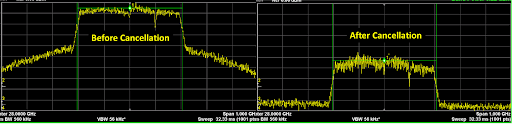
Again, when it comes to mmWave IABs, because of their RF characteristics, almost all the needed additional 40-50 dB of isolation can be achieved only through digital SLIC. Here are the frequency response charts of a commercial-grade mmWave digital SLIC IP block developed by Kumu Networks. This response is for a 28 GHz, 400 MHz mmWave system, and as evident, it can reduce the interference, i.e. increase the isolation by 40-50 dB.
unnamed 1

SLIC enables full-duplex IABs

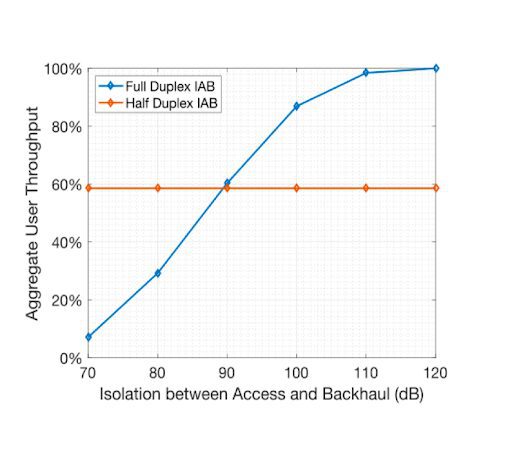
Here is a chart that further illustrates the importance of SLIC in enabling full-duplex operation of IABs.  
unnamed 2

t plots the IAB efficiency against the amount of isolation. The efficiency here is measured as the total IAB throughput when compared to the throughput of a regular site with a fiber backhaul.  As can be seen, IAB in full-duplex mode is more efficient than half-duplex, if the isolation is 90 dB or more. And with 120 dB of isolation, IAB can provide the same amount of capacity as that of a regular mmWave site. It is pretty clear that SLIC is a must to make IABs really useful for 5G. 

When will IABs with SLIC be available?

Well, there are two parts to that question. Let’s look at the second part first. SLIC is not a new concept. In fact, it is available in the products being shipped today. For example, Kumu Network’s LTE Relays that support SLIC are already deployed by many operators. And they already have developed the core IP for 5G mmW digital SLIC and it is currently being evaluated by many of its customers.  As mentioned before, the frequency chart showing the interference cancellation is from the same IP block. 

Now, regarding the first part, 3GPP Rel. 16, which introduced IABs was finalized only a few months ago in Jun 2020. It usually takes 9-12 months for the new standard to be supported in commercial products. Verizon and AT&T are already testing IABs and have publicly disclosed that they will start deploying them in their networks in 2021. 

Final thoughts

In a series of articles, we took a very close look at 5G IABs, especially for the mmWave deployments. The first article examined why hyper densification of mmWave sites is a must for 5G operators, the second article explained how IABs address the main challenge of cost-effective backhaul, and this article illustrates why SLIC is a basic need for highly efficient, full-duplex operation of IABs. 

5G mmWave IABs are a powerful combination of well-understood concept, proven technology, and an ideal spectrum band. No wonder the industry is really excited about their introduction. The finalization of 3GPP Rel. 16 has set the IAB commercialization in motion, and operators can’t wait for them to be deployed in their networks. 

For more articles like this, and up-to-date analysis of the latest mobile and tech industry news, sign-up for our monthly newsletter at TantraAnalyst.com/Newsletter, or listen to our Tantra’s Mantra podcast.

You Might Also Like
  • Huawei outlines AI-centric network roadmap for telecom monetization
  • Why consolidation will reshape MDU connectivity (part 3/3) – Analyst Angle
  • Indosat outlines AI Grid vision as 5G modernization targets nationwide AI-ready network
  • Huawei shows how 5G and AI are reshaping tourism in China
  • China Tower shifts to ‘digital’ and ‘intelligent’ towers
  • Why consolidation will reshape MDU connectivity (part 2/3) – Analyst Angle
Share 0 LinkedinEmail
Prakash Sangam

Prakash Sangam is the founder and principal at Tantra Analyst, a leading research and consultancy firm covering IP strategy, 5G, IoT, AI, as well as client and cloud computing. He has more than 20 years of wireless industry experience working for Qualcomm, Ericsson, and AT&T. A prolific writer, blogger, and speaker, Prakash enjoys analyzing technical and business challenges and transforming them into impactful strategies and persuasive messaging. He is a regular contributor to Forbes, EETimes, RCR Wireless, Medium, and other leading publications and has been on the speaking circuit for leading industry events, including Mobile World Congress, and CTIA. Prakash holds a Bachelor’s of Engineering in electronics and communications from Karnatak University in India, and a Masters of Business Administration from San Diego State University. He can be reached on twitter @MyTechMusings

previous post
The Sunday Brief: What pandemic? Telecom 3Q earnings preview (Part 2)
next post
Miss the boat on IoT, miss the boat on business – warns Voda poll of IoT adopters

White Papers

  • Enea White Paper: Why Intelligent AAA is the Swiss Army Knife of Telecom

  • CSG White Paper: Telco AI Enabler: Mediation’s Defining Role

  • Enea White Paper: Scalable Database Design for 5G and Beyond

  • Supermicro and NVIDIA Whitepaper: Powering sovereign AI at scale

  • VIAVI Whitepaper: RAN scenario generators and their critical role for future-proofing AI-native RAN in Advanced 5G and 6G networks

Editorial Reports

  • Report: Scaling Optical Networks For The Hyperscale And AI Era

  • Test And Measurement Market Pulse Report

  • Editorial Report: Securing telecom infrastructure for the quantum era

Webinars

  • Webinar: Rethinking the RAN as AI, cloud and openness converge

  • Webinar: Scale-Up, Scale-Out, Scale-Across – Building AI-Era Network Fabrics

  • Webinar: NTN in motion – evolving standards, expanding services

  • Webinar: Noise-Figure Measurements with RFmx and PXI VSTs

  • Qualcomm Webinar – Building the 6G Standard: Key developments to know

Since 1982, RCR Wireless News has been providing wireless and mobile industry news, insights, and analysis to mobile and wireless industry professionals, decision makers, policy makers, analysts and investors.

Facebook Twitter Youtube Linkedin Envelope Rss

Useful Links

  • Subscribe
  • About RCR Wireless News
  • Contact Us
  • Advertise
  • Editorial Calendar
  • Archive
  • RSS
  • Wireless News Archive
  • Subscribe
  • About RCR Wireless News
  • Contact Us
  • Advertise
  • Editorial Calendar
  • Archive
  • RSS
  • Wireless News Archive

Edtior's Picks

Enea White Paper: Why Intelligent AAA is the Swiss Army Knife of Telecom
Huawei outlines AI-centric network roadmap for telecom monetization
Why consolidation will reshape MDU connectivity (part 3/3) – Analyst Angle

Latest Articles

Enea White Paper: Why Intelligent AAA is the Swiss Army Knife of Telecom
Huawei outlines AI-centric network roadmap for telecom monetization
Why consolidation will reshape MDU connectivity (part 3/3) – Analyst Angle
Quantum Safe Networks Forum 2026

© 2026 RCR Wireless News All Right Reserved. Developed by Eight Hats.

Cookie Policy | Privacy Policy

RCR Wireless
  • News
  • Channels
    • 5G
    • 6G
    • BSS OSS
    • Carriers
    • IoT
    • Network Infrastructure
    • Open RAN
    • Private 5G
    • Telco AI
    • Telco Cloud
    • Test & Measurement
  • Resources
    • Reports
    • Webinars
    • White papers
    • AI Fundamentals
    • Analyst Angle
    • Editorial Calendar
    • Fundamentals
      • 5G NR Release 17
      • AI
        • Telco AI in 2025
    • Podcasts
      • Let’s Get Digital with Carrie Charles
      • Wireless Connectivity to Enable Industry 4.0 for the Middleprise
      • Well Technically…
      • Will 5G Change the World
      • Accelerating Industry 4.0 Digitalization
  • AI Infrastructure
  • Programs
  • Events
  • RCRtv
  • Advertise
  • Subscribe
RCR Wireless
  • News
  • Channels
    • 5G
    • 6G
    • BSS OSS
    • Carriers
    • IoT
    • Network Infrastructure
    • Open RAN
    • Private 5G
    • Telco AI
    • Telco Cloud
    • Test & Measurement
  • Resources
    • Reports
    • Webinars
    • White papers
    • AI Fundamentals
    • Analyst Angle
    • Editorial Calendar
    • Fundamentals
      • 5G NR Release 17
      • AI
        • Telco AI in 2025
    • Podcasts
      • Let’s Get Digital with Carrie Charles
      • Wireless Connectivity to Enable Industry 4.0 for the Middleprise
      • Well Technically…
      • Will 5G Change the World
      • Accelerating Industry 4.0 Digitalization
  • AI Infrastructure
  • Programs
  • Events
  • RCRtv
  • Advertise
  • Subscribe
@2020 - All Right Reserved. Designed and Developed by PenciDesign
