

RCR Wireless
  • News
  • Channels
    • 5G
    • 6G
    • BSS OSS
    • Carriers
    • IoT
    • Network Infrastructure
    • Open RAN
    • Private 5G
    • Telco AI
    • Telco Cloud
    • Test & Measurement
  • Resources
    • Reports
    • Webinars
    • White papers
    • AI Fundamentals
    • Analyst Angle
    • Editorial Calendar
    • Fundamentals
      • 5G NR Release 17
      • AI
        • Telco AI in 2025
    • Podcasts
      • Let’s Get Digital with Carrie Charles
      • Wireless Connectivity to Enable Industry 4.0 for the Middleprise
      • Well Technically…
      • Will 5G Change the World
      • Accelerating Industry 4.0 Digitalization
  • AI Infrastructure
  • Programs
  • Events
  • RCRtv
  • Advertise
  • Subscribe
Tuesday, July 7, 2026
RCR Wireless
  • News
  • Channels
    • 5G
    • 6G
    • BSS OSS
    • Carriers
    • IoT
    • Network Infrastructure
    • Open RAN
    • Private 5G
    • Telco AI
    • Telco Cloud
    • Test & Measurement
  • Resources
    • Reports
    • Webinars
    • White papers
    • AI Fundamentals
    • Analyst Angle
    • Editorial Calendar
    • Fundamentals
      • 5G NR Release 17
      • AI
        • Telco AI in 2025
    • Podcasts
      • Let’s Get Digital with Carrie Charles
      • Wireless Connectivity to Enable Industry 4.0 for the Middleprise
      • Well Technically…
      • Will 5G Change the World
      • Accelerating Industry 4.0 Digitalization
  • AI Infrastructure
  • Programs
  • Events
  • RCRtv
  • Advertise
  • Subscribe
Add RCR Wireless as a preferred source on Google
  • Qualcomm 6G Insights
  • Huawei Content Hub
  • Qualcomm – 6G Vision
  • OSS/BSS Channel
RCR Wireless
RCR Wireless
  • Advanced Mimo
  • Mobile mmWave
  • 5G Positioning
  • Green Networks
  • Metaverse
  • Automotive
  • Industrial and Wide-area IoT
Copyright 2021 - All Right Reserved
Home - 5G operator dilemma: Focus on coverage or capacity? (Analyst Angle)
5GAnalyst Angle

5G operator dilemma: Focus on coverage or capacity? (Analyst Angle)

by Prakash Sangam June 17, 2020
written by Prakash Sangam June 17, 2020 Share
LinkedinEmail
Share 0LinkedinEmail
5G
198

5G has seen unprecedented traction; many flagship devices are already in the market, and many more are on the way, including the much-rumored and anticipated iPhone 5G. After the excitement of limited initial launches, when operators are starting the large-scale deployments, the basic question they are faced with is whether to focus on coverage or capacity. Well, the right answer is both, but that is easier said than done, especially for operators such as Verizon and AT&T that have limited low and mid-band (aka Sub-6Hz) spectrum. 

In a series of articles, I will discuss this dilemma and explore the solutions that the industry is working on to effectively address it. Especially the ones such as Integrated Access Backhaul (IAB) that have shown early promise, and many innovations that not only enable such solutions but also make them efficient. This is the first article in the series. 

When launching a 5G network, the easiest thing is to utilize sub-6GHz bands, if you have access to them, and provide a basic coverage layer. That is exactly what Sprint (now part of T-Mobile) in the US and many operators outside the US did. However, the amount of bandwidth available in the sub-6GHz spectrum is limited, and hence the capacity in those networks would quickly be used up, especially if the growth of 5G continues as predicted. There is every indication that it will, for example, contrary to what many people expected, 5G deployment in the US is not affected by the Covid-19 pandemic. This means those operators will soon have to move to the bandwidth-rich high-band spectrum, i.e. millimeter wave bands (mmWave). These bands have more than ten-times available spectrum than sub-6GHz, and are critical to deliver on the promise of 5G—multi-gigabit user speeds, the extreme capacity to offer new services, be it fixed wireless access to homes and offices, massive IoT, Mission Critical Services, or bringing new user experiences on a massive scale.     

Operators such as Verizon and AT&T, who did not have access to enough Sub-6GHz bands, leapfrogged and took the bold step of launching 5G with mmWave spectrum. This spectrum is far different in many aspects than others that the mobile industry has used so far. 

<<Side note: If you would like to know more about mmWave bands, check out my article – Is mmWave just another band for 5G?>>

The biggest differences between Sub-6GHz and mmWave bands are coverage and indoor penetration. Because of their RF properties, mmWave bands have smaller coverage footprint and do not penetrate solid objects such as walls. Although this was long known by experts, it came almost as a shock to uninformed general industry observers. Operators, especially Verizon, got a lot of flak from the media on this. Some even doubted the feasibility of mmWave bands. Thanks to the extensive field tests, any lingering doubts are now duly resolved. In fact, almost all global regions are now working toward allocating the mmWave spectrum for 5G.

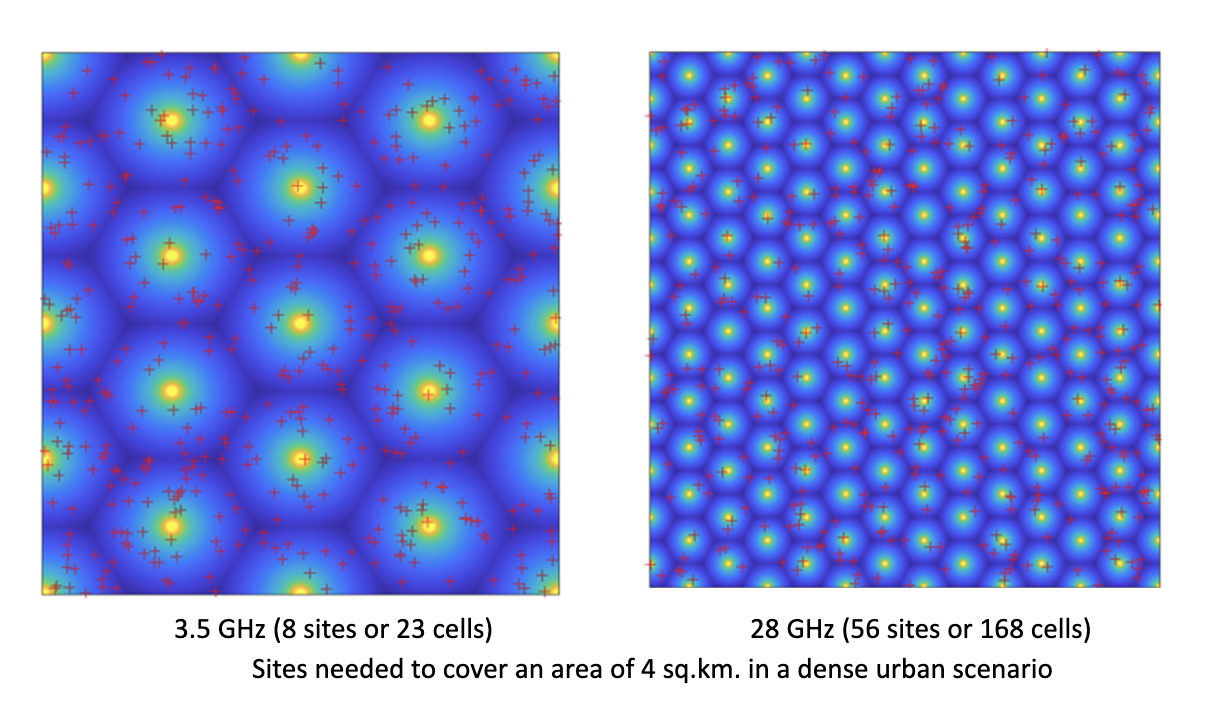
By the virtue of a smaller footprint, mmWave will need more sites than Sub-6GHz to provide similar coverage. For example, simulations run by Kumu Networks estimate that 26 GHz spectrum will need seven to eight times more sites than 3.5 GHz spectrum, as shown in the figure below:
Screen Shot 2020 06 17 at 10.17.21 AM

The ideal 5G deployment strategy for operators is to utilize sub-6GHz to provide expansive, city, and country-wide coverage, and utilize dense deployment of mmWave, as shown in the figure, in high-traffic dense urban, urban and even in pockets of suburban areas to provide extreme capacity. Because of the density and a large amount of spectrum available, the mmWave cluster will provide magnitudes higher capacity than sub-6GHz clusters. Additionally, such dense deployments are much easier with mmWave, because of their smaller coverage footprint. 

Many operators are working with city governments and utilities to deploy mmWave sites on lampposts, which should provide good densification. Studies have shown that such deployments could provide excellent results, supporting a large number of subscribers with a huge amount of capacity resulting in excellent user experience. FCC, being proactive, has been working to streamline regulations for the deployment of such outdoor sites. 

Clearly, lampposts, and in some cases building tops, are the ideal spots for mmWave installations, because they readily have access to power, which is one of the two key requirements for a new site. However, the other requirement—backhaul, is a far different story. Since these are high capacity sites, they need fiber or other high bandwidth means of backhaul. The first issue is, there may not be fiber drops near all the lampposts. Even if there are, bringing fiber to each post is not only extremely time consuming and very expensive, but also hard to manage and maintain on an ongoing basis. This means the industry has to look for alternate cost-effective, and easy to install solutions that offer bandwidth and latency similar to fiber. 

Realizing this, the industry body 3GPP has been working on an interesting solution called Integrated Access Backhaul (IAB). IABs are being standardized in Rel. 16, and further enhanced in Rel. 17. Rel. 16 is expected to be finalized in July of this year and followed by Rel 17 in 2021. 

<<Side note: If you would like to know more about 3GPP standardization and Rel 17, please check this article series – The Chronicles of 3GPP Rel. 17.>>

IABs use wireless links for both backhaul and access (i.e. regular user traffic). As evident, they will need a large amount of licensed spectrum to offer fiber-like backhaul performance. But that raises a lot of questions —such as “Don’t IABs decrease the available spectrum for access? How would that affect the network capacity? Can you still deliver on the grand promises of 5G?” and many more.

All those are valid questions and concerns. What if I say that there are ways to make and deploy IABs without compromising on the available spectrum? More like having the cake and eating it too, yes, that is possible! How, you ask? Well, you will have to wait for my next article to find out!

Also, for more articles like this, and up-to-date analysis of the latest mobile and tech industry news, sign-up for our monthly newsletter at TantraAnalyst.com/Newsletter, or listen to our Tantra’s Mantra podcast.

You Might Also Like
  • Huawei outlines AI-centric network roadmap for telecom monetization
  • Why consolidation will reshape MDU connectivity (part 3/3) – Analyst Angle
  • Indosat outlines AI Grid vision as 5G modernization targets nationwide AI-ready network
  • Huawei shows how 5G and AI are reshaping tourism in China
  • China Tower shifts to ‘digital’ and ‘intelligent’ towers
  • Why consolidation will reshape MDU connectivity (part 2/3) – Analyst Angle
Share 0 LinkedinEmail
Avatar of Prakash Sangam
Prakash Sangam

Prakash Sangam is the founder and principal at Tantra Analyst, a leading research and consultancy firm covering IP strategy, 5G, IoT, AI, as well as client and cloud computing. He has more than 20 years of wireless industry experience working for Qualcomm, Ericsson, and AT&T. A prolific writer, blogger, and speaker, Prakash enjoys analyzing technical and business challenges and transforming them into impactful strategies and persuasive messaging. He is a regular contributor to Forbes, EETimes, RCR Wireless, Medium, and other leading publications and has been on the speaking circuit for leading industry events, including Mobile World Congress, and CTIA. Prakash holds a Bachelor’s of Engineering in electronics and communications from Karnatak University in India, and a Masters of Business Administration from San Diego State University. He can be reached on twitter @MyTechMusings

previous post
Swiss telecoms association calls for acceleration in 5G deployments
next post
Korea’s LG Uplus completes key tests for 5G SA launch

White Papers

  • Enea White Paper: Why Intelligent AAA is the Swiss Army Knife of Telecom

  • CSG White Paper: Telco AI Enabler: Mediation’s Defining Role

  • Enea White Paper: Scalable Database Design for 5G and Beyond

  • Supermicro and NVIDIA Whitepaper: Powering sovereign AI at scale

  • VIAVI Whitepaper: RAN scenario generators and their critical role for future-proofing AI-native RAN in Advanced 5G and 6G networks

Editorial Reports

  • Report: Scaling Optical Networks For The Hyperscale And AI Era

  • Test And Measurement Market Pulse Report

  • Editorial Report: Securing telecom infrastructure for the quantum era

Webinars

  • Webinar: Rethinking the RAN as AI, cloud and openness converge

  • Webinar: Scale-Up, Scale-Out, Scale-Across – Building AI-Era Network Fabrics

  • Webinar: NTN in motion – evolving standards, expanding services

  • Webinar: Noise-Figure Measurements with RFmx and PXI VSTs

  • Qualcomm Webinar – Building the 6G Standard: Key developments to know

Since 1982, RCR Wireless News has been providing wireless and mobile industry news, insights, and analysis to mobile and wireless industry professionals, decision makers, policy makers, analysts and investors.

Facebook Twitter Youtube Linkedin Envelope Rss

Useful Links

  • Subscribe
  • About RCR Wireless News
  • Contact Us
  • Advertise
  • Editorial Calendar
  • Archive
  • RSS
  • Wireless News Archive
  • Subscribe
  • About RCR Wireless News
  • Contact Us
  • Advertise
  • Editorial Calendar
  • Archive
  • RSS
  • Wireless News Archive

Edtior's Picks

Enea White Paper: Why Intelligent AAA is the Swiss Army Knife of Telecom
Huawei outlines AI-centric network roadmap for telecom monetization
Why consolidation will reshape MDU connectivity (part 3/3) – Analyst Angle

Latest Articles

Enea White Paper: Why Intelligent AAA is the Swiss Army Knife of Telecom
Huawei outlines AI-centric network roadmap for telecom monetization
Why consolidation will reshape MDU connectivity (part 3/3) – Analyst Angle
Quantum Safe Networks Forum 2026

© 2026 RCR Wireless News All Right Reserved. Developed by Eight Hats.

Cookie Policy | Privacy Policy

RCR Wireless
  • News
  • Channels
    • 5G
    • 6G
    • BSS OSS
    • Carriers
    • IoT
    • Network Infrastructure
    • Open RAN
    • Private 5G
    • Telco AI
    • Telco Cloud
    • Test & Measurement
  • Resources
    • Reports
    • Webinars
    • White papers
    • AI Fundamentals
    • Analyst Angle
    • Editorial Calendar
    • Fundamentals
      • 5G NR Release 17
      • AI
        • Telco AI in 2025
    • Podcasts
      • Let’s Get Digital with Carrie Charles
      • Wireless Connectivity to Enable Industry 4.0 for the Middleprise
      • Well Technically…
      • Will 5G Change the World
      • Accelerating Industry 4.0 Digitalization
  • AI Infrastructure
  • Programs
  • Events
  • RCRtv
  • Advertise
  • Subscribe
RCR Wireless
  • News
  • Channels
    • 5G
    • 6G
    • BSS OSS
    • Carriers
    • IoT
    • Network Infrastructure
    • Open RAN
    • Private 5G
    • Telco AI
    • Telco Cloud
    • Test & Measurement
  • Resources
    • Reports
    • Webinars
    • White papers
    • AI Fundamentals
    • Analyst Angle
    • Editorial Calendar
    • Fundamentals
      • 5G NR Release 17
      • AI
        • Telco AI in 2025
    • Podcasts
      • Let’s Get Digital with Carrie Charles
      • Wireless Connectivity to Enable Industry 4.0 for the Middleprise
      • Well Technically…
      • Will 5G Change the World
      • Accelerating Industry 4.0 Digitalization
  • AI Infrastructure
  • Programs
  • Events
  • RCRtv
  • Advertise
  • Subscribe
@2020 - All Right Reserved. Designed and Developed by PenciDesign