

RCR Wireless
  • News
  • Channels
    • 5G
    • 6G
    • BSS OSS
    • Carriers
    • IoT
    • Network Infrastructure
    • Open RAN
    • Private 5G
    • Telco AI
    • Telco Cloud
    • Test & Measurement
  • Resources
    • Reports
    • Webinars
    • White papers
    • AI Fundamentals
    • Analyst Angle
    • Editorial Calendar
    • Fundamentals
      • 5G NR Release 17
      • AI
        • Telco AI in 2025
    • Podcasts
      • Let’s Get Digital with Carrie Charles
      • Wireless Connectivity to Enable Industry 4.0 for the Middleprise
      • Well Technically…
      • Will 5G Change the World
      • Accelerating Industry 4.0 Digitalization
  • AI Infrastructure
  • Programs
  • Events
  • RCRtv
  • Advertise
  • Subscribe
Tuesday, July 14, 2026
RCR Wireless
  • News
  • Channels
    • 5G
    • 6G
    • BSS OSS
    • Carriers
    • IoT
    • Network Infrastructure
    • Open RAN
    • Private 5G
    • Telco AI
    • Telco Cloud
    • Test & Measurement
  • Resources
    • Reports
    • Webinars
    • White papers
    • AI Fundamentals
    • Analyst Angle
    • Editorial Calendar
    • Fundamentals
      • 5G NR Release 17
      • AI
        • Telco AI in 2025
    • Podcasts
      • Let’s Get Digital with Carrie Charles
      • Wireless Connectivity to Enable Industry 4.0 for the Middleprise
      • Well Technically…
      • Will 5G Change the World
      • Accelerating Industry 4.0 Digitalization
  • AI Infrastructure
  • Programs
  • Events
  • RCRtv
  • Advertise
  • Subscribe
Add RCR Wireless as a preferred source on Google
  • Qualcomm 6G Insights
  • Huawei Content Hub
  • Qualcomm – 6G Vision
  • OSS/BSS Channel
  • RCRTech Roundtable: AI Infrastructure
RCR Wireless
RCR Wireless
  • Advanced Mimo
  • Mobile mmWave
  • 5G Positioning
  • Green Networks
  • Metaverse
  • Automotive
  • Industrial and Wide-area IoT
Copyright 2021 - All Right Reserved
Home - Neural networks address the challenges of CSI reporting in 5G NR (Reader Forum)
5GOpinionReader Forum

Neural networks address the challenges of CSI reporting in 5G NR (Reader Forum)

by Reader Forum September 4, 2019
written by Reader Forum September 4, 2019 Share
LinkedinEmail
Share 0LinkedinEmail
296

Introduction 

The performance specification for 5G is much more demanding than for previous generations of mobile networks, requiring high data rates, (up to 20 Gbps), very low latency, (< 1 mSec), ultra-high reliability, energy efficiency and very high numbers of connected devices. To meet these challenges a completely new air interface has been developed for 5G, 5G New Radio, (5G NR) which must support frequencies from low band all the way up to 100 GHz.

MU-MIMO and beamforming are two core techniques used within 5G networks which lead to multiple signal paths between base station and user equipment, each with different propagation characteristics. Channel state information (CSI) is collected for each potential signal path and then used by the Link Performance Adaptation Process to determine the optimum signal path for the specific UE.

This article examines these techniques, describes how neural networks are well suited to the computational requirements of Link Performance Adaptation and then describes how CEVA’s PentaG™ IP platform can address the CSI reporting and other challenges presented by 5G NR.

MU MIMO and beamforming

MU MIMO employed by 5G NR in order to increase throughput, uses a large number of antennas in the base station array, enabling multiple, spatially separated users to use the same time and frequency resources. 3GPP Release 15 defines 32 antennas but future releases of the 3GPP specification are expected to require 64 or more.

Beamforming, used in combination with MU MIMO, enables the radiation pattern of the antenna array to be adapted to a particular scenario, steering a lobe of power in a particular direction toward a user. Three different beamforming schemes are supported by 5G NR, depending on the architecture of the antenna-array, as shown in figure 1.
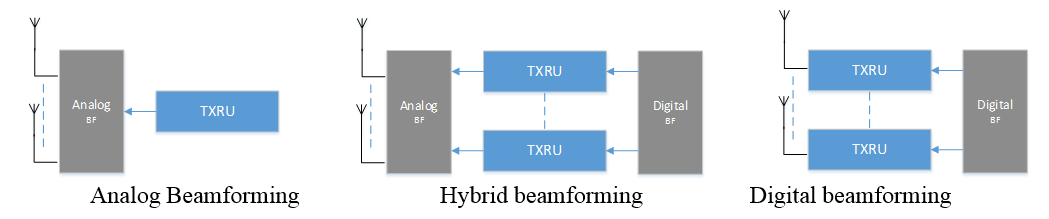
image1

Figure 1: 5G NR Beamforming Schemes

Data transmitted between a MIMO antenna and user equipment (UE) is affected by the surrounding environment, particularly at high transmission frequencies. For example, buildings and other obstacles may cause reflections of the original signal, resulting in multiple transmission paths, each with its own signal characteristics, such as delay, attenuation, and direction of arrival. 

CSI and link performance abstraction

Channel state information (CSI) is used to define the known channel properties of a communication link, describing how a signal propagates from transmitter to receiver. and represents the combined effect of, for example, scattering, fading, and power decay with distance. Effectively a collection of the spatial transfer functions between each antenna and each user terminal, CSI information is gathered in a matrix (H), as shown in Figure 2.
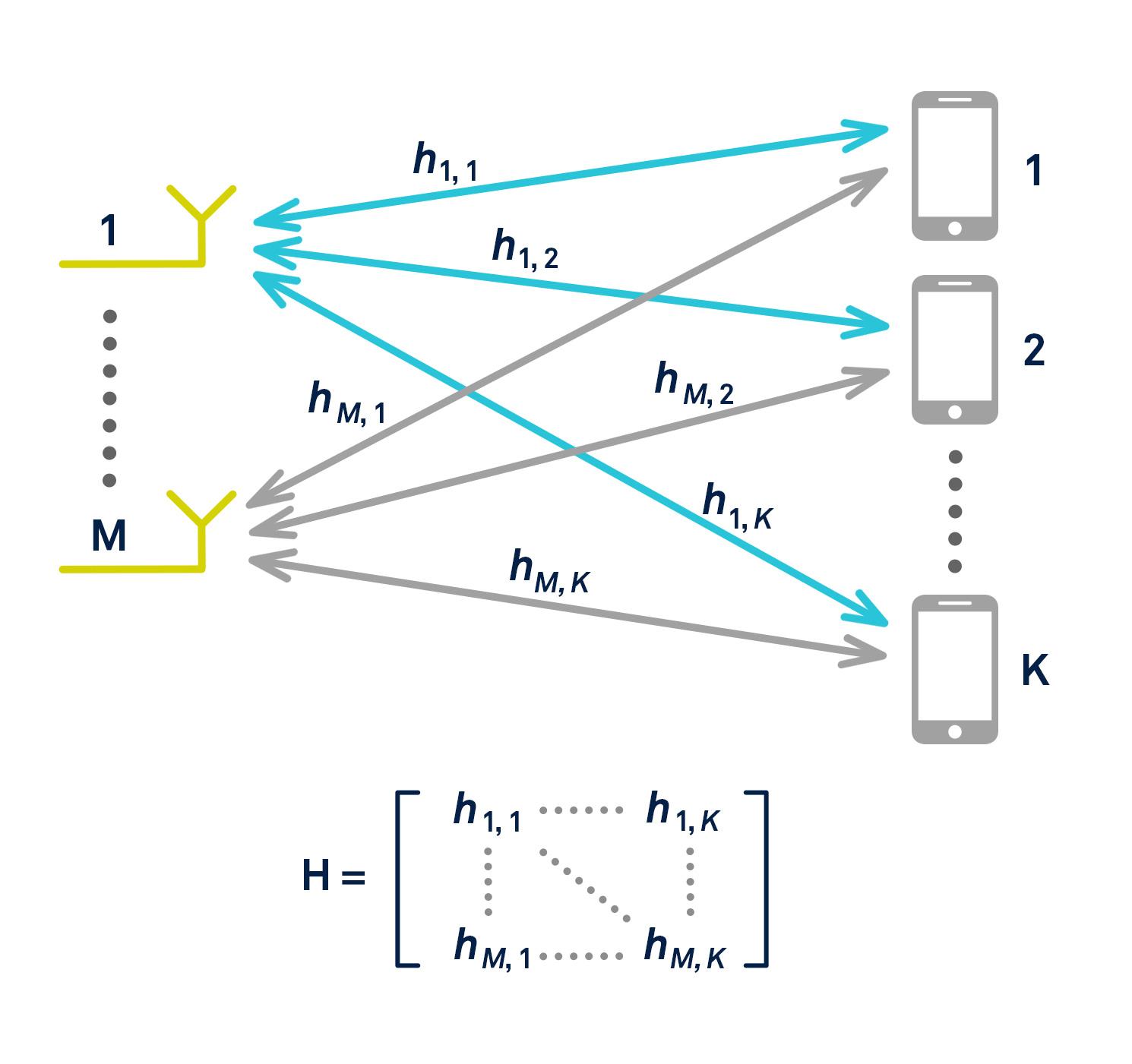
image5

Figure 2: Channel State Information used to Characterise a massive MIMO system

Downlink CSI reporting is used in 5G NR to enable the UE to select the best transmission path from all of the possible options, as represented by the various configuration parameters in the CSI matrix.

To do this in a computationally efficient way, the Link Performance Abstraction process converts the MIMO channel conditions, into a single, scalar metric which can then be used to predict the Block Error Rate, (BLER), of a given channel. 

Effective Exponential SINR metric is a well-known approach for link abstraction which is suitable for linear receivers but has disadvantages when used in more complex array systems. A great deal of research has been conducted into link performance methods and Mutual Information per Bit (MIB) has emerged as a process which enables a higher computational accuracy with reduced overhead.

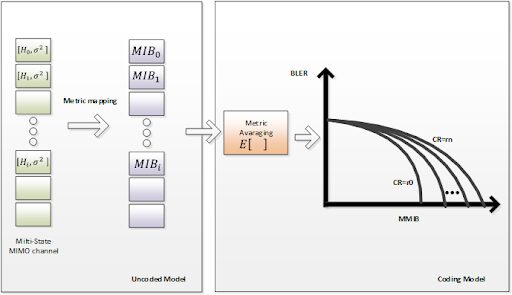
Figure 3 illustrates the 2-stage MIB process; in the first, compression stage, a large number of quality‐related measures is reduced to a single scalar value which is then input to stage 2 where mapping is used estimate the BLER. 
unnamed 3

Figure 3: Link Performance Abstraction Procedure by MIB Metric 

CEVA AI processor for 5G NR CSI reporting 

Neural networks (NNs) are widely used in many engineering disciplines and their success is based on their ability to solve problems for which there is no analytic formula by learning about hidden patterns in data sets. 

NNs are therefore ideally suited for CSI reporting techniques, such as MIB, and a number of NN – based processing platforms, such as CEVA’s PentaG™ IP device, (figure 4), are emerging to address the CSI reporting and other challenges presented by 5G NR.

The modular architecture of the PentaG platform contains specialized scalar and vector DSP processors, co-processors, an AI processor, accelerators, software, and other essential IP blocks. The device has been designed to meet the extreme performance, low latency, and strict power budget requirements of the 3GPP 5G NR UE solution for eMBB devices. 
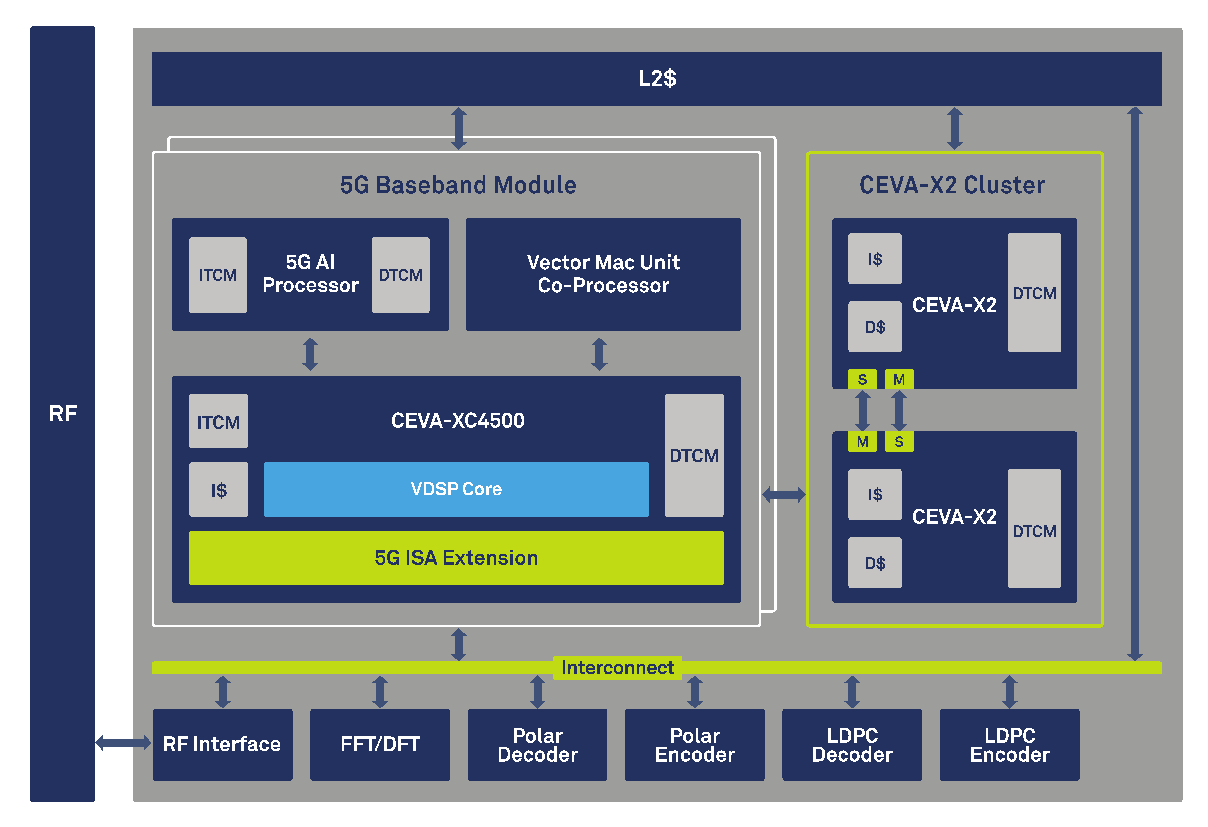
image6

Figure 4: PentaG Hardware Architecture 

The CEVA AI processor at the heart of the PentaG IP platform uses machine-learning methods to support advanced beamforming techniques by performing link adaptation computations using a neural network (NN). 

The CEVA AI processor is adapted for 5G NR CSI reporting and offers the following advantages:

  • Flexibility: During the training stage, the NN learns to predict optimal MIMO configuration parameters for any type of link abstraction metric. 

The NN can be adjusted for any type of receiver, using a dataset for NN training generated by PHY link layer Monte-Carlo simulations. 

  • Scalability: The accuracy of prediction can be traded for the size of an NN, and a more complex NN will provide better performance. 

Depending on the scenario, fully or partially connected NN architectures can be used. The most suitable type of NN is automatically selected at runtime for optimization of power consumption (patent pending). 

A number of standard training toolboxes, such as the MATLAB NN toolbox or Google’s TensorFlow can be used to train the CEVA AI processor. 

Link adaptation in 5G NR involves a number of complex CSI computational processes whilst respecting the dramatically reduced latency performance requirements of the 5G specification. Computational throughput is therefore critical and figures 5 and 6 show a comparison between the average achievable downlink throughput using a CEVA AI processor to calculate the MIB metric, and the achievable throughput using an EESM metric, computed without the use of the CEVA AI processor. (The throughput was measured for medium and high correlation channels)

Conclusion

Massive MIMO and beamforming techniques deployed in 5G NR lead to complex CSI reporting requirements requiring sophisticated computational methods. The learning capabilities of neural networks are well suited to the requirements of CSI reporting and CEVA’s PentaG IP is an example of a technology that has been developed specifically to support 5G UE devices.
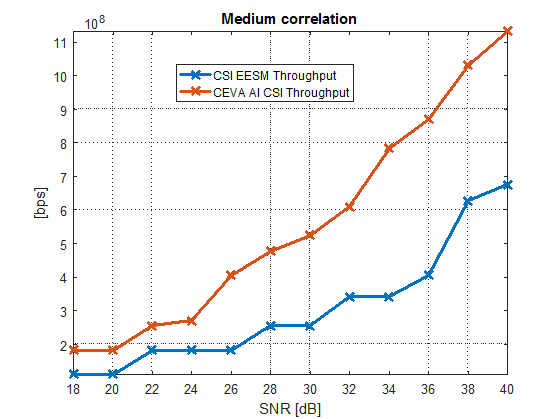
image4

Figure 5: Performance Results (Medium Correlation)
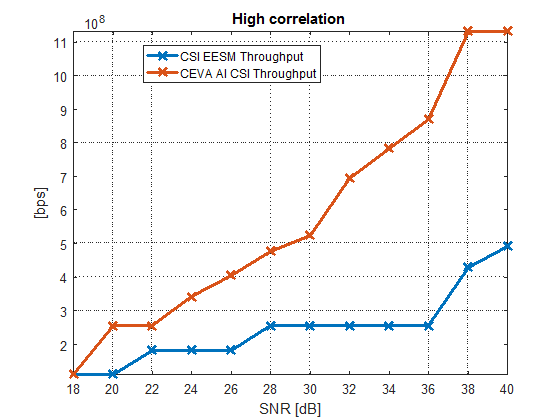
image3

Figure 6: Performance Results (High Correlation)

You Might Also Like
  • The (agentic) future of AI-to-AI connectivity (Reader Forum)
  • Monday (telco diary) | Consolidation, orchestration, automation
  • Netgear’s quiet reinvention as a B2B and SaaS company (Analyst Angle)
  • Friday (telco diary) | Telco reset, RAN reboot, P5G reality check
  • How operations leaders see 5G as vital for mission-critical workflows (Reader Forum)
  • Thursday (telco diary) | The plumbing is the product

Table of Contents

  • Introduction 
  • MU MIMO and beamforming
  • CSI and link performance abstraction
  • CEVA AI processor for 5G NR CSI reporting 
  • Conclusion
Share 0 LinkedinEmail
Reader Forum

Submit Reader Forum articles to [email protected]. Articles submitted to RCR Wireless News become property of RCR Wireless News and will be subject to editorial review and copy edit. Posting of submitted Reader Forum articles shall be at RCR Wireless News sole discretion.

previous post
DoCoMo joins global alliance to promote use of 5G in manufacturing sector
next post
Huawei ships over 200,000 5G base stations globally

White Papers

  • Enea White Paper: Why Intelligent AAA is the Swiss Army Knife of Telecom

  • CSG White Paper: Telco AI Enabler: Mediation’s Defining Role

  • Enea White Paper: Scalable Database Design for 5G and Beyond

  • Supermicro and NVIDIA Whitepaper: Powering sovereign AI at scale

  • VIAVI Whitepaper: RAN scenario generators and their critical role for future-proofing AI-native RAN in Advanced 5G and 6G networks

Editorial Reports

  • Report: Scaling Optical Networks For The Hyperscale And AI Era

  • Test And Measurement Market Pulse Report

  • Editorial Report: Securing telecom infrastructure for the quantum era

Webinars

  • Webinar: Building 6G — aligning technology, policy and purpose

  • SIMCom Webinar: Scaling your next deployment – from plastic to provisioning

  • Webinar: Rethinking the RAN as AI, cloud and openness converge

  • Webinar: Scale-Up, Scale-Out, Scale-Across – Building AI-Era Network Fabrics

  • Webinar: NTN in motion – evolving standards, expanding services

Since 1982, RCR Wireless News has been providing wireless and mobile industry news, insights, and analysis to mobile and wireless industry professionals, decision makers, policy makers, analysts and investors.

Facebook Twitter Youtube Linkedin Envelope Rss

Useful Links

  • Subscribe
  • About RCR Wireless News
  • Contact Us
  • Advertise
  • Editorial Calendar
  • Archive
  • RSS
  • Wireless News Archive
  • Subscribe
  • About RCR Wireless News
  • Contact Us
  • Advertise
  • Editorial Calendar
  • Archive
  • RSS
  • Wireless News Archive

Edtior's Picks

The (agentic) future of AI-to-AI connectivity (Reader Forum)
Monday (telco diary) | Consolidation, orchestration, automation
Korean telcos pivot to AI infra as government pursues AI G3 ambitions

Latest Articles

The (agentic) future of AI-to-AI connectivity (Reader Forum)
Monday (telco diary) | Consolidation, orchestration, automation
Korean telcos pivot to AI infra as government pursues AI G3 ambitions
Wireless Logic’s 21st acquisition exposes IoT consolidation paradox

© 2026 RCR Wireless News All Right Reserved. Developed by Eight Hats.

Cookie Policy | Privacy Policy

RCR Wireless
  • News
  • Channels
    • 5G
    • 6G
    • BSS OSS
    • Carriers
    • IoT
    • Network Infrastructure
    • Open RAN
    • Private 5G
    • Telco AI
    • Telco Cloud
    • Test & Measurement
  • Resources
    • Reports
    • Webinars
    • White papers
    • AI Fundamentals
    • Analyst Angle
    • Editorial Calendar
    • Fundamentals
      • 5G NR Release 17
      • AI
        • Telco AI in 2025
    • Podcasts
      • Let’s Get Digital with Carrie Charles
      • Wireless Connectivity to Enable Industry 4.0 for the Middleprise
      • Well Technically…
      • Will 5G Change the World
      • Accelerating Industry 4.0 Digitalization
  • AI Infrastructure
  • Programs
  • Events
  • RCRtv
  • Advertise
  • Subscribe
RCR Wireless
  • News
  • Channels
    • 5G
    • 6G
    • BSS OSS
    • Carriers
    • IoT
    • Network Infrastructure
    • Open RAN
    • Private 5G
    • Telco AI
    • Telco Cloud
    • Test & Measurement
  • Resources
    • Reports
    • Webinars
    • White papers
    • AI Fundamentals
    • Analyst Angle
    • Editorial Calendar
    • Fundamentals
      • 5G NR Release 17
      • AI
        • Telco AI in 2025
    • Podcasts
      • Let’s Get Digital with Carrie Charles
      • Wireless Connectivity to Enable Industry 4.0 for the Middleprise
      • Well Technically…
      • Will 5G Change the World
      • Accelerating Industry 4.0 Digitalization
  • AI Infrastructure
  • Programs
  • Events
  • RCRtv
  • Advertise
  • Subscribe
@2020 - All Right Reserved. Designed and Developed by PenciDesign
