

RCR Wireless
  • News
  • Channels
    • 5G
    • 6G
    • BSS OSS
    • Carriers
    • IoT
    • Network Infrastructure
    • Open RAN
    • Private 5G
    • Telco AI
    • Telco Cloud
    • Test & Measurement
  • Resources
    • Reports
    • Webinars
    • White papers
    • AI Fundamentals
    • Analyst Angle
    • Editorial Calendar
    • Fundamentals
      • 5G NR Release 17
      • AI
        • Telco AI in 2025
    • Podcasts
      • Let’s Get Digital with Carrie Charles
      • Wireless Connectivity to Enable Industry 4.0 for the Middleprise
      • Well Technically…
      • Will 5G Change the World
      • Accelerating Industry 4.0 Digitalization
  • AI Infrastructure
  • Programs
  • Events
  • RCRtv
  • Advertise
  • Subscribe
Wednesday, July 8, 2026
RCR Wireless
  • News
  • Channels
    • 5G
    • 6G
    • BSS OSS
    • Carriers
    • IoT
    • Network Infrastructure
    • Open RAN
    • Private 5G
    • Telco AI
    • Telco Cloud
    • Test & Measurement
  • Resources
    • Reports
    • Webinars
    • White papers
    • AI Fundamentals
    • Analyst Angle
    • Editorial Calendar
    • Fundamentals
      • 5G NR Release 17
      • AI
        • Telco AI in 2025
    • Podcasts
      • Let’s Get Digital with Carrie Charles
      • Wireless Connectivity to Enable Industry 4.0 for the Middleprise
      • Well Technically…
      • Will 5G Change the World
      • Accelerating Industry 4.0 Digitalization
  • AI Infrastructure
  • Programs
  • Events
  • RCRtv
  • Advertise
  • Subscribe
Add RCR Wireless as a preferred source on Google
  • Qualcomm 6G Insights
  • Huawei Content Hub
  • Qualcomm – 6G Vision
  • OSS/BSS Channel
RCR Wireless
RCR Wireless
  • Advanced Mimo
  • Mobile mmWave
  • 5G Positioning
  • Green Networks
  • Metaverse
  • Automotive
  • Industrial and Wide-area IoT
Copyright 2021 - All Right Reserved
Home - Deciphering the CBRS regulatory process (Analyst Angle)
Analyst AngleNetwork Infrastructure

Deciphering the CBRS regulatory process (Analyst Angle)

by Adlane Fellah July 30, 2019
written by Adlane Fellah July 30, 2019 Share
LinkedinEmail
Share 0LinkedinEmail
CBRS
Image courtesy of CommScope.
141

The idea that an enterprise can get easy access to use CBRS spectrum to deploy their own LTE wireless networks is an exciting one. CBRS is a business and technological puzzle, and many pieces still need to come together for this novel approach to spectrum sharing to work. In this article we focus our attention on the various regulatory processes still ahead before OnGo systems go live as the terms and steps can be confusing. 

SAS administrators

The Spectrum Access System (SAS) solution is essentially a database that allows for dynamic spectrum management of the CBRS frequencies for the incumbent DoD/US Navy radar systems, PAL entities, and GAA users, and to eliminate interference issues between the various users.

There are currently eleven companies which have submitted registrations to the FCC to be SAS administrators, and they are divided into Wave 1 and Wave 2 applicants. These companies are listed in our report “CBRS: The Indoor Market Opportunity and Forecasts 2019-2024 “and designated with “W1” for Wave 1 and “W2” for Wave 2.

On December 21, 2016, the FCC’s Wireless Telecommunications Bureau (WTB) and Office of Engineering and Technology (OET) conditionally approved seven companies which comprise the Wave 1 applicants.

Wave 2 applicants are still awaiting the ability to submit their SAS solutions for lab testing with NTIA and the Department of Defense (DoD). In May of 2019, the NTIA announced that it had completed lab testing for five SAS vendors from Wave 1. With the industry focusing on launching services, we believe that it may not be until the second half of 2020 before Wave 2 applicants are able to enter the lab testing phase.

CBRS is multi-phase process

For a SAS to be certified by the Institute for Telecommunication Sciences (ITS)/NTIA and be fully approved by the FCC, it must undergo several months of capability testing and review and pass major milestones. There are six major milestones for SAS capability/vendor certification by the ITS/NTIA and the FCC:

  1. ITS/NTIA Testing for SAS Vendor
  2. ITS/NTIA Test Report for SAS Vendor
  3. SAS Vendor Review
  4. FCC Test Report and Initial Commercial Deployment (ICD) Public Notice for SAS Vendor
  5. Initial Commercial Deployment (ICD) Field Testing/Review
  6. FCC ICD Report and Commercial Launch Public Notice
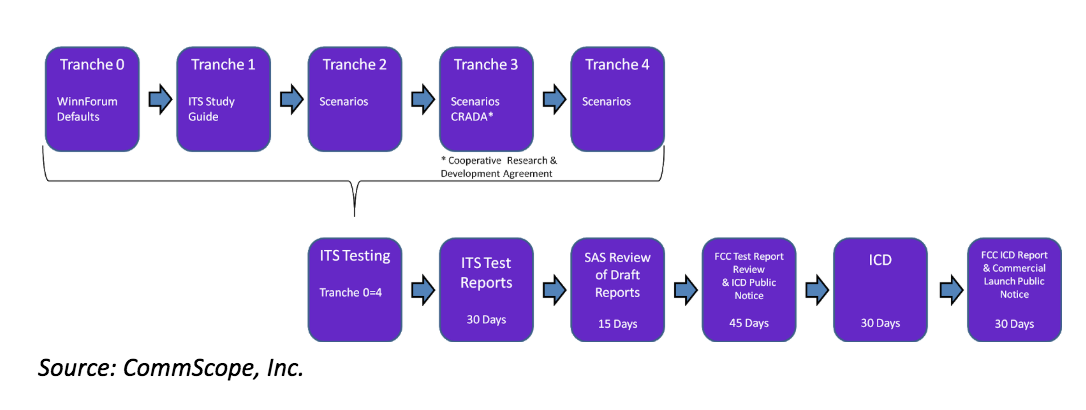
Screen Shot 2019 07 30 at 8.41.16 AM


Upon conclusion of the ICD field trials and receipt of approval from the FCC via the Commercial Launch public notice, the SAS vendor is ready for commercial services. The ITS testing phase consists of five tranches from 0-4. Tranche 4 is currently optional, and the ITS/NTIA has not required any SAS vendors to undergo this phase if they have passed Tranche 3.

ICD testing

Upon the FCC reviewing the ITS/NTIA report and issuing an ICD public notice, the SAS vendor/administrator is able to enter the ICD field trials stage of certification. The purpose of the ICD is to complement controlled lab testing by providing a real-world environment to assess the aspects of an SAS that can’t be effectively verified in lab testing. The FCC wants to run each SAS through a comprehensive set of tests with actual CBRS devices (CBSDs) deployed in commercial settings. The time period for ICD is thirty days. At the end of the thirty-day period, the SAS vendor/administrator will submit a report to the FCC noting all of the test results and any variances for review and approval.

ICD tests include:

  • Verifying that CBSDs can communicate with and register on the SAS
  • Verifying CBSDs can seek and receive spectrum grants and suspend operations
  • Verifying ESC-SAS-CBSD capability along coastal deployments

Due to the fact that Federated Wireless, Inc. is the only ESC network operator to have already deployed its entire ESC network within the continental U.S. coastline, it will be the only SAS vendor/administrator to also include this critical test within the ICD phase. However, at the time this article is published, the FCC announced that it has approved three ESC operators: CommScope, Google and Federated Wireless. Now it’s just a matter of getting the “SASes” approved as well.

In a recent blog entitled Final CBRS SAS test reports are complete, RCR Wireless News indicated that Final CBRS SAS test reports are complete and that the CBRS Alliance had been alerted by its SAS administrator members that they had received their official result reports from ITS, and that it expects all of them to submit those reports to the FCC within the next few days. More details are available in our recent report CBRS: The Indoor Market Opportunity and Forecasts 2019-2024.


You Might Also Like
  • Why consolidation will reshape MDU connectivity (part 3/3) – Analyst Angle
  • Wednesday | Telco agents and smash hits (Editorial Diary)
  • Tuesday | Vertical build-outs, horizontal break-ups (Editorial Diary)
  • Why consolidation will reshape MDU connectivity (part 2/3) – Analyst Angle
  • BT and Verizon merge international arms in $4bn global enterprise JV
  • Friday | Starlink raises the stakes (Editorial Diary)

Table of Contents

  • SAS administrators
  • CBRS is multi-phase process
  • ICD testing
Share 0 LinkedinEmail
Avatar of Adlane Fellah
Adlane Fellah

Mr. Fellah is a veteran industry analyst and investor with 25 years experience in the telecom sector. He authored various landmark reports on Wi-Fi, 5G and technology trends in various industries including residential, enterprise and industry 4.0. He is regularly asked to speak at leading wireless and to contribute to various influential portals and magazines such as Fierce, RCR Wireless, Rethink Wireless, The Mobile Network, IoT for All to name a few. He is a Certified Wireless Network Administrator (CWNA) and Certified Wireless Technology Specialist (CWTS). He also regularly serves as judge for the Glomo Awards (GSMA), Fierce, Glotel, WBA Awards and WiFi Now Awards.

previous post
Anglo American approves $226m deal for ‘most advanced’ smart mine in Australia
next post
Connectivity Wireless Solutions deploys in-building wireless system in Cincinnati

White Papers

  • Enea White Paper: Why Intelligent AAA is the Swiss Army Knife of Telecom

  • CSG White Paper: Telco AI Enabler: Mediation’s Defining Role

  • Enea White Paper: Scalable Database Design for 5G and Beyond

  • Supermicro and NVIDIA Whitepaper: Powering sovereign AI at scale

  • VIAVI Whitepaper: RAN scenario generators and their critical role for future-proofing AI-native RAN in Advanced 5G and 6G networks

Editorial Reports

  • Report: Scaling Optical Networks For The Hyperscale And AI Era

  • Test And Measurement Market Pulse Report

  • Editorial Report: Securing telecom infrastructure for the quantum era

Webinars

  • Webinar: Rethinking the RAN as AI, cloud and openness converge

  • Webinar: Scale-Up, Scale-Out, Scale-Across – Building AI-Era Network Fabrics

  • Webinar: NTN in motion – evolving standards, expanding services

  • Webinar: Noise-Figure Measurements with RFmx and PXI VSTs

  • Qualcomm Webinar – Building the 6G Standard: Key developments to know

Since 1982, RCR Wireless News has been providing wireless and mobile industry news, insights, and analysis to mobile and wireless industry professionals, decision makers, policy makers, analysts and investors.

Facebook Twitter Youtube Linkedin Envelope Rss

Useful Links

  • Subscribe
  • About RCR Wireless News
  • Contact Us
  • Advertise
  • Editorial Calendar
  • Archive
  • RSS
  • Wireless News Archive
  • Subscribe
  • About RCR Wireless News
  • Contact Us
  • Advertise
  • Editorial Calendar
  • Archive
  • RSS
  • Wireless News Archive

Edtior's Picks

How the FCC can protect IoT innovation and GPS resilience in the 900...
What defines network performance in 5G and beyond? A CTO Perspective
Elisa says AI automation has cut network incidents by over 80%

Latest Articles

How the FCC can protect IoT innovation and GPS resilience in the 900 MHz band (Reader Forum)
What defines network performance in 5G and beyond? A CTO Perspective
Elisa says AI automation has cut network incidents by over 80%
“We’re going after the operator channel” – Druid bets on simplicity to scale private 5G

© 2026 RCR Wireless News All Right Reserved. Developed by Eight Hats.

Cookie Policy | Privacy Policy

RCR Wireless
  • News
  • Channels
    • 5G
    • 6G
    • BSS OSS
    • Carriers
    • IoT
    • Network Infrastructure
    • Open RAN
    • Private 5G
    • Telco AI
    • Telco Cloud
    • Test & Measurement
  • Resources
    • Reports
    • Webinars
    • White papers
    • AI Fundamentals
    • Analyst Angle
    • Editorial Calendar
    • Fundamentals
      • 5G NR Release 17
      • AI
        • Telco AI in 2025
    • Podcasts
      • Let’s Get Digital with Carrie Charles
      • Wireless Connectivity to Enable Industry 4.0 for the Middleprise
      • Well Technically…
      • Will 5G Change the World
      • Accelerating Industry 4.0 Digitalization
  • AI Infrastructure
  • Programs
  • Events
  • RCRtv
  • Advertise
  • Subscribe
RCR Wireless
  • News
  • Channels
    • 5G
    • 6G
    • BSS OSS
    • Carriers
    • IoT
    • Network Infrastructure
    • Open RAN
    • Private 5G
    • Telco AI
    • Telco Cloud
    • Test & Measurement
  • Resources
    • Reports
    • Webinars
    • White papers
    • AI Fundamentals
    • Analyst Angle
    • Editorial Calendar
    • Fundamentals
      • 5G NR Release 17
      • AI
        • Telco AI in 2025
    • Podcasts
      • Let’s Get Digital with Carrie Charles
      • Wireless Connectivity to Enable Industry 4.0 for the Middleprise
      • Well Technically…
      • Will 5G Change the World
      • Accelerating Industry 4.0 Digitalization
  • AI Infrastructure
  • Programs
  • Events
  • RCRtv
  • Advertise
  • Subscribe
@2020 - All Right Reserved. Designed and Developed by PenciDesign
