RCR Wireless
  • News
  • Channels
    • 5G
    • 6G
    • BSS OSS
    • Carriers
    • IoT
    • Network Infrastructure
    • Open RAN
    • Private 5G
    • Telco AI
    • Telco Cloud
    • Test & Measurement
  • Resources
    • Reports
    • Webinars
    • White papers
    • AI Fundamentals
    • Analyst Angle
    • Editorial Calendar
    • Fundamentals
      • 5G NR Release 17
      • AI
        • Telco AI in 2025
    • Podcasts
      • Let’s Get Digital with Carrie Charles
      • Wireless Connectivity to Enable Industry 4.0 for the Middleprise
      • Well Technically…
      • Will 5G Change the World
      • Accelerating Industry 4.0 Digitalization
  • AI Infrastructure
  • Programs
  • Events
  • RCRtv
  • Advertise
  • Subscribe
Monday, July 13, 2026
RCR Wireless
  • News
  • Channels
    • 5G
    • 6G
    • BSS OSS
    • Carriers
    • IoT
    • Network Infrastructure
    • Open RAN
    • Private 5G
    • Telco AI
    • Telco Cloud
    • Test & Measurement
  • Resources
    • Reports
    • Webinars
    • White papers
    • AI Fundamentals
    • Analyst Angle
    • Editorial Calendar
    • Fundamentals
      • 5G NR Release 17
      • AI
        • Telco AI in 2025
    • Podcasts
      • Let’s Get Digital with Carrie Charles
      • Wireless Connectivity to Enable Industry 4.0 for the Middleprise
      • Well Technically…
      • Will 5G Change the World
      • Accelerating Industry 4.0 Digitalization
  • AI Infrastructure
  • Programs
  • Events
  • RCRtv
  • Advertise
  • Subscribe
Add RCR Wireless as a preferred source on Google
  • Qualcomm 6G Insights
  • Huawei Content Hub
  • Qualcomm – 6G Vision
  • OSS/BSS Channel
  • RCRTech Roundtable: AI Infrastructure
RCR Wireless
RCR Wireless
  • Advanced Mimo
  • Mobile mmWave
  • 5G Positioning
  • Green Networks
  • Metaverse
  • Automotive
  • Industrial and Wide-area IoT
Copyright 2021 - All Right Reserved
Home - New considerations for deploying fronthaul to Small Cells (Reader Forum)
OpinionReader Forum

New considerations for deploying fronthaul to Small Cells (Reader Forum)

by Reader Forum November 27, 2018
written by Reader Forum November 27, 2018 Share
LinkedinEmail
Share 0LinkedinEmail
Fronthaul
101

As revenue per bit falls and demand rises, mobile network operators (MNOs) are looking for ways to increase network capacity and reduce cost.  Trends for accomplishing this include densification, e.g., small cells, cloudification for resource “elasticity”, and centralization of the RAN, i.e., C-RAN.  A distinguishing feature of C-RAN is fronthaul. This article will explain why MNOs want to deploy fronthaul and how millimeter wave using electronic beam steering technology can serve and accelerate fronthaul deployment to small cells today.

Fronthaul benefits

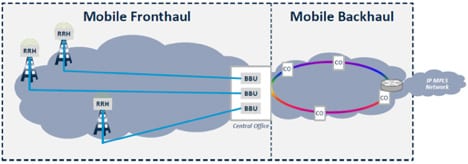
Figure 1 defines fronthaul as the connection between the two main parts of the cellular base station, the baseband unit (BBU) and the radio unit (RRH).  Fronthaul enables C-RAN by transporting the unprocessed RF signal from the antennas to the remote BBUs. While fronthaul requires a higher bandwidth, lower latency and more accurate synchronization than backhaul, it enables a more efficient use of RAN resources, plus interference and mobility management tools.
fronthaul

Figure 1.

Subscribers will notice better performance with C-RAN because they can acquire coverage and capacity from multiple cell sites, not just one as typified by traditional distributed RAN (D-RAN) networks.  This comes in handy when, for example, a cell site serving a shopping mall has little capacity left over for those in the parking lot.

It’s worth noting that C-RAN offers lower OPEX than D-RAN in which the RRHs are co-located with BBUs at the cell-site. That’s because cell sites represent 72% of an MNO’s total power consumption.  Power and site rent dominate the cost of a D-RAN cell site, so it makes sense to centralize BBUs to economize on space and power.

Fronthaul, CPRI and Small Cells

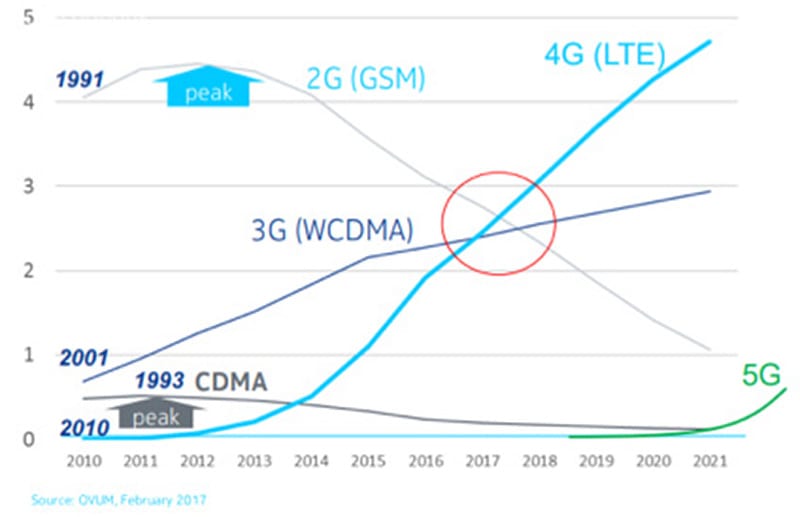
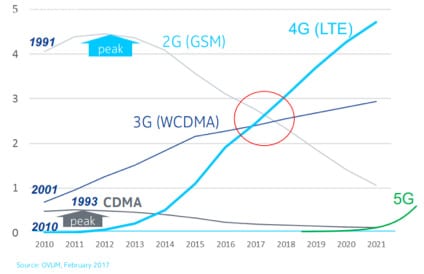
Leading MNOs in Europe and the US have applied fronthaul to 4G macro cell sites but have mostly hesitated with small cells. That’s because the fronthaul connection between the cell sites and central office —the RRHs to the BBUs — requires mostly fiber to handle the Common Public Radio Interface (CPRI). CPRI was originally developed in 2003 for handling BBU-to-RRH traffic in D-RAN cell sites; that is, between the bottom and top of the mast. Only 6 percent of CPRI traffic goes to end-users. The rest is overhead.  ven when a more efficient transport protocol comes along, like eCPRI, CPRI will dominate 4G and, to a lesser extent, 5G, fronthaul networks for years. Indeed, 4G subscriber growth is expected to outpace 5G growth for at least the next ten years, according to OVUM (Figure 2).  The Small Cell Forum forecasts that year-over-year 4G small cell installations will not decline until 2024 and will outpace 5G installations through 2025.
Fronthaul fig 2

Fig. 2

Millimeter Wave to the rescue

Millimeter wave frequencies, which include the 24, 26, 28 and 39 GHz varieties to be auctioned soon in the US and Europe, can handle CPRI fronthaul traffic without introducing unacceptable latency that results from high compression required by lower frequency solutions. Millimeter wave gives MNOs a way to minimize the use of fiber in deploying CPRI fronthaul to 4G small cells. They can accomplish this by feeding a donor small cell with fiber and using licensed millimeter wave frequencies to wirelessly bridge fronthaul connectivity to another small cell, which bridges to another, and so on, as long as each site is not more than a few hundred yards away from, and in sight of, the other. Not every small cell will require fiber, and all can be upgraded to 5G and a more efficient transport protocol as demand requires.

 Small Cell antennas matter

The need for point-to-point fiber between RRHs and BBUs makes fronthaul not only expensive but also logistically difficult because of zoning issues or fragmented ownership of street furniture like utility poles.  There will be places where it’s simply too difficult to get permission from the municipality to install small cells on street furniture much less the fiber to serve them.

Figure 3 reminds the reader that municipalities care about small cell aesthetics. The aesthetic appeal of thousands of existing D-RAN small cells has not been helped by them being more visible, numerous, and laden with co-located RRHs and BBUs.

Fronthaul Fig. 3

Fig. 3

Fronthaul fig 3a


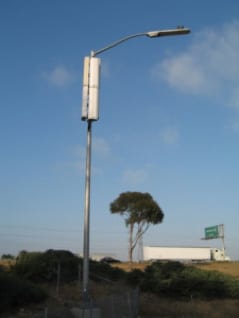
MNOs should endeavor to deploy small cell equipment with the best ability to go unnoticed. It should offer the lowest size, lowest weight (SWaP), and the ability to conform to curved surfaces if necessary. These characteristics would be most impactful in the antenna, which is typically the largest and therefore most visible element of a small cell (Figure 4).
Fronthaul Fig 4

Fig. 4

Electronic beam steering antennas offer the additional benefit of minimizing operations and maintenance (O&M), which is the largest operational expense of a small cell after site rent. This is true because beamsteering antennas simplify installation, configuration and monitoring — no small consideration with tens of thousands of small cells.


About the author

Kent Lundgren v. 2Kent Lundgren is vice president of marketing for Pivotal Commware and has more than 25 years of wireless industry experience working with IBM, Motorola, AT&T, Wavtrace, Harris and Microsoft. Pivotal Commware is the creator of Holographic Beam Forming, a technology that expands the capacity and spectral efficiency of 4G and 5G networks to address the rapid growth in wireless data consumption. Kent joined Pivotal from Intellectual Ventures, where he conducted market research and strategy.

You Might Also Like
  • Netgear’s quiet reinvention as a B2B and SaaS company (Analyst Angle)
  • Friday (telco diary) | Telco reset, RAN reboot, P5G reality check
  • How operations leaders see 5G as vital for mission-critical workflows (Reader Forum)
  • Thursday (telco diary) | The plumbing is the product
  • How the FCC can protect IoT innovation and GPS resilience in the 900 MHz band (Reader Forum)
  • Thursday (telco diary) | The telco AI imperative

Table of Contents

  • Fronthaul benefits
  • Fronthaul, CPRI and Small Cells
  • Millimeter Wave to the rescue
  •  Small Cell antennas matter
Share 0 LinkedinEmail
Avatar of Reader Forum
Reader Forum

Submit Reader Forum articles to [email protected]. Articles submitted to RCR Wireless News become property of RCR Wireless News and will be subject to editorial review and copy edit. Posting of submitted Reader Forum articles shall be at RCR Wireless News sole discretion.

previous post
Cisco VNI: IoT moves from connections to value
next post
How intent-based networking provides business value (Reality Check)

White Papers

  • Enea White Paper: Why Intelligent AAA is the Swiss Army Knife of Telecom

  • CSG White Paper: Telco AI Enabler: Mediation’s Defining Role

  • Enea White Paper: Scalable Database Design for 5G and Beyond

  • Supermicro and NVIDIA Whitepaper: Powering sovereign AI at scale

  • VIAVI Whitepaper: RAN scenario generators and their critical role for future-proofing AI-native RAN in Advanced 5G and 6G networks

Editorial Reports

  • Report: Scaling Optical Networks For The Hyperscale And AI Era

  • Test And Measurement Market Pulse Report

  • Editorial Report: Securing telecom infrastructure for the quantum era

Webinars

  • Webinar: Building 6G — aligning technology, policy and purpose

  • SIMCom Webinar: Scaling your next deployment – from plastic to provisioning

  • Webinar: Rethinking the RAN as AI, cloud and openness converge

  • Webinar: Scale-Up, Scale-Out, Scale-Across – Building AI-Era Network Fabrics

  • Webinar: NTN in motion – evolving standards, expanding services

Since 1982, RCR Wireless News has been providing wireless and mobile industry news, insights, and analysis to mobile and wireless industry professionals, decision makers, policy makers, analysts and investors.

Facebook Twitter Youtube Linkedin Envelope Rss

Useful Links

  • Subscribe
  • About RCR Wireless News
  • Contact Us
  • Advertise
  • Editorial Calendar
  • Archive
  • RSS
  • Wireless News Archive
  • Subscribe
  • About RCR Wireless News
  • Contact Us
  • Advertise
  • Editorial Calendar
  • Archive
  • RSS
  • Wireless News Archive

Edtior's Picks

Korean telcos pivot to AI infra as government pursues AI G3 ambitions
Wireless Logic’s 21st acquisition exposes IoT consolidation paradox
Netgear’s quiet reinvention as a B2B and SaaS company (Analyst Angle)

Latest Articles

Korean telcos pivot to AI infra as government pursues AI G3 ambitions
Wireless Logic’s 21st acquisition exposes IoT consolidation paradox
Netgear’s quiet reinvention as a B2B and SaaS company (Analyst Angle)
Friday (telco diary) | Telco reset, RAN reboot, P5G reality check

© 2026 RCR Wireless News All Right Reserved. Developed by Eight Hats.

Cookie Policy | Privacy Policy

RCR Wireless
  • News
  • Channels
    • 5G
    • 6G
    • BSS OSS
    • Carriers
    • IoT
    • Network Infrastructure
    • Open RAN
    • Private 5G
    • Telco AI
    • Telco Cloud
    • Test & Measurement
  • Resources
    • Reports
    • Webinars
    • White papers
    • AI Fundamentals
    • Analyst Angle
    • Editorial Calendar
    • Fundamentals
      • 5G NR Release 17
      • AI
        • Telco AI in 2025
    • Podcasts
      • Let’s Get Digital with Carrie Charles
      • Wireless Connectivity to Enable Industry 4.0 for the Middleprise
      • Well Technically…
      • Will 5G Change the World
      • Accelerating Industry 4.0 Digitalization
  • AI Infrastructure
  • Programs
  • Events
  • RCRtv
  • Advertise
  • Subscribe
RCR Wireless
  • News
  • Channels
    • 5G
    • 6G
    • BSS OSS
    • Carriers
    • IoT
    • Network Infrastructure
    • Open RAN
    • Private 5G
    • Telco AI
    • Telco Cloud
    • Test & Measurement
  • Resources
    • Reports
    • Webinars
    • White papers
    • AI Fundamentals
    • Analyst Angle
    • Editorial Calendar
    • Fundamentals
      • 5G NR Release 17
      • AI
        • Telco AI in 2025
    • Podcasts
      • Let’s Get Digital with Carrie Charles
      • Wireless Connectivity to Enable Industry 4.0 for the Middleprise
      • Well Technically…
      • Will 5G Change the World
      • Accelerating Industry 4.0 Digitalization
  • AI Infrastructure
  • Programs
  • Events
  • RCRtv
  • Advertise
  • Subscribe
@2020 - All Right Reserved. Designed and Developed by PenciDesign