

SpaceX’s IPO filing reads like a techno-futurist manifesto – but then that’s its business: a vertically integrated empire of rockets, satellites, and AI infrastructure to scale intelligence globally – and make humans a multi-planetary species. The numbers are enormous, the losses are real, and Starlink is carrying the whole operation.
In sum – what to know:
Economic engine – Starlink satellite business generated more than 60 percent of SpaceX’s 2025 revenue, serving 10.3 million subscribers across 164 markets, effectively bankrolling the company’s wider ambitions…
Growth gamble – but it’s not enough to stymie the losses, or fund its grand xAI space ambition – which is the focus of 76% of SpaceX cap-ex, but a $26.5 trillion opportunity spanning infrastructure, software, services.
Corporate sci-fi – Alongside 40 pages of risk disclosures, the document frames SpaceX’s mission in existential terms: extending “the light of consciousness to the stars”, protecting humanity from catastrophe etc.
RCR was going to write up BT’s results in the UK, but then this dropped: “We believe we have identified the largest actionable total addressable market (TAM) in human history,” writes Elon Musk’s SpaceX. Maybe this is the biggest statement in the whole document; SpaceX goes on to caution that its mad-sized projections only attempt to describe what’s “quantifiable” – some kind of false modesty there, maybe, that even the biggest of big thinkers might not be thinking big enough.
That’s right: SpaceX’s filing with the FCC about a proposed IPO is available, and it is a big read. It goes on: “Our quantifiable TAM is $28.5 trillion, consisting of: $370 billion from space-enabled solutions; $1.6 trillion across $870 billion in Starlink Broadband and $740 billion in Starlink Mobile; $26.5 trillion across $2.4 trillion in AI infrastructure, $760 billion in consumer subscriptions, $600 billion in digital advertising, and $22.7 trillion in enterprise applications.”
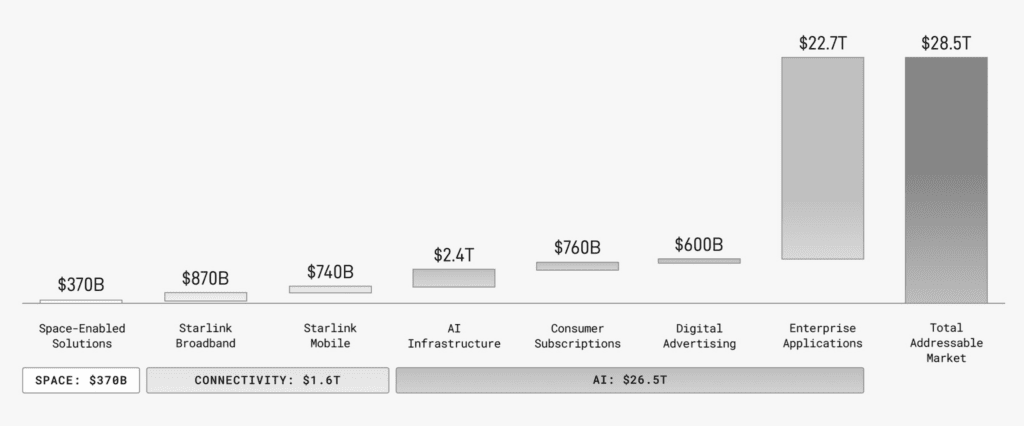
It adds: “For illustrative purposes of sizing our addressable market opportunity, we exclude China and Russia from our global estimates.” So there you have it – a hyper-scale business, already, that wants to scale human ambition in totally new ways. Everyone knows this about Musk, of course; but here it is, in print, in a 300-page document that is part sci-fi fantasy and part corporate manifesto, presented with pages of pictures like a coffee-table brochure.
SpaceX wants to ride its rockets into outer-space, and hyper-scale hyperscale. Its mission statement is to “build the systems and technologies necessary to make life multiplanetary, to understand the true nature of the universe, and to extend the light of consciousness to the stars”, it says. It is the kind of thing George Lucas would have written as escapism for teenage geeks. Except some of it will come to pass, and turn its author into a trillionaire.
Orbital space savers
There is too much to go through; RCR will have another crack, maybe. But for now, the rumours are true: SpaceX brings in a lot of money, but still makes a loss; and its Starlink satellites, carried physically into low-Earth orbit (LEO) on SpaceX rockets, carry the whole SpaceX business. SpaceX earned $18.674 billion in revenue in 2025, but lost $2.589 billion after paying asset-related operational costs, and other things; its adjusted EBITDA was $6.584 billion.
This EBITDA number ignores some of the same items (interest, taxes, depreciation, sundry one-offs), but not the big asset burn that goes with space ships and jet fuel. Last quarter, it made $4.694 billion, and lost $1.943 billion. Most of the money comes from its Starlink connectivity business, as written, and not its space operation. Starlink generated revenue of $11.387 billion in 2025 – about 61 percent of its takings across the three core SpaceX units.
Starlink earned income of $4.423 billion from operations, and adjusted EBITDA of $7.168 billion in 2025. But even Starlink’s returns – up 49.8 percent, 120.4 percent, and 86.2 percent in the year on the three counts, respectively – are not enough to push its parent business into the black. Last quarter, Starlink made $3.257 billion, $1.188 million, $2.087 million on the same scores. It cited subscriber growth, notably with enterprises, and better network efficiency.
Starlink has 9,600 broadband and mobile LEO satellites, providing fixed internet connectivity (at 225 Mbps on average in peak hours) to 10.3 million subscribers in 164 “countries, territories, and other markets”, apparently. The 9,600-count represents about 75 percent of all “active maneuverable satellites” in orbit, it writes. New SpaceX V3 satellites will be deployed post-summer, pegged to deliver 1 Tbps of downlink capacity per satellite.
The firm’s new Starship launch shuttle can deploy 60 V3 satellites per trip, it said – which is a “twenty-fold” jump, it said, versus Falcon 9 launch capacities, and a key plank in its IPO growth strategy. Starlink Mobile, launched in 2024, offering satellite-to-mobile (D2D) services, using different satellites, serves 7.4 million (monthly unique) devices in 30 countries, connected via 650 V1 Mobile satellites – and via 30-odd mobile operators “on six continents”.
Cap-ex moneypit
The original SpaceX space-business, with all its asset blowout, posted revenue of $4.086 billion, operational losses of $657 million, and adjusted EBITDA of $653 million in 2025. It posted $619 million, negative $662 million, and negative $351 last quarter. It was impacted by $930 million and $3 billion in R&D costs in the periods respectively, for the Starship vehicle, which will also deliver “step-function” changes in rocket reusability and launch cadence.
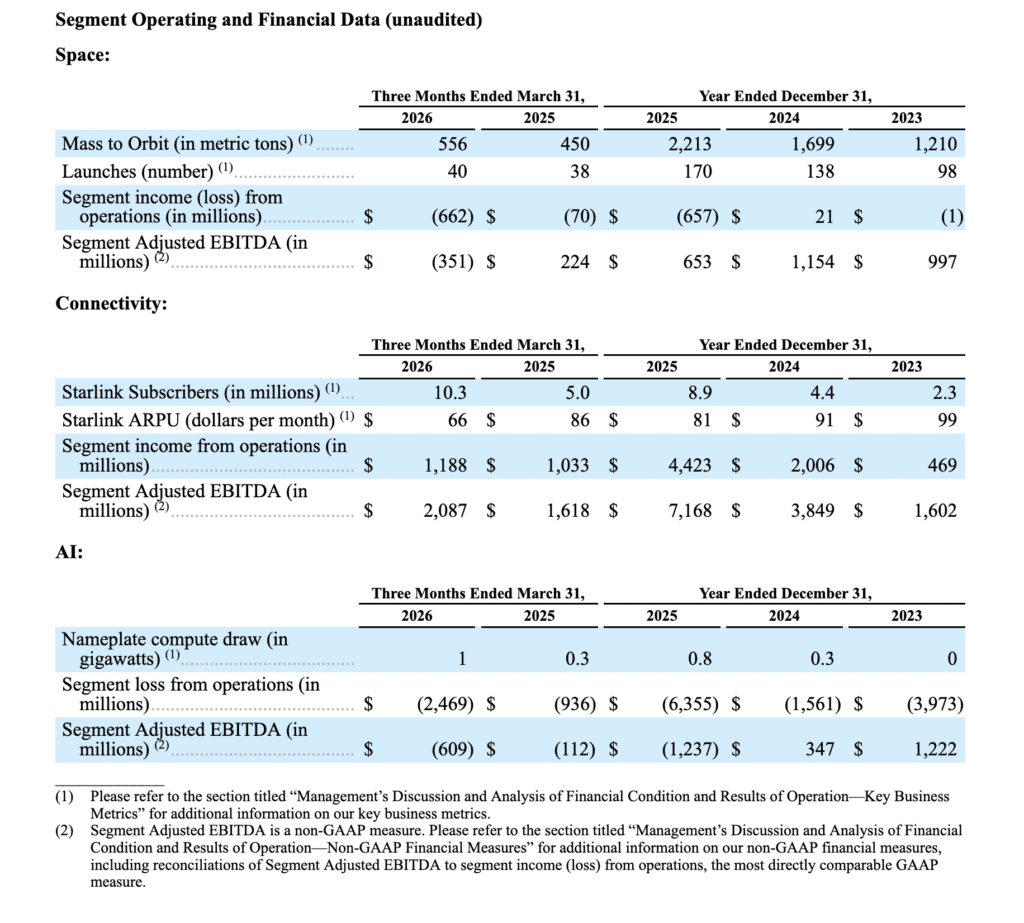
Its AI business generated revenue of $3.201 billion, loss from operations of $6.355 billion, and adjusted EBITDA-loss of $1.237 billion in 2024, and $818 million, negative $2.469 billion, negative $609 million in the quarter just ended (March 31). This reflected its “earlier stage of development and continued investments to support long-term growth opportunities in AI”, it said. Its cap-ex skews heavily towards AI; its TAM figures at the top explain why.
AI represented 61 percent ($12.727 billion) of its total cap-ex spend ($20.737 billion) across the three businesses in 2025, rising to 76 percent ($7.723 billion) of its first-quarter cap-ex total in 2026 ($10.107 billion). Connectivity commanded 20 percent of its total cap-ex last year ($4.178 billion) and 13 percent last quarter ($1.332 billion); its space business took 18.5 percent ($3.832 billion) and 10 percent ($1.052 billion). Which is the story – AI at scale.
The business logic is plain: a “vertically-integrated innovation engine” in the form of a fleet of SpaceX rockets, a Starlink satellite constellation, and an xAI supercomputer to shuttle compute power to and from the Earth, and host it where energy is cheap and abundant, data can be processed at planetary scale, and intelligence rains down globally. Plus, yeah, if the Earth’s days are numbered, then the rich can settle Mars – so humans don’t go the way of the dinosaurs.
Saviour of humanity
This “matters now”, states the pitch document. “The current paradigm, in which human civilization is confined to one planet, exposes humanity to existential threats that are unpredictable and uncontrollable on a planetary scale. By moving beyond the only home we have ever known, we ensure species-level redundancy and that the light of consciousness will not be tied to a single planet subject to the inevitable hazards of a harsh and vast universe.
“We do not want humans to have the same fate as dinosaurs. We want to give them a reason to look ahead with excitement, with the prospect that we are entering an age of abundance with an endlessly prosperous and exciting future.” There is a lot of this in there, plus lots else, including a two-page (out of 380) “summary of risk factors”, and a further 41 pages to cover them in detail (pp. 24-63, before all the financial and legal stuff, plus the indexes).
It will be interesting to go through those – another time.

