


T-Mobile US signed off another good quarter with some fighting talk about acquisition strategies and accounting habits at rivals AT&T and Verizon, and said its 5G network and compute build-out will be the best in the business to support enterprise inference workloads for physical AI.
In sum – what to know:
Strategy and competition – T-Mobile posted good quarterly scores on most metrics, and said its value proposition is resonating with customers to the extent it is taking share without buying the market.
Enterprises and satellites – Management cited weaker Q1 trends at rivals, and rising share in B2B, where it is rolling out 5G slicing, private networks, satellite broadband; no SpaceX-MVNO, it repeated.
AI inference and the edge – It repeated its best network/value/satisfaction shtick, and said its 5G and “fallow compute” build-out puts it ahead of the game to support inference workloads for physical AI.
Here’s another straight report about a brighter quarter for US telecoms, as T-Mobile followed AT&T and Verizon to post even stronger late-winter growth, in the period to March 31 – good scores across the board, as detailed below. And T-Mobile’s first quarter – like its last, and counting – was more impressive, in a way, because it has none of the hot-wired criss-cross fiber-interconnect (DCI) assets of its rivals – with which to network the feverish early-stage AI economy. But buried deep in an entertaining earnings call, there was plenty more to pick over.
There was some good fighting talk about acquisition costs and accounting practices, aimed at AT&T and Verizon. There was a smart dismissal (of sorts) of the excitable direct-to-cellular (D2C) satellite market – or the idea, at least, that it poses an existential threat to terrestrial operators, and especially to agitator brands like T-Mobile, which has already moved onto the next big thing. A SpaceX MVNO? Don’t make me laugh – was the gist; like space is a busy place, suddenly, and D2C will be a commodity prop, to be buried and bundled into 5G-anchored service contracts.
Because the best networks deliver the best services, and matter more than mobile devices now – per its value proposition (and rather dim view of its rivals). But the best stuff was at the end of the call, deep in industry time, when Morgan Stanley asked an RCR-style trade question about how T-Mobile will optimize its infrastructure at the metro edge and the enterprise edge for the new inference chapter in this AI saga. Its answer is repeated, uncut, at the bottom, but it is worth raising to the top of the piece; it is from John Saw, president of technology at T-Mobile.
“We are more than prepared… We are the only ones to have rolled out 5G Advanced… We have a bunch of innovations… to increase spectral efficiency and capacity, especially for the uplink… This is why the latest Apple and Samsung phones perform best on our network. But we didn’t build 5G Advanced just for faster phones. We built it for physical AI… And now that we have [the] network, we can take on the extra capabilities… to support edge inferencing for physical AI better than anybody else… We have a multi-year advantage over the competition for this.”
Anyway, all of this is included below the straighter financial round-up – which we have italicized in case you want to skip to the main talking points.
Financial review
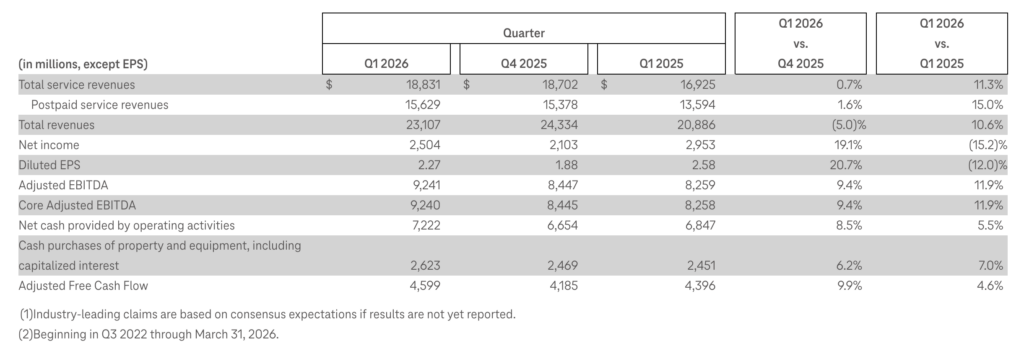
T-Mobile US saw total service revenue rise 11 percent year-on-year to $18.8 billion in the first quarter of 2026, with postpaid (contract) service revenue showing even stronger growth – increasing by 15 percent to $15.6 billion in the period. Performance was driven primarily by sustained demand for higher-value plans and continued growth in multi-line household accounts, it said – which remain central to the firm’s strategy of increasing revenue per customer rather than relying solely on single-line additions.
On the customer side, the company added 217,000 postpaid net accounts during the quarter. The figure was ahead of expectations and continued a consistent trend of account-level growth that T-Mobile has been emphasizing over raw line metrics for a couple of years. As such, average revenue per account (ARPA) increased 3.9 percent on the quarter last year to $151.93 – based on upselling and account bundling. Profitability was mixed but broadly solid beneath the surface. Net income declined 15 percent to $2.5 billion, and diluted earnings per share fell 12 percent to $2.27.
These declines were primarily influenced by integration-related and non-operating factors rather than deterioration in underlying business performance. Adjusted EBITDA increased 12 percent to $9.2 billion, underscoring continued operating leverage as revenue growth flowed through to earnings. Cash generation remained strong as well, with adjusted free cash flow rising five percent to $4.6 billion and operating cash flow also increasing by the same margin to $7.2 billion. T-Mobile duly raised its full-year 2026 guidance – to take between 950,000 and 1.05 million postpaid net additions in 2026, adjusted EBITDA of $37.1-$37.5 billion, and adjusted free cash flow of $18.1-$18.7 billion.
Acquisition costs
On the earnings call, a response from Peter Osvaldik, the firm’s chief financial officer, to a fairly technical question about equipment margins turned into a sharper debate about the underlying economics of customer acquisition, and justification for how the company’s growth model is working beneath its headline numbers – and, conversely, how the equivalent quarterly show-and-tell from its competitors in the US telecoms market masks weaker performance.
Pressed (by Wolfe Research) about a negative split between equipment sales and equipment costs, widening by “several hundred million dollars” versus the year-ago quarter, and steadily quarter-by-quarter over two years, Osvaldik pushed back – it is not because T-Mobile is subsidising phones to win customers, he said. Indeed; the whole pitch from T-Mobile is that it doesn’t have to – because it has the “best network, best value, best experience”.
As it kept saying. T-Mobile doesn’t have to buy the market, it suggested; customers are flocking to it, anyway. Higher acquisition costs are not a “cost problem”, said Osvaldik; they are just the result of a bigger base, growing faster than its rivals’ – where more customers means more phones, discounted for upgrades and new subscriptions. So the absolute dollar loss will invariably rise; it is not reflective of newly-skewed acquisition economics or market trends.
He said: “Our upgrade rate was similar [to previously], and our acquisitions were higher because more [customers are] switching to T-Mobile… So you’re going to have a higher dollar amount associated with that.” Device promotions are not used indiscriminately, he said, but tied to higher-tier plans. Sixty percent of new lines are attached to premium contracts – so hardware costs are increasingly paired with higher-earning accounts.
Which is the real offset, he implied – that rising losses on device subsidies are clawed back through richer customer relationships and stronger account revenue (ARPA; up 3.9 percent). “Q1 couldn’t have been a better demonstration of the things we’ve been talking about – which is [to] invest in your product. I’ve heard others say ‘you don’t need to invest in your network; it’s not important’. I mean, kudos to them if that’s what they think. [But] it’s our product.
“It’s what we sell to customers. Consumer sentiment [is] following network progress [which is reflected in] the value in our plans… You see the flow of customers to us; it’s not the devices [but] these three other elements (network, value, experience). Not only do you see that in top-line KPIs in terms of service revenue, four times the next competitor, and core EBITDA and free cash-flow generation. But if you click down to the next level, you see a stark difference in Q1.”
Fighting talk
Which is where T-Mobile put the boot into AT&T and Verizon – which have both just posted decent quarterly results (see here and here), on the fact of it. T-Mobile’s performance – 11 percent service revenue growth, 217,000 postpaid account gains, nearly four percent ARPA growth – reflects a different growth engine compared with these older-school operatives, he suggested – which are more exposed to traditional subscriber and pricing dynamics.
“If you look at [our] postpaid additions and ARPA growth – that’s what delivers the top line service revenue. Verizon lost 127,000 postpaid net accounts [in Q1]; its ARPU was down by almost two percent. If you [remove] the Frontier revenue contribution… [its] core business actually declined… AT&T has just delivered the highest year-over-year postpaid phone churn increase in the industry – proving that all the convergence talk is just that: it’s talk.
“More importantly, it had declines in postpaid phone ARPU sequentially and year-over-year.” Osvaldik suggested some AT&T trickery, as well, to defer “$300 million” of costs that should have reduced its EBITDA in the quarter – where they were capitalised, shifted into contract assets, and not fully visible in its Q1 show. “If you adjust for that, [its] EBITDA was down year-over-year there,” he said, before restating T-Mobile’s network/value/service pitch.
“The formula [is] way more than a device promotionality,” he said – again, pointing to its growth scores for account revenue, core profit, and free cash-flow. Of course, Verizon might argue that it is raising ARPU quality rather than volume by reducing low-margin promo subs, and that ARPU pressure comes from any number of retention drives – as well as that corporations adjust for acquisitions (like Frontier) and other accounting one-offs all the time.
AT&T might say the same – that churn also reflects pricing changes and low-end clean-ups, and that it can amortize like anybody else. And really, corporations will talk up and around quarterly results – including rivals’, it turns out – however suits them. At the same time, T-Mobile is the ‘uncarrier’ agitator brand in the market, and it wants to make waves. Indeed, Gopolan said on the call that T-Mobile had 20 million “network seekers” to go after.
Enterprise strategy

These comprises households and businesses, not locked in emotionally or contractually, picking carriers based on their perceived network performance – which, in terms of NPS, is 20 percent higher (45 percent, it says) for T-Mobile than for either of the old guard. “This is an opportunity with a lot of runway, where we’re making great progress. The highest percentage ever [this quarter] said they chose us for one reason: network quality,” said Gopolan.
He talked about “underpenetrated cohorts”, where the firm will take increasing share from AT&T and Verizon – rural households, and enterprises generally. RCR has written at some length about T-Mobile’s new adventures in the enterprise space, making a virtue of its (temporarily) more-advanced national 5G SA rollout – which allows it to “drive TAM creation with advanced network solutions”, said Golpolan. He cited its 29-stadium MLB private 5G rollout.
It has just announced a new “SuperBroadband” bundle for enterprises (only), combining terrestrial 5G FWA with a built-in non-terrestrial backup link to the Starlink satellite constellation provide “always-on” broadband redundancy – in one router, on one contract, “in every single ZIP code in America”, said Andre Almeida, president for growth and emerging businesses, on the call. It is targeting both rural and multi-site enterprises, it said.
Satellite position
On the call, Gopalan responded to a question about T-Mobile’s partnership with SpaceX, by contrast or comparison with Starlink, and whether it might form an MVNO with Musk’s outfit – a proposition he has dismissed in the past. He said: “Firstly, we see them (Starlink and SpaceX) as different [propositions] – where [the first] is a substitution to broadband, especially in the rural areas, and direct-to-cell (D2C; the other) is a complementary product.
He explained: “If you listen to [what] SpaceX talked about at MWC, [it was] very clear to position it as a complementary product…. [And] our partnership with SpaceX is very strong. We’ve worked closely with it to really invent an entire category to put an end to dead zones…. [But] because of the great network [we have] built, we’re seeing a lot less usage than we were originally thinking. But it’s a great complementary product.
“As you look at the future, we will see multiple other space providers show up. [But D2C] will [be] a complementary product; it will be a standard feature in a whole set of offerings – and so less differentiated. We’re good with that as the Un-carrier – because this is our history. We go create a breakthrough, solve a problem, and others follow. And while they are following, we are on to our next big thing. So that’s how we see D2C as a whole.”
Which informs its anti space-MVNO position, as outlined previously. Gopalan remarked: “We’ve got a very clear MVNO philosophy: MVNOs make sense when it’s a TAM expansion – because it’s a new customer base that we couldn’t target earlier. It’s a new channel… It is not obvious to me how an MVNO with SpaceX or any other LEO operator fulfills those conditions.”
Edge inference
The other thing from the call – in ways, the most interesting thing; which every other US operator (particularly) has discussed in its rangier analyst sessions – is about how T-Mobile will optimize its infrastructure for the new inference chapter in this AI saga. Morgan Stanley, probably closest to the subject among city analyst firms, put it directly to Gopalan and co: is T-Mobile better positioned than its peers to capture this opportunity?
It framed the question in terms of T-Mobile’s “network architecture, AI-RAN; your spectrum position”; and also its business model, and whether it will “have to buy GPUs”; plus just the size of the metro/enterprise-edge AI opportunity at large? It was the kind of question RCR likes, and Gopalan, plus John Saw, the firm’s president of technology, got stuck in. It is a good note to end on – strategic, speculative, meaningful, and fairly candid in the scheme of things.
Gopalan responded: “Let me deal with the second part; we might be here for a while. So here’s the vision, right – for [whether] we need to buy GPUs etc. We’ve already started introducing large amounts of AI into our network. And as we move closer to AI-RAN, [these] things like… [autonomous] antenna adjustments, network optimization, self-healing [are] in many ways not science-fiction; [they are] a reality. It is the way our network runs every day.”
He went on: “Now as we [build and use] more and more AI in our network, we will build compute into our network [as well]. And just as in FWA, we have this concept of fallow capacity – so as we build more AI into our network, we will generate a bunch of fallow compute, especially at the edge. That fallow compute, plus low latency, creates an incredible opportunity because it’s impossible to do [physical AI] without low latency.
“Think of robots running into each other, or even remote heart surgery – without low latency, right? Low latency is essential to any form of robotics or automation that you do. So that combination of low latency and fallow compute is what makes us excited. It is too early to size the TAM; it depends on who you’re listening to at any point in time. But all the estimates are very large.”
Physical AI firsts
Finally, over to Saw, who picked up the physical AI edge-piece, in 5G SA access networks and private/sliced networks at the metro edge and the enterprise edge. “We are highly optimistic about the prospects of physical AI – just because, when intelligence moves into the real world, you’re going to see a shift from generative AI to physical AI. And where objects move [with] built-in intelligence, we think we have a big role to play.
“So we are more than prepared to take this on, and we saw this coming a while back. The big advantage is our 5G Advanced (post 5G SA) network; we are the only ones to have rolled out 5G Advanced nationwide. With it, we have a bunch of innovations… to increase spectral efficiency and capacity, especially for the uplink – which is really needed for physical AI – [with] things like uplink transmit switching, higher transmit power, and uplink MIMO.
“This is why the latest Apple and Samsung phones perform best on our network. But we didn’t build a 5G Advanced network just for faster phones. We built it for physical AI, with an eye to the future, right? And now that we have [the] network, we can take on the extra capabilities that are needed to support edge inferencing for physical AI better than anybody else. And we believe that we have a multi-year advantage over the competition for this.”
Interesting times.

