

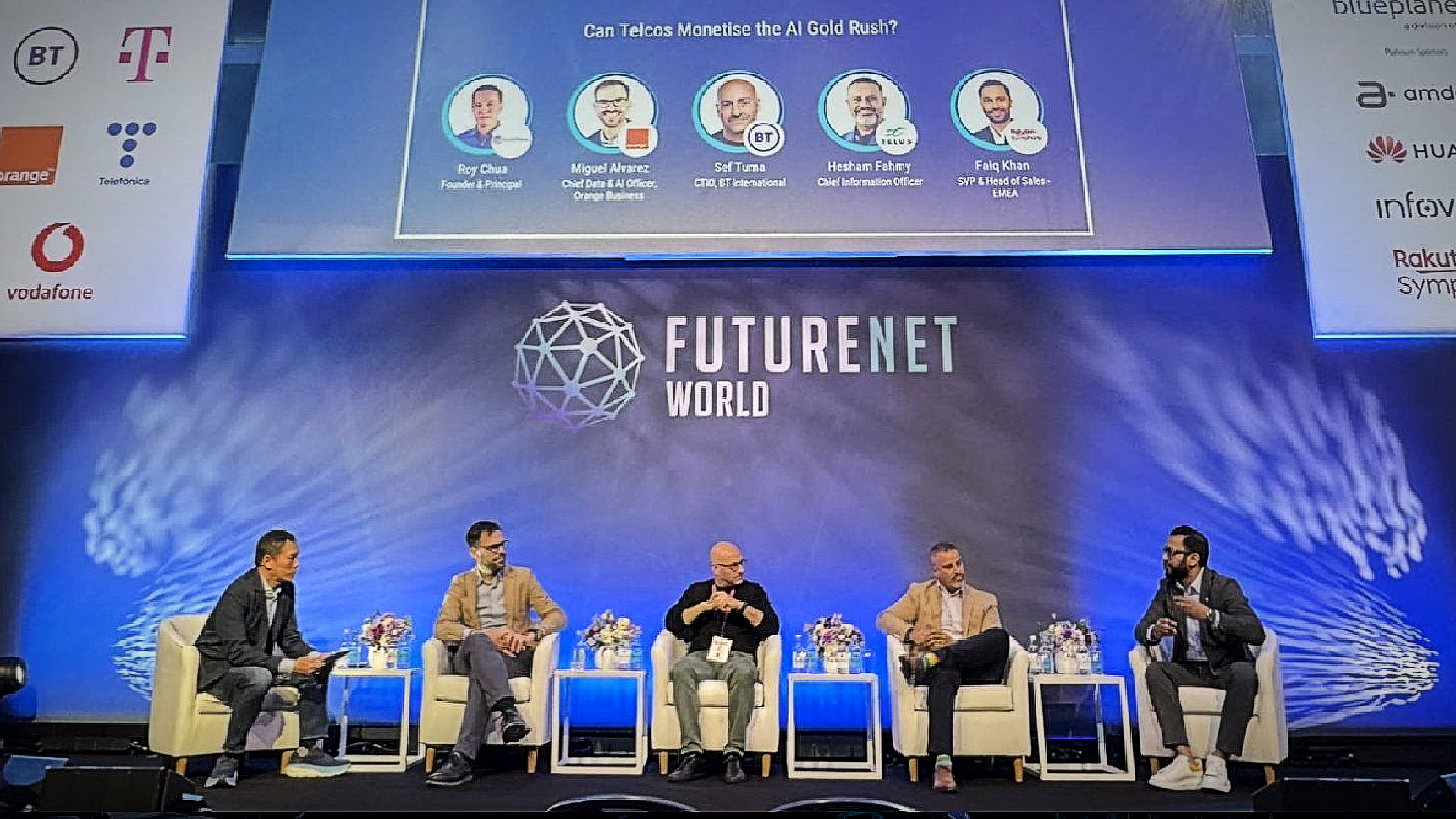
Debate at FutureNet World shifted from strategy to execution, as telcos BT and Orange outlined platform-led, partner-driven models, while Telus and Rakuten pressed for faster moves into AI-led solutions and infrastructure plays like GPU as-a-service.
In sum – what to know:
Value propositions – telcos broadly agree on platform strategies, but appear to differ on execution: sell smarter connectivity, sell vertical solutions, or sell connectivity in vertical solutions.
Partnership plays – BT and Orange appear to be drawing clearer lines: enable and orchestrate, rather than build full vertical solutions, and avoiding the integration trap (per private 5G).
Megawatt gambles – early moves into limited GPU as-a-service and “AI factories” show real demand, but timing and capital discipline will be critical as hyperscale capacity comes online.
Note, this article is continued from here.
Again, more like differences of execution; except the Europeans sounded cautious by comparison. This was the statement that Khan at Rakuten (and Fahmy at Telus, subsequently) picked up on (see here) at FutureNet World in London – to ask whether Orange, and BT also, want to use their network platforms to sell straight connectivity, albeit smarter, or to bundle connectivity into broader enterprise solutions for vertical markets. It is the same discussion, of course, that vendors and integrators (and the business divisions of these operators themselves) have had about private 5G for several years – which has come to a head with Nokia’s pending exit from the space (on the grounds of too much custom integration). And to an extent, the disagreements on stage in London were about AI bundles, channels, verticals.
In turn, Alvarez at Orange responded to Khan’s question about how to sell AI insights about network data, gathered in platforms on top of AI insights about network operations. “I agree, but telcos don’t have the muscle to deliver super-verticalized solutions. To think we can do better than a [vertical] specialist is arrogant. We need to partner to build vertical solutions together. We [have our own expertise] – like with customer experience and contact centers, which we’ve been doing for 20 years. Plus, there is a lot of data that relates to connectivity itself… But we need to be careful. One of the lessons from the cloud era is that if you try to do everything yourself, you get into a zero-sum game; whereas if you do things with others, then, okay, you don’t get the whole pie, but you have a solid position.”
He added: “I agree that we need to go up the value chain in terms of what we provide to customers. But we shouldn’t pretend we’re going to do [everything].” To which Tuma at BT International responded in kind: “In the end, you need context… That has always been one of the issues when you’re at the network [layer], going bottom-up… We don’t traditionally have access to the application layer. But in the AI world, with a tradable asset, with agents that can be smarter about how to use the network based on context, [we can]… start building capabilities to have an understanding about what’s up the value chain – without being experts, [without] trying to go up and down it.”
Tuma went on: “That’s where partnerships are important – to build models and solutions… and provide the data they need and [get the] data we need, and [that way make] yourself [part of] the solution without investing in a whole vertical. We have to build those capabilities anyway for the core business. So it’s not like we’re building something on the side to go up the value chain. We need [to do that anyway] to optimize the network to sell stuff better and to be easier to work with and easier to partner with. In my mind, that is the way to monetize it – versus trying to sell shrink-wrapped solutions to the market. Because that market is tricky.” See what I mean – the private 5G story, all over; written-large in broader telco brushstrokes about AI network / monetization for enterprises.
GPU as-a-service
The other most interesting point, almost a diversion on the panel in London, was about AI factories, and how telcos might tokenize GPUs in their infrastructure for model builders and cloud providers in the short term (over 18 months, nominally, as suggested by Chua in his original question) and for enterprise and others for inference workloads in the longer term. Telus is making a decent fist of this, it turns out – small but effective, as Fahmy tells it. “Right now, the market is getting over its skis on this; you see the numbers being thrown around. But a level deeper, there is a lot of demand and not enough supply. And most of the demand is just from training models; we haven’t hit the inflection curve for inference yet – when all those models are used at scale,” he explained.
“The question is how telcos don’t get caught up in it with capital outlay. But you can be smart. Because all these big gigawatt factories are three years out; they’re big and aspirational plays. If someone wants [AI compute] right now, they can’t get it. And there is a way to fill-in that demand. Telcos have their own assets – data centers that have been atrophying or not being used; central offices, which are connected to the network, with access to power. Power and land allocations – these are assets telcos have. So you can make these smaller 5-10 megawatt bets and build them out, and minimize the risk. You can get it up and running in six months, and not wait three years. It is a very [short but] interesting window. We built our first AI factories, and shocked ourselves – we were sold out in six months.”
He went on: “We are scrambling to get the next month online. You minimize the risk because these are smaller incremental bets. Your capital outlay is a lot less, and a lot of times you are pre-selling, even before you build out – you’re bringing 1,000 GPUs online, and 97 percent are pre-sold.” But what about after 18 months – or when the gigawatt factories are completed? Fahmy responded: “Even then, you can probably sell them for 70 cents on the dollar. So there’s downside protection there, and you’re not betting on a single generation of GPUs. You do a big $300 million buy now, lock into Blackwell, and here’s Reuben coming; but if you do it in tranches, you have a genius capability with all these [GPU] generations, and you can sort of do price arbitrage based on [service demand].”
Good stuff; and a hat tip to Chua for stewarding it so well.
Platforms of trust
There was more in the session, besides; but RCR is short of time. To close, here are the corresponding answers from Telus, BT, and Orange to Chua’s final question about where telcos will be in 18-24 months with AI. Fahmy responded: “I’m an eternal optimist, so I’m going to say that we will succeed and take a piece of the pie here. For two reasons. Internally, because we walk the talk as telcos. We have, at Telus, transformed and adopted AI, and become an AI-first kind of company. Everything is driven by AI… And externally, we have stopped trying to sell connectivity point solutions. [We now think] of it as a value chain entirely, and go to market that way, whether through partners or not. We aren’t trying to sell it as piecemeal technology, but as part of an integrated solution.”
Tuma at BT said: “Platform-based thinking and culture is important. It’s about the speed of product engineering versus the speed of the telco setup. That is how we talk about it internally – that ability to go fast. Of course, there are all the guardrails to make sure you don’t make mistakes. But in the end, the network isn’t a SaaS product, right; people are buying for how resilient and responsible we are. We want to make sure we don’t lose that because that is how trust is built over time. But the ability to build software capabilities, quickly, on top is how we have reduced our dependency on third parties. Our ability to innovate faster in areas we think are competitive advantages – is what we are going to own ourselves. Which allows us to partner in more unique ways.”
He added: “I’m pretty confident that, as a platform business versus a telco, we are going to be relevant… At the same time, we have to find ways to sell outside of the CIO and CTIO, which is why it is not just about your solutions but your sales force – so they can talk to manufacturers and all the other [verticals]. We need to [build] that partnering muscle, which has not been a telco [strength] in the past… Again, taking a page from AWS.”
Alvarez at Orange closed the session; he said: “I subscribe to all of that. It also depends on how you define success. Are we going to multiply our valuation to be a two-trillion [dollar] company? That would be nice, but I would not bet on it. We are going to succeed because we provide a service that is critical, which is increasing in value, and which will evolve. We want to be reliable and trusted, but we also need to [increase] speed. That is a critical balance to strike – to [also] be able to go fast. We can do both… We want to build software that is very reliable, very safe, very secure, but we want to do it much faster.”
Conservative to a fault
Whether framed as reinvention or evolution, the industry is circling the same idea: build flexible software platforms on top of critical network assets, made open to the ecosystem to collaborate on solutions that make a virtue of programmable connectivity. The real divide is not about strategy but about speed and conviction. The question, really, is how short the window of opportunity is, and how urgently and completely telcos jump through it. There are smart cap-ex gambles available to clever telcos, perhaps – although, as BT hinted here, and Vodafone confirmed in another session, there is little justification to host AI compute at the edge in a geography the size of the UK, where the round-trip latency to a central cloud region is lightning-quick (RCR will review its notes) anyway.
The thing is, if AI does afford a short-term once-only reset for telcos, and all enterprises, then any kind of caution – measured against the rest of the tech industry; justified by legacy, scale, or reputation – might be the biggest risk.

