

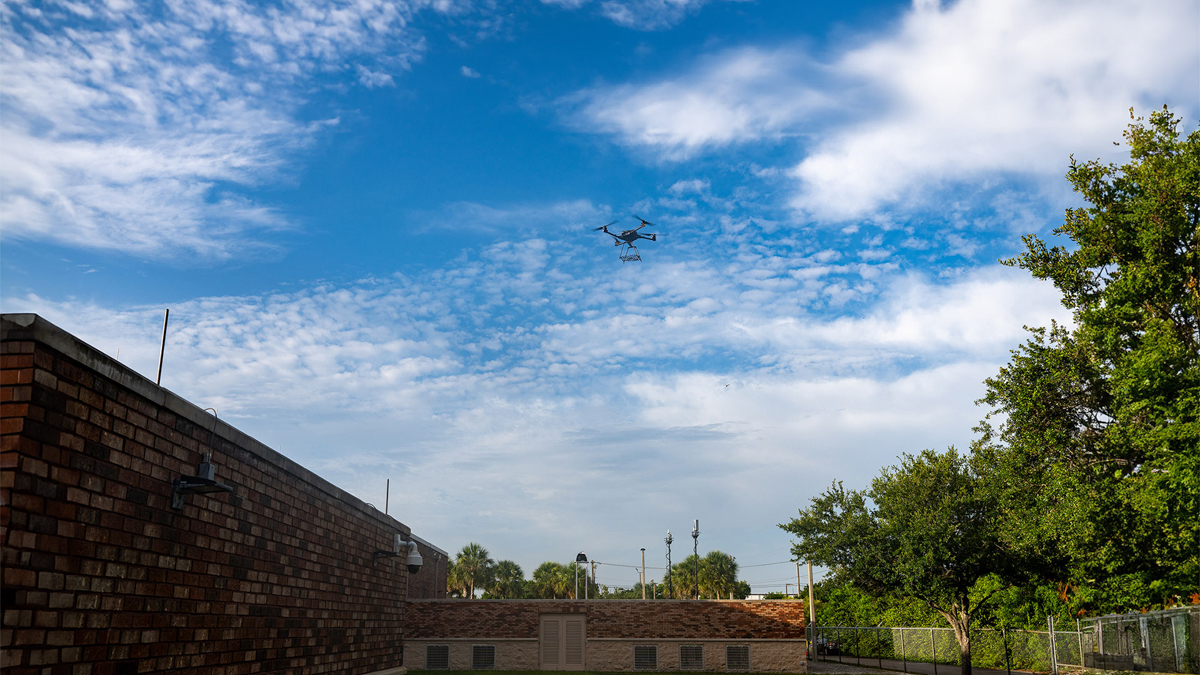
NetSense demo in Miami tracked drones with unmodified 5G radios
In sum – what we know:
- No new hardware needed – NetSense detects and tracks drones by reading RF disturbances in Verizon’s existing 5G network, with no modified radios required.
- A six-company stack – Verizon, ODC, Nvidia, Lockheed Martin, Keysight, and Astris AI each cover a layer, from spectrum and AI-RAN software to edge compute and tracking algorithms.
- Subscription model, 2027 rollout – NetSense will launch as a subscription “Airspace Awareness-as-a-Service,” with pilots starting late 2026 and broad availability targeted for 2027.
Lockheed Martin, Verizon, and Nvidia — along with Keysight Technologies, ODC, and Astris AI — have demonstrated a drone detection and tracking system that runs entirely on an existing 5G network. The demonstration took place in the Miami area in July 2026, with the partners showcasing Lockheed’s NetSense Airspace Awareness-as-a-Service detecting, tracking, and predicting the flight paths of actual drones over a live Verizon 5G network.
The test was conducted at what Lockheed describes as a “crowded site” — meaning a complex, real-world RF environment rather than a controlled range. The system reportedly maintained continuous track custody from initial acquisition through the end of each flight. Notably, none of Verizon’s deployed radios were modified for the demonstration. That’s the core pitch. Traditional counter-UAS solutions rely on dedicated radar or standalone RF sensors that have to be purchased, installed, and integrated site by site. NetSense instead interprets the RF disturbances that drones naturally create in cellular bands as they move, using infrastructure that’s already in the ground.
The partners are targeting public safety events, critical infrastructure sites like energy facilities and ports, and potentially airport authorities down the line. Of course, it also happens to be the second drone-detection demo in only a few weeks — the other being conducted by AT&T and Ericsson outside AT&T Stadium.
Under the hood: AI-RAN and edge computing
Each partner covers a distinct layer of the stack. Verizon supplies the 5G spectrum and physical infrastructure. ODC provides the AI-RAN software, which exposes granular RF metrics like channel state information, signal strength, and interference patterns that base stations already collect but don’t typically surface. Nvidia’s AI Aerial platform handles the GPU-accelerated edge computing needed to process those RF data streams with low enough latency to be useful for real-time tracking. On top of that sit Lockheed Martin’s algorithms, split into a warning system for initial detection and threat classification, and a tracking system that maintains custody and anticipates drone trajectories. Keysight rounds out the group with RF simulation and modeling tools used to optimize detection configurations and validate performance before and during deployment.
The elegance of the approach is also its constraint. Because NetSense reads disturbances in the cellular RF environment rather than actively scanning the sky, it’s heavily dependent on the network itself. Detection will likely be less effective in rural areas where 5G coverage is sparse.
Dense urban environments cut the other way. That’s where 5G coverage is strongest, but urban multipath and high user density also increase the risk of false positives — non-drone RF anomalies that look enough like a drone to trigger an alert. Filtering that background noise is exactly the job the AI models are being asked to do, and it’s probably the part of the system that will need the most independent validation. The Miami demo suggests it works in at least one crowded setting. Published false-alarm rates across varied environments would be more convincing.
Commercialization and service model
NetSense will be managed by Astris AI, Lockheed Martin’s wholly owned AI subsidiary, under a subscription-based Airspace Awareness-as-a-Service model — a managed service rather than a hardware sale. The system is built entirely on commercial off-the-shelf components, from Verizon’s radios to Nvidia’s general-purpose edge compute, with no bespoke defense-grade hardware anywhere in the chain.
That’s the economic argument in a nutshell. Traditional radar and RF sensor deployments carry significant upfront hardware costs and can take months to install and integrate. Because NetSense reuses infrastructure that’s already in place, the partners claim it can cut those costs dramatically and compress deployment timelines to something closer to a software rollout. For a city that wants airspace awareness over a stadium for one weekend, or a port authority covering a sprawling facility, that’s a genuinely different value proposition than buying and siting radar units.
Pilot deployments are planned for the second half of 2026 and early 2027, with general commercial availability targeted for 2027. What’s missing so far is the fine print. Subscription pricing, data ownership, and the exact division of contractual responsibilities between Lockheed, Astris, Verizon, and the end customer remain undisclosed. And that fine print matters more than usual here, because repurposing public telecom infrastructure for airspace surveillance raises legitimate privacy and civil liberties questions — what data is collected, how it’s processed, and whether a system built to sense drones could quietly expand its scope to track other devices. None of the partners have addressed that publicly yet.
6G ISAC roadmap
Lockheed frames NetSense as a response to a growing “gap in public protection” as consumer drones get cheaper and more capable of illegal surveillance, smuggling, or outright attacks. That framing is self-serving, but the underlying trend is real, and existing counter-UAS options are expensive and slow to deploy in civilian settings.
The more interesting story may be what this demonstration represents for the telecom industry. Integrated Sensing and Communications — ISAC — is a headline feature of the 6G roadmap, the idea being that future networks will sense their environment as a native capability rather than just move data. NetSense is effectively an argument that operators don’t have to wait for formal 6G standards to get there. Verizon, Lockheed, and Nvidia are positioning themselves as early leaders in ISAC by proving it can be bolted onto today’s 5G networks in software.
The roadmap calls for deployment across non-Verizon 5G networks and, eventually, native integration into 6G. Scaling beyond Verizon is easier said than done, though. It requires buy-in from competing operators and strict interoperability across diverse 5G architectures.
Table of Contents

