According to one analyst, Amazon and Starlink are chasing different markets: one, mass-market connectivity vs another, high-margin enterprise services
This week, Blue Origin hit a milestone — or thereabouts. For some time, the Jeff Bezos-founded rocket company had been noodling with the concept of a reusable booster to help lower spaceflight costs and boost flight cadence. On Sunday, the rocket company put the technology to test on the New Glenn rocket with an AST SpaceMobile satellite on board. 10 minutes after liftoff, the booster made an on-target touchdown (voila!), marking its first successful reuse. The feat was met with great enthusiasm as it makes Blue Origin the next company to crack the reusability code after rival company, SpaceX. However, BO’s rocket experienced some upper-stage failures later in the flight, narrowly missing the correct orbit.
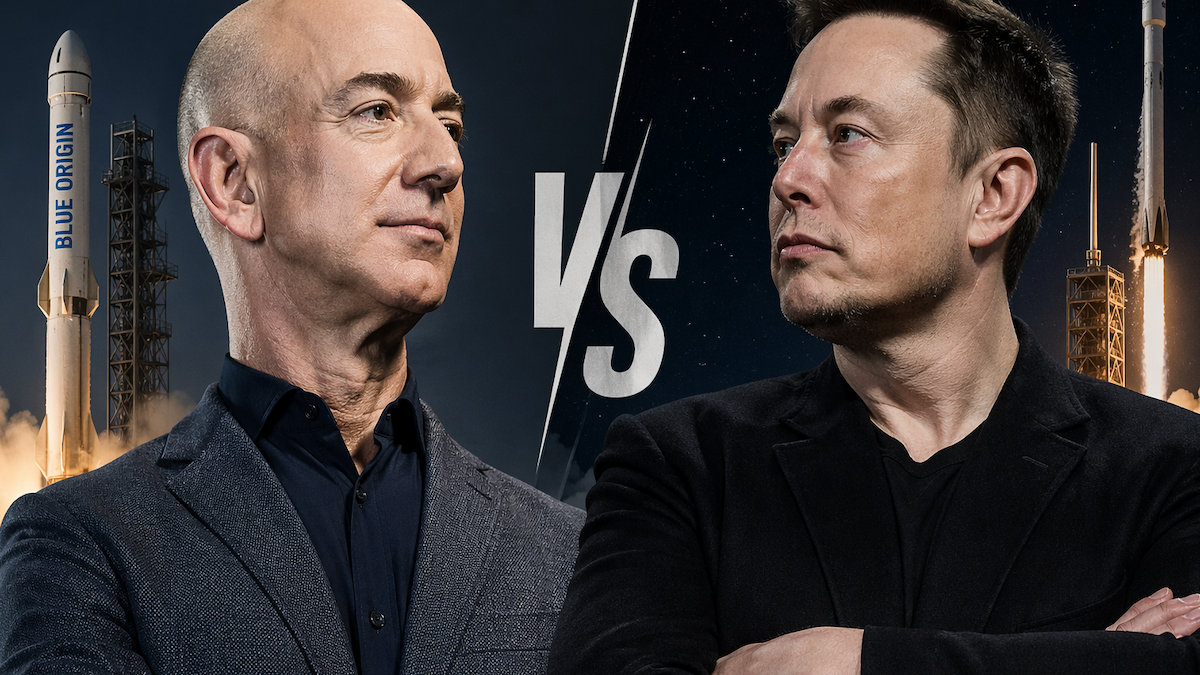
Unsurprisingly, the mission reopened the Starlink vs Amazon Leo debate. With both being low-Earth orbit (LEO) players, the theory over the past year has been that Leo is a direct competitor of Starlink. That has shaped into a convincing narrative cemented by countless headlines and discussions in media about how the two titans are locked in an arm-wrestle to win the satellite race. But, upon a closer look, that argument starts to fall apart.
Apples to oranges
Starting with the basics, Starlink today commands a fleet of over 10,000 in-orbit satellites. Leo’s, only some 235 satellites strong, with 3,000 more planned in the next launch, is much smaller and ergo, no match to Starlink’s as of now. “If this is a symmetrical war for consumer broadband, Amazon is already mathematically dead,” Sebastian Barros, an independent analyst who often dissects popular narratives in the telco space on Substack, writes in an opinion piece.
Let’s unpack that for a second. As noted, with only a fraction of Starlink’s mega-constellation, Leo cannot possibly compete with Starlink on density. And without its own reusable rocket technology, the kind that Starlink’s parent company SpaceX has developed and using, Amazon is already pretty behind in the race.
To go around that, Amazon has to shell a pretty penny each time it decides to send a rocket to space. “[Amazon] executed a $10 billion commercial procurement for launches using expendable or partially reusable vehicles from ULA, Arianespace, and Blue Origin,” according to Barros, a cost that Starlink can dodge, thanks to SpaceX’s 230-foot reusable Falcon 9 rocket.
With its orbital-class reusability, the Falcon 9 has transformed rockets from single-use crafts to repeatable services, delivering tens of satellites in a single ride. Today, it routinely launches Starlink satellites — and those for other companies as well for a price.
Barros observes that with the Falcon 9, Starlink has put a total of 1,000 satellites in orbit so far this year. That capacity will be amplified so much more with the upcoming Starship V3 that boasts capacity to haul 150 metric tons of satellite weight for only $10 million. “By 2029, Starlink will be the “Android” of space, ubiquitous, massive, and built on a foundation of raw spectral scale,” Barros says.
Amazon on the other hand does not have much to show for its own launch capacity just yet. According to Barros, the company is paying somewhere between $2,600 and $7,000 per kilogram to third-party vendors for rocket flights. “You cannot win a price war when your competitor rides for free, and you pay premium retail just to leave the atmosphere,” Barros argues.
Even in terms of earnings, the picture is deeply disparate. Although SpaceX’s annual revenues are not publicly known, and nor is Leo’s, people familiar with the matter told Reuters that Elon Musk’s rocket company generated approximately $16 billion in revenue in 2025, with roughly an EBITDA (earnings before interest, taxes, depreciation, and amortization) profit of $8 billion. Starlink’s revenues accounted for 60 to 80% of this number. Blue Origin’s numbers are pale by comparison. Ars Technica reported that it is currently “on the order of $1 billion a year.”
Busting the myth
So, knowing what it’s up against, is Amazon really trying to compete with Starlink or does it have a different game in mind altogether? “Amazon isn’t stupid enough to play SpaceX’s game,” Barros states. According the analyst, Leo and Starlink are in very different plays: one in high-margin service, and the other, high-volume.
The argument makes perfect sense. If you look at the companies’ low-altitude shells, in their third orbital shell, Leo’s satellites sit at 590 km to 630 km from Earth, whereas Starlink’s hover much closer to Earth at 340 km to 550 km. Being at a higher altitude, Leo’s satellites cover greater areas with fewer assets. Conversely, Starlink’s closer proximity to Earth requires it to maintain a much larger fleet to cover more areas and maintain line-of-sight at all times. The advantage there is, less physical distance and higher density equal greater capacity due to spectrum overlap. This allows Starlink to support millions of households and users across rural, and urban areas in some cases. Not so much the case for Leo.
“A single satellite at Amazon’s 600 km altitude illuminates a geographic footprint the size of a large state,” Barros writes, “If 50,000 rural households under one beam attempt to stream high-definition video simultaneously, demand would reach 1 Tbps, causing the network to collapse.” That physics naturally narrows down Leo’s market segment.
That said, the only way Leo can get on par with Starlink is by addressing a niche which offers higher margin, if not volume, and that’s what it increasingly seems to be doing. As Barros writes, the “head-to-head” narrative is a myth.” Starlink is in the B2C (business-to-consumer) game or as Barros puts it, the “consumer-volume” game. On the fixed broadband side, the company targets millions of rural households and enterprises with its ~ $120 monthly subscription-based broadband service, which alone is a sizable portion of the market left open by telcos. On the mobile side, its addressable market includes direct-to-device (D2D) consumers, think hikers, emergency workers, frequent travelers, flyers, et all. The company holds contracts with over 31 airline carriers around the world for in-flight Wi-Fi service as of now.
Leo, on the other hand, is going for the B2B (business-to-business) market: high-end customers in the enterprise and cloud niche — a very familiar market for its tech business unit, AWS. These include enterprises, maritime companies, government agencies, and logistics firms that require guaranteed SLA-backed connectivity. Leo is also expanding footprint in the commercial airlines sector with deals with carriers like JetBlue — and most recently, Delta — to provide Wi-Fi services on flight.
“Having watched the 5G monetization failures of terrestrial operators, Amazon is avoiding the trap of squeezing $120 a month out of a suburban household. Instead, they are building a closed-loop, deterministic SLA router for corporate campuses, automated supply chains, and tier-1 operators looking for high-margin backhaul,” Barros explains.
His 2029 prediction for Leo is just as interesting. “By 2029, Amazon will not be an ISP [internet service provider]; it will be an orbital extension of the AWS data center.”
The company is tapping into its techco privilege to curve its place in the market. Its nifty satellite fleet is a physical extension of AWS — the largest cloud infrastructure in the world — and path to a bigger orbital play. By integrating the AWS infrastructure with Leo’s network, Amazon is set to replicate its cloud-based transport network in space.
For that reason itself, some are willing to bet big on Leo, despite being an evidently smaller player in the LEO space. Ron Westfall, VP and practice lead of networking and infrastructure, HyperFRAME Research says, “The Amazon Leo proposition holds solid competitive prospects due to its deep integration with AWS and the massive existing retail logistics network. While Starlink has a significant first-mover advantage with thousands of satellites already in orbit, Amazon can undercut competitors by bundling satellite connectivity into broader enterprise and Prime consumer ecosystems.”
Westfall argues that Amazon’s strong foundation lends itself to the behemoth’s satellite initiative, providing it an unexpected advantage over Starlink. While Starlink clearly remains the bigger, stronger, faster player, the competition will likely shift from basic connectivity to integrated services, where Amazon’s ability to offer low-latency links directly into its global cloud infrastructure provides a distinct value proposition that Starlink can be hard-pressed to directly counter, Westfall says.
Additionally, the deal with Apple which came with Amazon’s recent $12 billion acquisition of Globalstar gains it a straight entry into the D2D space, giving its upcoming next-gen services (expected in 2028) an on-ramp to the market.
However, to settle the Leo vs Starlink debate for now, it’s safe to say that the companies are going in different directions, focusing on bringing differentiated services to separate markets where the economies are most compelling. As Barros puts it, “They are no longer competing for the same dollar; they are defining two different layers of the modern telecommunications stack.”
.