

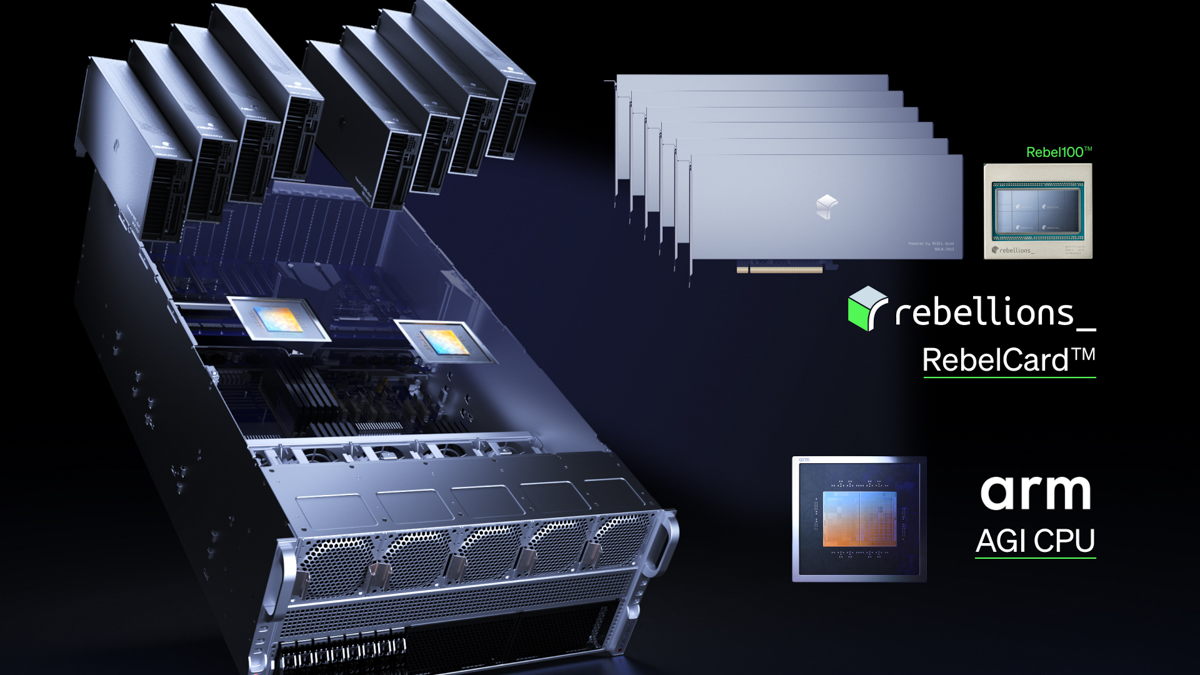
By combining Arm CPUs and Rebellions accelerators, the trio aims to provide a domestic alternative for sovereign AI data centers
In sum – what we know:
- A full-stack collaboration – The partnership between Rebellions, SK Telecom, and Arm covers the entire value chain from chip design to real-world validation in live AI data centers.
- Optimized for inference – The RebelCard accelerator uses HBM3E and chiplet technology to target large-scale multimodal models while maintaining a cost-effective, air-cooled design.
- Sovereign AI focus – The initiative specifically targets public sector and telecom customers looking to reduce dependency on foreign proprietary tech stacks and the Nvidia ecosystem.
Sovereign AI infrastructure takes significant effort from a variety of companies — and three major companies are partnering up to build out that infrastructure in South Korea. The partnership brings together Rebellions, a South Korean AI inference infrastructure company; SK Telecom, one of South Korea’s biggest telecom operators; and Arm, the British chip design giant. Their target is the fast-expanding AI inference market, and they’re going after it with a system designed to be high-performance, energy-efficient, and built entirely outside the Nvidia ecosystem.
What makes this collaboration stand out at such an early stage is its scope. It covers the full value chain, from infrastructure design all the way through deployment and real-world validation, which is ambitious for something that’s technically still an MOU. The hardware centerpiece is Rebellions’ RebelCard accelerator, slated for release in Q3 2026.
The tech behind the deal
Under the hood, the architecture pairs Arm’s AGI CPU with Rebellions’ RebelCard module-type accelerator. The Arm AGI CPU is Arm’s first chip built in-house, so it’s interesting to see it used so quickly after release. The RebelCard itself is built around the Rebel100 AI semiconductor, which integrates four NPU chiplets alongside 5th-generation High Bandwidth Memory (HBM3E). It’s optimized for running ultra-large multimodal and Mixture of Experts (MoE) models, using high-speed chip-to-chip communication across those chiplets to keep data flowing.
One interesting design choice is that the RebelCard is built for standard air-cooled operation. As AI data centers wrestle with spiraling cooling costs and the complexity of liquid cooling deployments, an air-cooled accelerator capable of handling large-scale inference could be a differentiator, assuming performance actually holds up in practice. Rebellions says the RebelCard delivers performance on par with flagship GPUs while beating them on power efficiency, and the company is leaning hard into a performance-per-dollar-per-watt marketing message. Jinwook Oh, CTO of Rebellions, described the RebelCard as offering “overwhelming performance and power efficiency” and called the collaboration a “significant precedent in the industry for building AI-specialized infrastructure.”
That said, performance claims from any chip startup deserve a healthy dose of skepticism until independent benchmarks show up. “Comparable to flagship GPUs” is a pretty broad claim, and the inference market has no shortage of challengers that looked great on paper but ran into walls when confronted with real-world workloads and the realities of software ecosystem maturity.
Software integration
Hardware won’t make or break this effort on its own, but software might. The three partners plan to co-develop the full software stack, firmware included, built on open source and open standards. This is an obvious decision given the fact that sovereign AI customers aren’t going to want proprietary lock-in layered on top of hardware they’re specifically buying to reduce dependency on foreign tech stacks.
For validation, the system will be tested inside SK Telecom’s live AI data center facilities. The plan is to run SK Telecom’s proprietary foundation model, A.X K1, on the new servers, with testing focused on verifying performance and stability for sovereign AI models and telco-scale data processing workloads. Jaeshin Lee, Vice President and Head of AI Business Development at SK Telecom, emphasized the value of combining inference-optimized infrastructure with the A.X K1 proprietary foundation model to strengthen competitiveness in the AI data center market.
Having a live environment and a real model to put through its paces is a meaningful advantage. But the distance between validating a system in a controlled telco data center and actually shipping production-ready infrastructure to a diverse set of customers is substantial.
Sovereign AI
The primary market targets here are global sovereign AI data centers, with particular emphasis on Asia. The customers they’re going after include telecom companies and public sector organizations that need independent AI infrastructure and supply chain resilience — essentially, anyone who wants to run AI workloads without being wholly dependent on American chipmakers or cloud providers.
This fits neatly into a broader industry trend that’s been building for a while now. Telecom operators around the world are investing directly in AI infrastructure and data center services, and geopolitical anxiety around AI autonomy and data sovereignty is pushing governments and enterprises to actively seek alternatives. Eddie Ramirez, VP Go-to-Market for Arm’s Cloud AI Business Unit, highlighted the AGI CPU’s role in coordinating workloads and emphasized scalability for sovereign AI and telecommunications markets.
The sovereign AI concept is gaining steam. But it’s worth keeping in mind that sovereign AI infrastructure remains a fragmented, still-emerging market. Customers in this space don’t just need competitive hardware — they need a mature ecosystem of tools, support, and integrations, and that’s exactly where Nvidia’s CUDA dominance remains a formidable barrier. The partners say they’ll explore broader commercial deployment immediately after technical validation wraps up, but turning an MOU and a promising accelerator into a scalable business is going to require sustained execution well beyond Q3 2026.
Table of Contents


