

RCR Wireless
  • News
  • Channels
    • 5G
    • 6G
    • BSS OSS
    • Carriers
    • IoT
    • Network Infrastructure
    • Open RAN
    • Private 5G
    • Telco AI
    • Telco Cloud
    • Test & Measurement
  • Resources
    • Reports
    • Webinars
    • White papers
    • AI Fundamentals
    • Analyst Angle
    • Editorial Calendar
    • Fundamentals
      • 5G NR Release 17
      • AI
        • Telco AI in 2025
    • Podcasts
      • Let’s Get Digital with Carrie Charles
      • Wireless Connectivity to Enable Industry 4.0 for the Middleprise
      • Well Technically…
      • Will 5G Change the World
      • Accelerating Industry 4.0 Digitalization
  • AI Infrastructure
  • Programs
  • Events
  • RCRtv
  • Advertise
  • Subscribe
Wednesday, July 8, 2026
RCR Wireless
  • News
  • Channels
    • 5G
    • 6G
    • BSS OSS
    • Carriers
    • IoT
    • Network Infrastructure
    • Open RAN
    • Private 5G
    • Telco AI
    • Telco Cloud
    • Test & Measurement
  • Resources
    • Reports
    • Webinars
    • White papers
    • AI Fundamentals
    • Analyst Angle
    • Editorial Calendar
    • Fundamentals
      • 5G NR Release 17
      • AI
        • Telco AI in 2025
    • Podcasts
      • Let’s Get Digital with Carrie Charles
      • Wireless Connectivity to Enable Industry 4.0 for the Middleprise
      • Well Technically…
      • Will 5G Change the World
      • Accelerating Industry 4.0 Digitalization
  • AI Infrastructure
  • Programs
  • Events
  • RCRtv
  • Advertise
  • Subscribe
Add RCR Wireless as a preferred source on Google
  • Qualcomm 6G Insights
  • Huawei Content Hub
  • Qualcomm – 6G Vision
  • OSS/BSS Channel
RCR Wireless
RCR Wireless
  • Advanced Mimo
  • Mobile mmWave
  • 5G Positioning
  • Green Networks
  • Metaverse
  • Automotive
  • Industrial and Wide-area IoT
Copyright 2021 - All Right Reserved
Home - Private 5G cellular networks: Transforming port operations (Reader Forum)
Private 5GReader ForumTransportation: Airports, Rail, Ports

Private 5G cellular networks: Transforming port operations (Reader Forum)

by Reader Forum February 12, 2025
written by Reader Forum February 12, 2025 Share
LinkedinEmail
Share 0LinkedinEmail
tacoma port private 5g
217

Editor’s note: The following Reader Forum was written by Anish Sharma, a junior at at Eastside Preparatory School, where he studies computer science, robotics and applied AI.

In the era of digital transformation, ports worldwide are embracing private 5G cellular networks to revolutionize their operations, enhance efficiency and maintain a competitive edge in the global maritime industry. These advanced networks offer a myriad of benefits that are reshaping port management and setting new standards for operational excellence.

The Tacoma Port Project stands as a shining example of the transformative power of private 5G networks. By implementing CBRS (Citizens Broadband Radio Service) 5G access points, the port has achieved a remarkable 10x coverage advantage over traditional Wi-Fi networks. This expansive coverage ensures seamless connectivity across the entire port area, extending even to incoming ships, thereby facilitating early data transfer and enhancing operational readiness. The stark contrast between the limited 10% coverage of 20 Wi-Fi hotspots and the comprehensive coverage provided by just two CBRS base stations underscores the superior efficiency of 5G technology in large-scale outdoor environments.

One of the most compelling advantages of private 5G networks is their ability to provide ultra-low latency connectivity. This is crucial for real-time applications such as remote crane control and automated guided vehicles, where split-second decisions can significantly impact efficiency and safety. The enhanced security features of these networks, including robust encryption and access control, safeguard sensitive information like cargo manifests and financial transactions, addressing the ever-growing concerns of cybersecurity in the maritime sector.

The economic benefits of private 5G networks are equally impressive. Despite an initial investment, the long-term gains are substantial. The Tacoma Port Project demonstrates a staggering 500% increase in available bandwidth. This dramatic improvement in data transfer rates enables faster downloads, uploads and real-time data streaming, supporting bandwidth-intensive applications like video surveillance and remote diagnostics.

Moreover, the implementation of private 5G networks is expected to optimize terminal tasks by 7-10% and reduce costs related to outages and downtime by 10-12%. These improvements stem from the networks’ ability to support predictive maintenance and enable automated preventative processes, which were previously unfeasible with limited Wi-Fi coverage. The consistent and reliable coverage provided by 5G networks ensures that workers and IoT devices can maintain connectivity throughout the port, eliminating the need to search for coverage hotspots and enabling a truly “always on, always available” connectivity environment.

From a cost perspective, the CBRS-based 5G system offers significant advantages over traditional Wi-Fi networks. The Tacoma Port Project revealed that the cost of deploying and managing a CBRS system is roughly one-sixth that of a Wi-Fi network, while providing ten times the coverage area. When comparing like-for-like coverage, the cost advantage of the CBRS system rises to an impressive 60:1 ratio. This substantial cost reduction, coupled with improved performance, makes a compelling case for ports to transition to private 5G networks.

The versatility of private 5G networks extends beyond current applications, providing a robust platform for future innovations. These networks can support advanced tracking and tracing systems, autonomous vehicles, optimized work schedules and a host of other emerging technologies. This forward-compatibility ensures that ports investing in private 5G infrastructure are well-positioned to adapt to future technological advancements and maintain their competitive advantage in the long term.
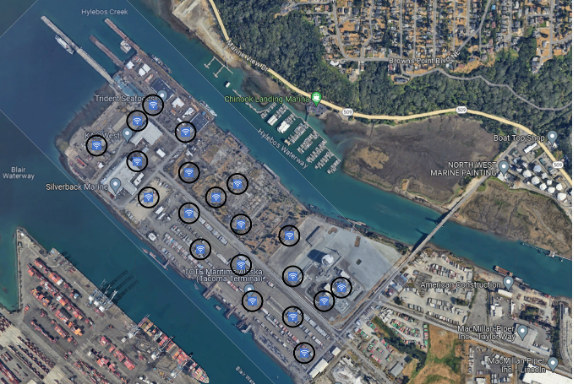
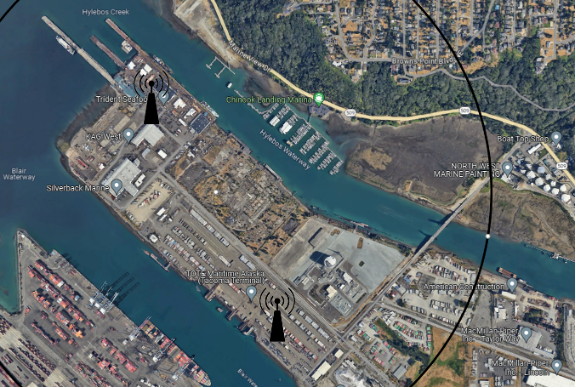
Picture1
a) WI-FI hotspots at the Tacoma Port (illustrative only)
Picture2
b) CBRS base stations at the Tacoma Port (illustrative only)

Private 5G networks also offer unique capabilities such as network slicing, which allows for the creation of multiple virtual networks with different performance characteristics on the same physical infrastructure. This feature enables ports to offer customized services and prioritize mission-critical applications, potentially generating additional revenue streams and improving overall operational flexibility.

The integration of private 5G networks with edge computing capabilities opens up new possibilities for data processing and analysis. By processing data locally, ports can reduce latency even further and improve real-time decision-making capabilities. This can be particularly beneficial for applications requiring immediate responses, such as automated collision avoidance systems or real-time cargo tracking.

Furthermore, private 5G networks can support high-bandwidth multimedia applications, including video streaming, augmented reality (AR) and virtual reality (VR). These technologies can be leveraged for various purposes, such as remote inspections, staff training and maintenance support, leading to improved efficiency and safety in port operations.

The environmental impact of port operations is an increasingly important consideration, and private 5G networks can play a significant role in promoting sustainability. By enabling more efficient operations and supporting the implementation of smart technologies, these networks can help reduce energy consumption, minimize waste and lower the overall carbon footprint of port activities.

As demonstrated by the Tacoma Port Project, the adoption of private 5G networks is no longer a luxury but a necessity for ports aiming to thrive in an increasingly digital and competitive global maritime landscape. The comprehensive coverage, enhanced security, increased data transfer rates and support for cutting-edge applications provided by these networks are not just improving current operations but are laying the groundwork for the smart ports of the future.

In conclusion, private 5G cellular networks represent a paradigm shift in port operations. They offer a powerful combination of improved performance, reduced costs, enhanced security and future-readiness that is unmatched by traditional connectivity solutions. As more ports around the world recognize these benefits, we can expect to see a widespread adoption of private 5G networks, leading to a new era of efficiency, innovation and sustainability in the maritime industry. Ports that embrace this technology early will likely find themselves at the forefront of the industry, better equipped to meet the challenges of tomorrow’s global trade landscape.

Author’s note: I would like to thank Jim Brisimitzis and Scott Waller at the 5G Open Innovation Lab and Rajesh Mishra at A5G Networks who provided invaluable guidance for the project.


You Might Also Like
  • How the FCC can protect IoT innovation and GPS resilience in the 900 MHz band (Reader Forum)
  • “We’re going after the operator channel” – Druid bets on simplicity to scale private 5G
  • Wednesday | Telco agents and smash hits (Editorial Diary)
  • Trust you can see – the convergence of voice, messaging, and identity (Reader Forum)
  • Subsea resilience needs to move beyond cable count – here’s why (Reader Forum)
  • Real-world network emulation is critical for 5G deployments (Reader Forum)
Share 0 LinkedinEmail
Reader Forum

Submit Reader Forum articles to [email protected]. Articles submitted to RCR Wireless News become property of RCR Wireless News and will be subject to editorial review and copy edit. Posting of submitted Reader Forum articles shall be at RCR Wireless News sole discretion.

previous post
Test and Measurement: Keysight expands 6G work in Europe
next post
EU launches InvestAI initiative to boost AI in Europe

White Papers

  • Enea White Paper: Why Intelligent AAA is the Swiss Army Knife of Telecom

  • CSG White Paper: Telco AI Enabler: Mediation’s Defining Role

  • Enea White Paper: Scalable Database Design for 5G and Beyond

  • Supermicro and NVIDIA Whitepaper: Powering sovereign AI at scale

  • VIAVI Whitepaper: RAN scenario generators and their critical role for future-proofing AI-native RAN in Advanced 5G and 6G networks

Editorial Reports

  • Report: Scaling Optical Networks For The Hyperscale And AI Era

  • Test And Measurement Market Pulse Report

  • Editorial Report: Securing telecom infrastructure for the quantum era

Webinars

  • Webinar: Rethinking the RAN as AI, cloud and openness converge

  • Webinar: Scale-Up, Scale-Out, Scale-Across – Building AI-Era Network Fabrics

  • Webinar: NTN in motion – evolving standards, expanding services

  • Webinar: Noise-Figure Measurements with RFmx and PXI VSTs

  • Qualcomm Webinar – Building the 6G Standard: Key developments to know

Since 1982, RCR Wireless News has been providing wireless and mobile industry news, insights, and analysis to mobile and wireless industry professionals, decision makers, policy makers, analysts and investors.

Facebook Twitter Youtube Linkedin Envelope Rss

Useful Links

  • Subscribe
  • About RCR Wireless News
  • Contact Us
  • Advertise
  • Editorial Calendar
  • Archive
  • RSS
  • Wireless News Archive
  • Subscribe
  • About RCR Wireless News
  • Contact Us
  • Advertise
  • Editorial Calendar
  • Archive
  • RSS
  • Wireless News Archive

Edtior's Picks

How the FCC can protect IoT innovation and GPS resilience in the 900...
What defines network performance in 5G and beyond? A CTO Perspective
Elisa says AI automation has cut network incidents by over 80%

Latest Articles

How the FCC can protect IoT innovation and GPS resilience in the 900 MHz band (Reader Forum)
What defines network performance in 5G and beyond? A CTO Perspective
Elisa says AI automation has cut network incidents by over 80%
“We’re going after the operator channel” – Druid bets on simplicity to scale private 5G

© 2026 RCR Wireless News All Right Reserved. Developed by Eight Hats.

Cookie Policy | Privacy Policy

RCR Wireless
  • News
  • Channels
    • 5G
    • 6G
    • BSS OSS
    • Carriers
    • IoT
    • Network Infrastructure
    • Open RAN
    • Private 5G
    • Telco AI
    • Telco Cloud
    • Test & Measurement
  • Resources
    • Reports
    • Webinars
    • White papers
    • AI Fundamentals
    • Analyst Angle
    • Editorial Calendar
    • Fundamentals
      • 5G NR Release 17
      • AI
        • Telco AI in 2025
    • Podcasts
      • Let’s Get Digital with Carrie Charles
      • Wireless Connectivity to Enable Industry 4.0 for the Middleprise
      • Well Technically…
      • Will 5G Change the World
      • Accelerating Industry 4.0 Digitalization
  • AI Infrastructure
  • Programs
  • Events
  • RCRtv
  • Advertise
  • Subscribe
RCR Wireless
  • News
  • Channels
    • 5G
    • 6G
    • BSS OSS
    • Carriers
    • IoT
    • Network Infrastructure
    • Open RAN
    • Private 5G
    • Telco AI
    • Telco Cloud
    • Test & Measurement
  • Resources
    • Reports
    • Webinars
    • White papers
    • AI Fundamentals
    • Analyst Angle
    • Editorial Calendar
    • Fundamentals
      • 5G NR Release 17
      • AI
        • Telco AI in 2025
    • Podcasts
      • Let’s Get Digital with Carrie Charles
      • Wireless Connectivity to Enable Industry 4.0 for the Middleprise
      • Well Technically…
      • Will 5G Change the World
      • Accelerating Industry 4.0 Digitalization
  • AI Infrastructure
  • Programs
  • Events
  • RCRtv
  • Advertise
  • Subscribe
@2020 - All Right Reserved. Designed and Developed by PenciDesign