


RCR Wireless
  • News
  • Channels
    • 5G
    • 6G
    • BSS OSS
    • Carriers
    • IoT
    • Network Infrastructure
    • Open RAN
    • Private 5G
    • Telco AI
    • Telco Cloud
    • Test & Measurement
  • Resources
    • Reports
    • Webinars
    • White papers
    • AI Fundamentals
    • Analyst Angle
    • Editorial Calendar
    • Fundamentals
      • 5G NR Release 17
      • AI
        • Telco AI in 2025
    • Podcasts
      • Let’s Get Digital with Carrie Charles
      • Wireless Connectivity to Enable Industry 4.0 for the Middleprise
      • Well Technically…
      • Will 5G Change the World
      • Accelerating Industry 4.0 Digitalization
  • AI Infrastructure
  • Programs
  • Events
  • RCRtv
  • Advertise
  • Subscribe
Wednesday, September 2, 2026
RCR Wireless
  • News
  • Channels
    • 5G
    • 6G
    • BSS OSS
    • Carriers
    • IoT
    • Network Infrastructure
    • Open RAN
    • Private 5G
    • Telco AI
    • Telco Cloud
    • Test & Measurement
  • Resources
    • Reports
    • Webinars
    • White papers
    • AI Fundamentals
    • Analyst Angle
    • Editorial Calendar
    • Fundamentals
      • 5G NR Release 17
      • AI
        • Telco AI in 2025
    • Podcasts
      • Let’s Get Digital with Carrie Charles
      • Wireless Connectivity to Enable Industry 4.0 for the Middleprise
      • Well Technically…
      • Will 5G Change the World
      • Accelerating Industry 4.0 Digitalization
  • AI Infrastructure
  • Programs
  • Events
  • RCRtv
  • Advertise
  • Subscribe
Add RCR Wireless as a preferred source on Google
  • Qualcomm 6G Insights
  • Huawei Content Hub
  • Qualcomm – 6G Vision
  • OSS/BSS Channel
  • RCRTech Roundtable: AI Infrastructure
RCR Wireless
RCR Wireless
  • Advanced Mimo
  • Mobile mmWave
  • 5G Positioning
  • Green Networks
  • Metaverse
  • Automotive
  • Industrial and Wide-area IoT
Copyright 2021 - All Right Reserved
Home - Democratizing testing for accelerated Open RAN deployment: Part 1 (Reader Forum)
Open RANReader ForumTest and Measurement

Democratizing testing for accelerated Open RAN deployment: Part 1 (Reader Forum)

by Sameh Yamany, Chief Technology Officer, VIAVI Solutions January 16, 2025
written by Sameh Yamany, Chief Technology Officer, VIAVI Solutions January 16, 2025 Share
LinkedinEmail
Share 0LinkedinEmail
open ran testing
249

The shift toward Open Radio Access Network (Open RAN) infrastructure, built on interoperable technologies from multiple vendors, is accelerating. To unlock the full potential of Open RAN — delivering cost efficiency, performance enhancements and greater flexibility — it’s crucial to encourage innovative, agile technology vendors to join the market, alongside the larger, well-funded incumbents.

However, small and medium-sized enterprises (SMEs), start-ups, and scale-ups often find the complex testing requirements of Open RAN — such as system verification, security assessments, certification and pre-deployment testing — daunting. Without access to comprehensive in-house testing facilities, many of these companies face significant time and cost burdens in bringing compliant, high-performance products to market. This complexity can act as a barrier, discouraging them from fully engaging in the Open RAN ecosystem.

Now, a new approach denoted as Lab-as-a-Service (LaaS) for Open RAN is democratizing testing for emerging Open RAN technology vendors by providing them with rapid access to comprehensive end-to-end and scalable testing for everything from product development to performance stress testing. The highly automated, on-demand ‘pay-as-you-go’ LaaS model reduces the need for extensive in-house testing and accelerates time-to-market by streamlining the development and pre-certification process and better preparing vendors for certification, badging and acceptance tests at OTICs and CSP labs.

Open RAN for businesses and technologies

Open RAN has the potential to accelerate the deployment of 5G, 5G Advanced, and future 6G services, driving innovation and offering significant benefits to technology suppliers, network operators, end users, and the broader economy. By fostering a more open and competitive ecosystem, Open RAN paves the way for faster advancements and greater flexibility, unlocking new opportunities across the entire telecommunications landscape. This is why governments worldwide have expressed support for Open RAN principles, cooperating internationally to increase openness in mobile networks as well as making domestic commitments such as the CHIPS Act’s allocation of $1.5 billion Public Wireless Supply Chain Innovation Fund for deploying Open RAN infrastructure.

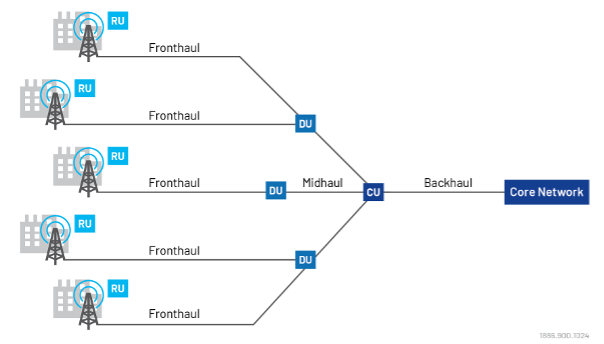
The concept of Open RAN disaggregates the traditional radio access network infrastructure into modules connected by standardized interfaces (Figure 1). Among these, the open radio unit (O-RU) handles the RF and digital front end and parts of the physical layer, as well as the digital beamforming functionality. One or more radio units connect to a distributed unit (O-DU) that sits close to the O-RU and runs the radio link, media access control (MAC), and remaining parts of the physical layer not handled by the O-RU. The O-CU is the centralized unit that manages one or more distributed units and connects to the core network, dealing with radio resource control (RRC) and data-packet handling, including compression and security.
RF1
Figure 1. Open RAN divides the radio-access infrastructure into multiple standardized modules and interfaces.

The Open RAN specifications, as developed by the O-RAN Alliance, aim to standardize the fronthaul interface between the O-RU and O-DU, and interoperability profiles for the midhaul interface between the O-DU and O-CU. In addition, the RAN Intelligent Controller (RIC) is a software-defined function that resides in the cloud and provides programmability.

By separating these elements of the network and standardizing the interfaces between them, Open RAN lets vendors focus their expertise and capabilities on developing specific items of equipment. This contrasts with the traditional model that requires companies to deliver a complete vertically integrated solution. As a result, smaller enterprises such as startups and scale-ups can bring individual innovations that add value, increase competition and accelerate deployment of new services.

Certification and badging

While opening the network can encourage new technology vendors to enter the market alongside established incumbents, any products placed on the market must offer strict assurances of performance and interoperability. Open RAN’s primary advantage is its open and modular architecture, which allows components from different vendors to work together seamlessly. However, rigorous testing is critical to ensure that products from various vendors provide the expected features and performance and can interoperate with equipment from other vendors without issues. Testing a module against the published standards and with different vendors’ equipment is critical to ensuring that it will integrate smoothly in multi-vendor environments.

The O-RAN Alliance, for example, oversees certification and badging for compliant modules, granted after successful evaluation at approved test facilities called Open Testing and Integration Centers (OTICs). An O-RAN certificate attests that an item of equipment is conformant to O-RAN specifications. O-RAN badging, on the other hand, confirms the equipment’s interoperability, or end-to-end functionality in the case of a complete O-RAN solution.

Product lifecycle testing

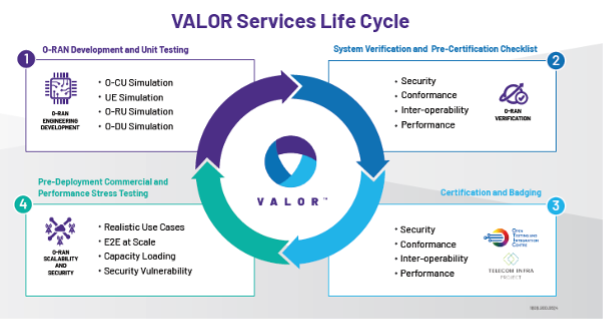
As part of the engineering process, companies need to test their products at various stages throughout development (Figure 2). In addition to highlighting any issues, testing allows vendors to experiment with new features and optimizations in a controlled environment.
RF2
Figure 2. Equipment-test requirements extend throughout the product lifecycle.

Moreover, informal testing immediately prior to performing official certification and badging tests can help avoid unexpected failures at the test house that can otherwise result in delays and extra expense. In addition, vendors often need to take approved equipment through dedicated pre-deployment tests in a realistic environment to verify commercial-grade performance.

Given the modular nature of Open RAN, with components sourced from multiple vendors, security testing is also essential to identify and mitigate potential risks. Through comprehensive security testing, vendors can identify vulnerabilities, ensure compliance with security standards and implement necessary safeguards to protect the network and user data.

By thoroughly testing products before they reach the customer, vendors can reduce the likelihood of post-deployment issues, thereby shortening the time-to-market and minimizing the need for costly and time-intensive troubleshooting.

However, the testing associated with Open RAN development, system verification, security, certification and pre-deployment is complex and the necessary equipment and systems represent a significant investment. Smaller companies often do not have the resources to establish their own dedicated testing lab and can face significant time and cost overheads to bring conformant products to market.

Editor’s note: This is Part 1 of a two part contributed article — you can read Part 2 here.

You Might Also Like
  • LoRaWAN is powering the next phase of IoT (Reader Forum)
  • How space traffic management can save our satellites (Reader Forum)
  • Agentic AI is exposing telecom’s visibility problem (Reader Forum)
  • Ensuring colocation success by eliminating network observability blind spots (Reader Forum)
  • The rise of agentic infra – why NetOps must outpace AI ambitions (Reader Forum)
  • Why throwing money at broadband speeds isn’t fixing America’s internet (Reader Forum)

Table of Contents

  • Open RAN for businesses and technologies
  • Certification and badging
  • Product lifecycle testing
Share 0 LinkedinEmail
Sameh Yamany, Chief Technology Officer, VIAVI Solutions

previous post
#TBT: Top tech and trends; ZTE bets on US telcos; telecom turns green… this week in 2013
next post
Dell offers telcos a holistic and ‘harmonious’ AI infrastructure approach

White Papers

  • Norton eBook: The 2026 Telco Playbook

  • Enea White Paper: Why Intelligent AAA is the Swiss Army Knife of Telecom

  • CSG White Paper: Telco AI Enabler: Mediation’s Defining Role

  • Enea White Paper: Scalable Database Design for 5G and Beyond

  • Supermicro and NVIDIA Whitepaper: Powering sovereign AI at scale

Editorial Reports

  • Report: Rethinking the RAN

  • Report: Building AI-Era Network Fabrics

  • Quantum Safe Networks Market Pulse Report

Webinars

  • Appledore Webinar: Closing the Agent-Ready Data Gap for Autonomous Networks

  • Mimosa Webinar – Build the Right Network

  • Webinar: Building 6G — aligning technology, policy and purpose

  • SIMCom Webinar: Scaling your next deployment – from plastic to provisioning

  • Webinar: Rethinking the RAN as AI, cloud and openness converge

Since 1982, RCR Wireless News has been providing wireless and mobile industry news, insights, and analysis to mobile and wireless industry professionals, decision makers, policy makers, analysts and investors.

Facebook Twitter Youtube Linkedin Envelope Rss

Useful Links

  • Subscribe
  • About RCR Wireless News
  • Contact Us
  • Advertise
  • Editorial Calendar
  • Archive
  • RSS
  • Wireless News Archive
  • Subscribe
  • About RCR Wireless News
  • Contact Us
  • Advertise
  • Editorial Calendar
  • Archive
  • RSS
  • Wireless News Archive

Edtior's Picks

New star in comms firmament – Softbank positions HAPS between terrestrial and satellite
Ericsson adaptive inventory
Appledore Webinar: Closing the Agent-Ready Data Gap for Autonomous Networks

Latest Articles

New star in comms firmament – Softbank positions HAPS between terrestrial and satellite
Ericsson adaptive inventory
Appledore Webinar: Closing the Agent-Ready Data Gap for Autonomous Networks
LoRaWAN is powering the next phase of IoT (Reader Forum)

© 2026 RCR Wireless News All Right Reserved. Developed by Eight Hats.

Cookie Policy | Privacy Policy

RCR Wireless
  • News
  • Channels
    • 5G
    • 6G
    • BSS OSS
    • Carriers
    • IoT
    • Network Infrastructure
    • Open RAN
    • Private 5G
    • Telco AI
    • Telco Cloud
    • Test & Measurement
  • Resources
    • Reports
    • Webinars
    • White papers
    • AI Fundamentals
    • Analyst Angle
    • Editorial Calendar
    • Fundamentals
      • 5G NR Release 17
      • AI
        • Telco AI in 2025
    • Podcasts
      • Let’s Get Digital with Carrie Charles
      • Wireless Connectivity to Enable Industry 4.0 for the Middleprise
      • Well Technically…
      • Will 5G Change the World
      • Accelerating Industry 4.0 Digitalization
  • AI Infrastructure
  • Programs
  • Events
  • RCRtv
  • Advertise
  • Subscribe
RCR Wireless
  • News
  • Channels
    • 5G
    • 6G
    • BSS OSS
    • Carriers
    • IoT
    • Network Infrastructure
    • Open RAN
    • Private 5G
    • Telco AI
    • Telco Cloud
    • Test & Measurement
  • Resources
    • Reports
    • Webinars
    • White papers
    • AI Fundamentals
    • Analyst Angle
    • Editorial Calendar
    • Fundamentals
      • 5G NR Release 17
      • AI
        • Telco AI in 2025
    • Podcasts
      • Let’s Get Digital with Carrie Charles
      • Wireless Connectivity to Enable Industry 4.0 for the Middleprise
      • Well Technically…
      • Will 5G Change the World
      • Accelerating Industry 4.0 Digitalization
  • AI Infrastructure
  • Programs
  • Events
  • RCRtv
  • Advertise
  • Subscribe
@2020 - All Right Reserved. Designed and Developed by PenciDesign
