


I know that now is the time of year for industry leaders to rattle off their top five predictions for the coming year, offering up a list of bullets that just so happen to fit into their product launch plans for the new year. I know because I’ve been guilty of this in the past.
This year I’ve found myself thinking at a different level and having deeper discussions with our customers and partners. The trigger for these discussions is AI, and its significance both for our industry and across industries – as industrial intelligence. It’s incumbent upon all of us to really think through both the impact and the possibilities. AI is a fundamentally different way of architecting networks and applications, and so places entirely different requirements on our networks. It is time for us to internalize the implications, and to rethink our approach.
Digital divide

The starting point for this conversation is to acknowledge something that has become obvious to me in my conversations with customers. There is a digital divide between enterprise office environments and the complex industrial environments managed by the largest industries across the globe.
Due to lack of connectivity in refineries, mining operations, manufacturing floors and warehouses, paper and pen are often used to collect data, which is then entered into a computer when the employee returns to the office and gets on Wi-Fi.
The resulting inaccuracy and inefficiency is astonishing. Add to this the promise of AI, and the widening gap is clear. Industries cannot reap the advantages of automation and AI if they haven’t solved the fundamental issue of connectivity.
Basics of AI
I need to talk about the two fundamental concepts of AI in order to make my next point. AI basically consists of two phases – training and inference – and these require two different concentrations of compute power. In the training phase, every piece of data that we can collect is sent to the cloud, including language and images from the Internet, information from the physical world, and all the data from digitized industrial environments. In the inference phase, the trained AI model applies its knowledge to respond to the environment and make real-time decisions.
AI training happens most efficiently in a large cloud data center. It requires a huge amount of compute running on parallel GPUs. In 2024 this is where all hype, attention and money were focused. But what we should be paying attention to is not where the puck is today, but where it is going.
As AI inference workloads are deployed, realizing the real value of AI, the need for compute power is very rapidly going to move to the edge. AI workloads will completely flip from the centralized data center where nearly 80% of the workload is today to more than half the workload running on the edge within two years.
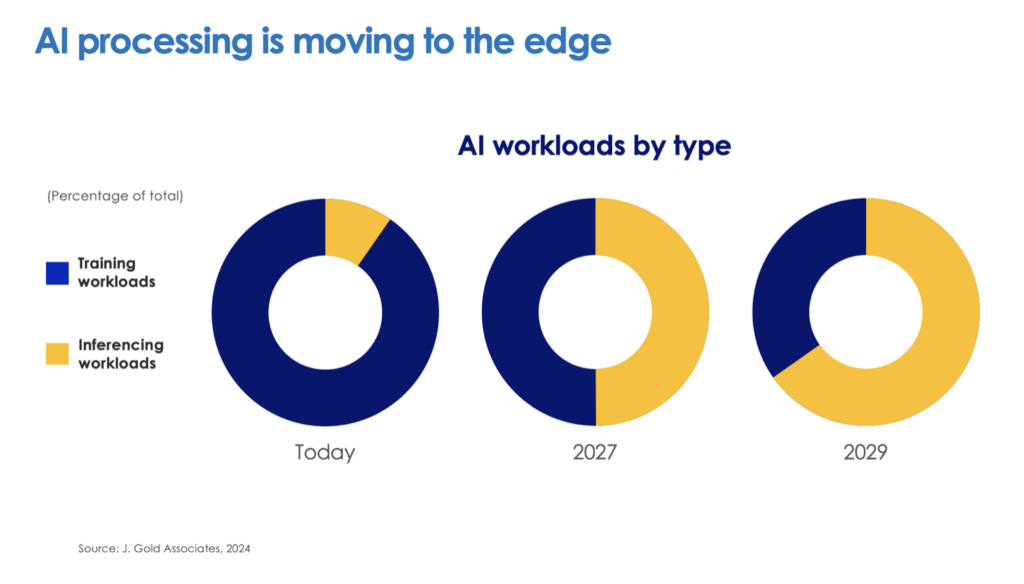
And within four years, more than 75% of the AI workload will be running on the network edge. That is a significant paradigm shift. And when we look at that shift as both network practitioners and network consumers, we need to ask ourselves, ‘what does this do to my network?’ That’s the question I’m exploring with my team and my customers. That’s the question I would encourage the industry to focus on in 2025, because this is the year to get ready for what’s coming. This shift requires a new way of architecting the network.
Intelligence stack
Let’s double click into the elements of this new AI inference-based edge model – the new intelligence stack – in an industrial environment where applied AI models will have a profound effect on productivity and profitability.
At the bottom of the stack are devices that range from low power legacy PLC controllers that are not going to run any modern operating system all the way up to sophisticated new cameras that will have embedded GPUs and next generation robots that will likely have some combination of local and centralized compute. Diversity in this device layer in an enterprise is extraordinary, and it will become even more so in this new age. All these devices need to get connected to the edge, which will stay on-prem.
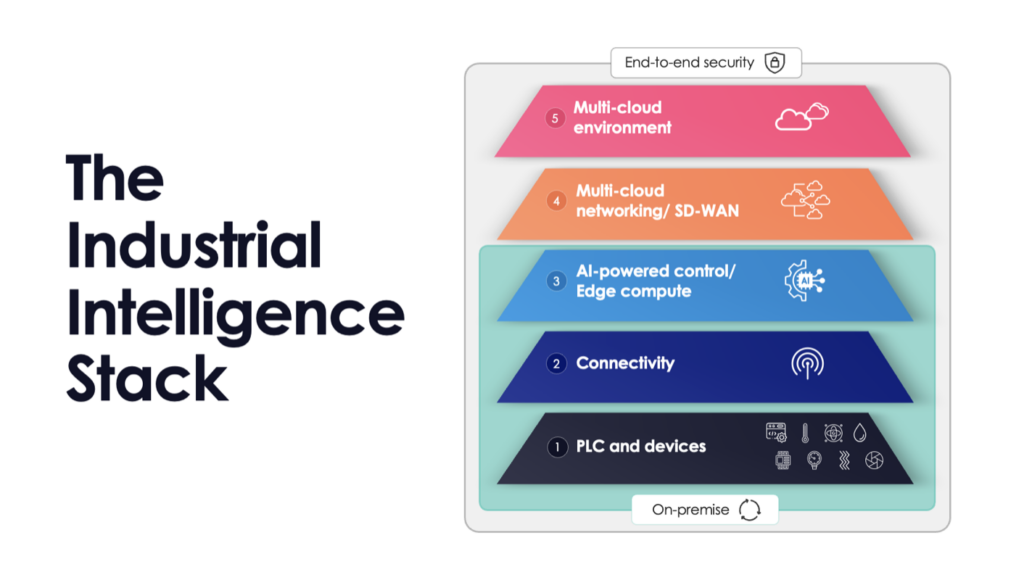
Edge compute is where there will be a significant amount of collaboration happening across devices. I’m not suggesting that this is where the entire AI inference workload will take place. I am confident that a big chunk of the workload will happen on the devices themselves, but this will also require a great deal of coordination and additional compute between the two layers.
This is going to be the new standard application in our networks. In two years, we will move away from simple client-server models. In its place will be highly computational devices that require ultra-low latency high performance connectivity to apply the learnings and efficiencies of the AI inference workloads in real time. The job of the off prem cloud will be to perform non-latency sensitive tasks – sending the batch data to the cloud for continued AI training. And of course no stack is complete without taking security into account. Security needs to be applied across all these layers from the ground up – the new Industrial Intelligence Stack.
Wireless edge
Connectivity is a critical success factor in the industrial intelligence stack, and it’s my strong contention that this connectivity layer demands the attributes of what I’m calling the wireless edge. In an industrial environment, the wireless edge requires some very practical and significant advantages over every other wireless technology that has been deployed in the past.
Coverage has got to be robust, both indoors and out, and unimpeded by obstacles like steel racks. Zero-trust security is a must on both the IT and the OT networks, with visibility down to the device and application for automated troubleshooting and mitigation. The network has got to be reliable and defensible with SLAs. It cannot be the cause of downtime and lost productivity. Mobility and handoffs between devices like AGVs need to be truly seamless, with no glitches. And in order to respond to AI actions that need to happen in real-time for both efficiency and safety, ultra-low latency is required.
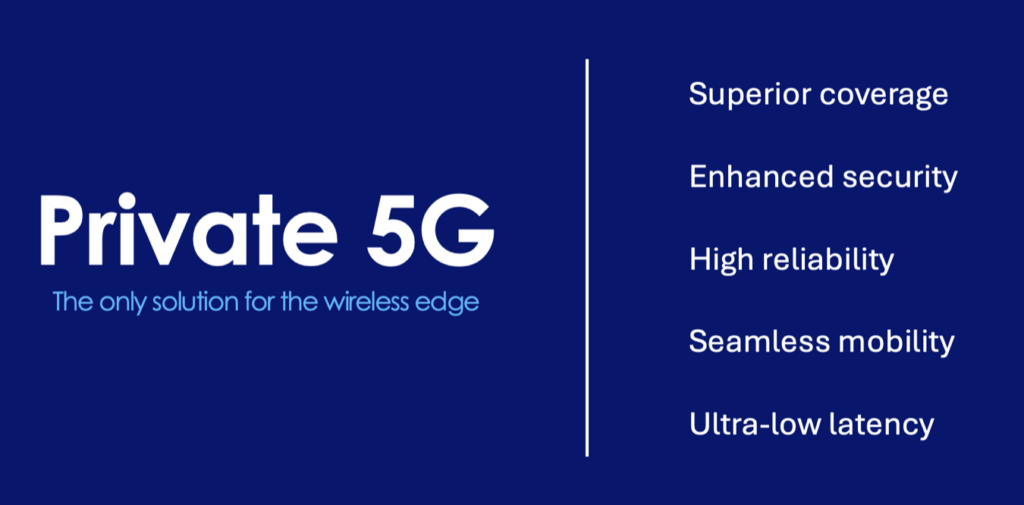
Five years into the Celona journey, I can confidently state that private 5G is the only technology that can solve this problem. There is no other option. Wi-Fi does not have the characteristics for the industrial environment. Wi-Fi is a great technology environment for offices, and it will continue to be the enterprise workhorse. But for industrial environments where AI will be deployed, it lacks all of these key characteristics. And public 5G is a consumer-oriented technology that was never built for the industrial enterprise. If it worked, industries would not be using pen and paper to solve their problems today.
Conclusion
My premise is that this complete stack does not exist today. Yet we will not achieve the vision of AI powered industry 4.0, without fixing this. Right now, all the big cloud vendors are spending billions, if not trillions, on the top layer. We have an extraordinarily mature SD-WAN and WAN environment. Edge compute is getting a lot of investment with new chips, new processors, and new energy from a few cutting-edge edge compute startups. And the industrial IoT device ecosystem itself is flourishing.
Our challenge – the industry’s challenge – is to figure out how best to create this new wireless edge, an industrial wireless edge that needs some very practical, yet significant advantages over every other wireless technology. I think the value, not just to our customers, but the entire economy and society, can be massive. The way I see it, we are building the glue that’s going to connect that stack to truly apply AI and drive levels of automation that will make the promise of Industry 4.0 a reality. This is the opportunity of a lifetime for all of us. That’s the vision.
Rajeev Shah is the co-founder and CEO of Celona, leading the charge to revolutionize wireless connectivity for enterprise customers. With an industry track record spanning nearly two decades, Rajeev leveraged his business and technology expertise in enterprise Wi-Fi to help establish the new private 4G/5G category, launching Celona in 2019.

