


RCR Wireless
  • News
  • Channels
    • 5G
    • 6G
    • BSS OSS
    • Carriers
    • IoT
    • Network Infrastructure
    • Open RAN
    • Private 5G
    • Telco AI
    • Telco Cloud
    • Test & Measurement
  • Resources
    • Reports
    • Webinars
    • White papers
    • AI Fundamentals
    • Analyst Angle
    • Editorial Calendar
    • Fundamentals
      • 5G NR Release 17
      • AI
        • Telco AI in 2025
    • Podcasts
      • Let’s Get Digital with Carrie Charles
      • Wireless Connectivity to Enable Industry 4.0 for the Middleprise
      • Well Technically…
      • Will 5G Change the World
      • Accelerating Industry 4.0 Digitalization
  • AI Infrastructure
  • Programs
  • Events
  • RCRtv
  • Advertise
  • Subscribe
Saturday, July 11, 2026
RCR Wireless
  • News
  • Channels
    • 5G
    • 6G
    • BSS OSS
    • Carriers
    • IoT
    • Network Infrastructure
    • Open RAN
    • Private 5G
    • Telco AI
    • Telco Cloud
    • Test & Measurement
  • Resources
    • Reports
    • Webinars
    • White papers
    • AI Fundamentals
    • Analyst Angle
    • Editorial Calendar
    • Fundamentals
      • 5G NR Release 17
      • AI
        • Telco AI in 2025
    • Podcasts
      • Let’s Get Digital with Carrie Charles
      • Wireless Connectivity to Enable Industry 4.0 for the Middleprise
      • Well Technically…
      • Will 5G Change the World
      • Accelerating Industry 4.0 Digitalization
  • AI Infrastructure
  • Programs
  • Events
  • RCRtv
  • Advertise
  • Subscribe
Add RCR Wireless as a preferred source on Google
  • Qualcomm 6G Insights
  • Huawei Content Hub
  • Qualcomm – 6G Vision
  • OSS/BSS Channel
  • RCRTech Roundtable: AI Infrastructure
RCR Wireless
RCR Wireless
  • Advanced Mimo
  • Mobile mmWave
  • 5G Positioning
  • Green Networks
  • Metaverse
  • Automotive
  • Industrial and Wide-area IoT
Copyright 2021 - All Right Reserved
Home - Neutral-host networks – 47% cheaper, 38% greener than separate 5G deployments
5G

Neutral-host networks – 47% cheaper, 38% greener than separate 5G deployments

by James Blackman November 21, 2024
written by James Blackman November 21, 2024 Share
LinkedinEmail
Share 0LinkedinEmail
Images: 123rf
Images: 123rf
244

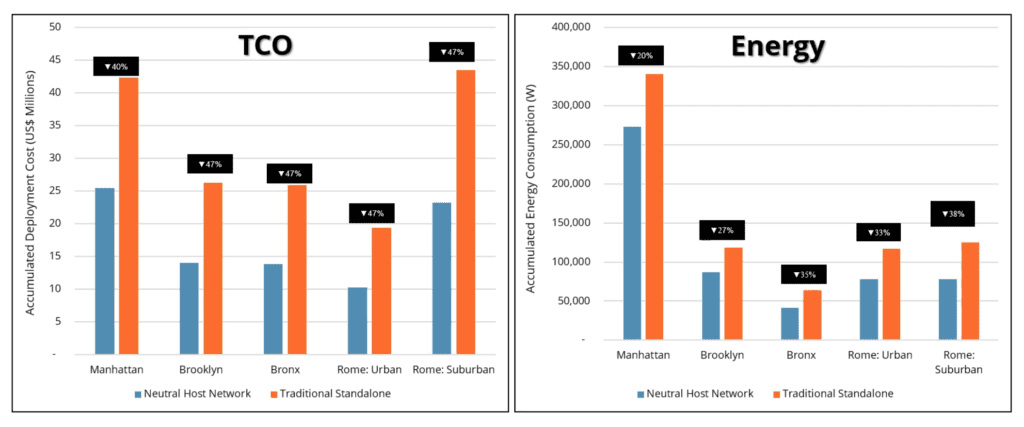
Neutral host networks are 47 percent cheaper and 38 percent greener (over a period) than traditional single-operator 5G deployments. This is the conclusion of a new study by ABI Research, commissioned by UK-based shared infrastructure specialist Boldyn Networks, which uses live neutral-host installations by the latter in New York City and Rome as the basis for its findings. The message is mobile operators, facing pressure to monetise 5G investments and scrutiny about ESG performance, should get an urgent grip on smarter shared 5G infrastructure densification.

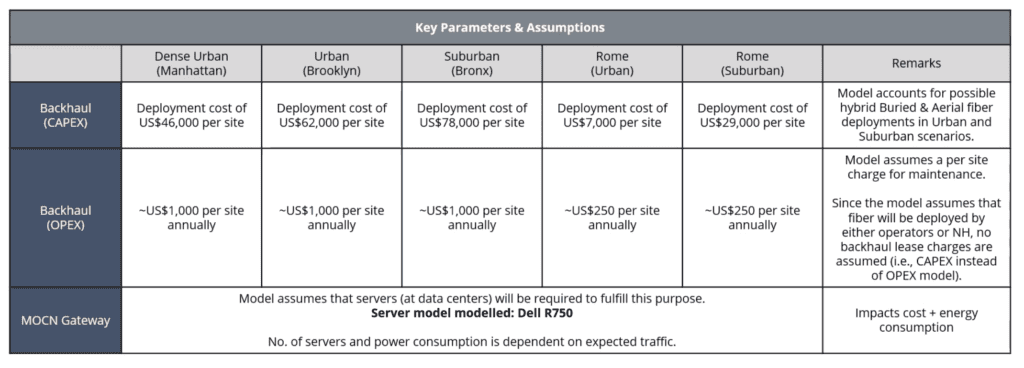
The model, which “simulates” deployments by Boldyn Networks in the US and Italy, assumes an average tenancy rate of 2.4 large mobile operators through to 2028, and a shared multi-operator core network (MOCN) as the neutral-host model. It proposes that fibre backhaul, MOCN gateways, small cells, power, trenching, construction, and maintenance are all shared by operators – where they would be managed separately with separate deployments. Traffic dimensioning, architecture comparisons, and greenfield/brownfield scenarios were factored in.

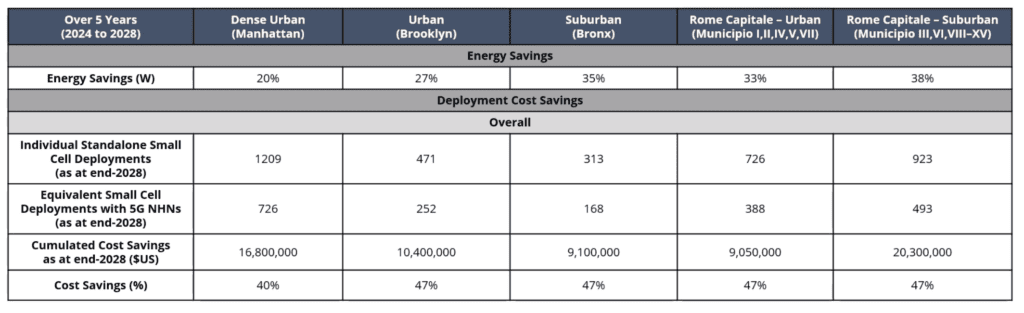
In New York City, the study considers a dense urban setup (with highest traffic) in Manhattan, an urban setup (high traffic) in Brooklyn, and a suburban setup (moderate traffic) in the Bronx. It proposes these will require 726, 252, and 168 neutral-host small cells (“2024 to 2028”) – versus 1,209, 471, and 313 in ‘standalone’ deployments, across 2.4 separate 5G densification projects. In Rome, it considers the same traffic payloads on urban and suburban setups in various districts (respectively: municipios one, two, four, five, seven; municipios three, six, eight-through-15). 
Boldyn ABI 2

ABI Research suggests 388 and 493 small deployments across two neutral-host networks in Rome; this is compared with 726 and 923 small cells in standalone deployments. ABI Research extrapolates figures based on cap-ex investments of between $7,000 (urban Rome) and $78,000 (suburban New York) per site for fibre backhaul, and annual op-ex investments of between $250 (Italy) and $1,000 (US) for the same. It also assumes usage of shared CBRS spectrum in the US, and of standard off-the-shelf small cells (from Nokia) and gateways (Dell). 

In sum, cumulative cost savings for neutral-host networks over four years are between 40 percent (in dense-urban setups; Manhattan) and 47 percent (for everywhere else), and that cumulative energy savings (based on reduced energy usage) over the same period are between 20 percent (dense-urban; Manhattan) and 38 percent (suburban; Rome). L“Energy savings [are] inversely proportional to densification/utilisation,” says ABI Research, leading on the latter. “Lower densification… in suburban areas leads to increased energy savings.”
Boldyn ABI 3

It goes on: “Cost savings (in terms of quantum amount) per site [are] highest in suburban areas. This is largely attributed to the higher cost of fibre deployments (longer pulls and trenching), due to less developed fibre infrastructure in suburban areas… [But] the relative cost percentage savings remain consistent across all scenarios – as [the] cost model scales… with traffic and the number of sites. Fixed costs, such as network planning, only takes up a small proportion of the overall costs…. With [more operators], the savings [would] be even higher.”

Savings in greenfield scenarios are described as “significant”, compared with brownfield deployments – primarily because of “consolidation of cap-ex costs to deploy fibre backhaul and power equipment”. Boldyn Networks writes: “At a time when carriers… are held accountable for how they are delivering on their ESG commitments, these findings demonstrate that the network sharing concept of neutral-host networks significantly lessens the environmental – and cost – challenges associated with 5G densification. The full report is available here. 
Boldyn ABI 4

Dimitris Mavrakis, senior research director at ABI Research, said: “There are significant cost, energy, and efficiency benefits when considering a neutral host over a traditional network deployment. Network modelling in New York and Rome shows… a substantial improvement [with neutral host arrangements] to operators’ 5G expansion efforts… Neutral host operators such as Boldyn Networks will play an increasing role in network densification efforts in the next few years.”

Brendan O’Reilly, group chief operating officer at Boldyn Networks, said: “As an industry, we have responsibility to roll-out new networks in a way that is both cost-effective and sustainable. The neutral host model is an elegant, practical solution to reducing capital and operating expenditure for [operators]. It is also critical to accelerating the adoption of 5G and ensuring the delivery of transformative connectivity services… If the telecoms industry is to truly deliver on the promise of a sustainable, inclusive, interconnected future then operators must consider neutral host [networks as] a real alternative to delivering future networks.”


You Might Also Like
  • Mimosa Networks and Viaero Wireless demonstrate scalable 5 GHz and 6 GHz fixed wireless broadband with AFC
  • What defines network performance in 5G and beyond? A CTO Perspective
  • Elisa says AI automation has cut network incidents by over 80%
  • Huawei outlines AI-centric network roadmap for telecom monetization
  • Indosat outlines AI Grid vision as 5G modernization targets nationwide AI-ready network
  • Huawei shows how 5G and AI are reshaping tourism in China
Share 0 LinkedinEmail
James Blackman
James Blackman

James Blackman has been writing about the technology and telecoms sectors for over a decade. He has edited and contributed to a number of European news outlets and trade titles. He has also worked at telecoms company Huawei, leading media activity for its devices business in Western Europe. He is based in London.

previous post
Singtel drafts-in Ericsson to slice and dice 5G at new Singapore ‘mega’ port
next post
#TBT: … wireline phones going out of style; Senate passes anti-spam bill; 800 MHz fight continues … this week in 2003

White Papers

  • Enea White Paper: Why Intelligent AAA is the Swiss Army Knife of Telecom

  • CSG White Paper: Telco AI Enabler: Mediation’s Defining Role

  • Enea White Paper: Scalable Database Design for 5G and Beyond

  • Supermicro and NVIDIA Whitepaper: Powering sovereign AI at scale

  • VIAVI Whitepaper: RAN scenario generators and their critical role for future-proofing AI-native RAN in Advanced 5G and 6G networks

Editorial Reports

  • Report: Scaling Optical Networks For The Hyperscale And AI Era

  • Test And Measurement Market Pulse Report

  • Editorial Report: Securing telecom infrastructure for the quantum era

Webinars

  • Webinar: Building 6G — aligning technology, policy and purpose

  • SIMCom Webinar: Scaling your next deployment – from plastic to provisioning

  • Webinar: Rethinking the RAN as AI, cloud and openness converge

  • Webinar: Scale-Up, Scale-Out, Scale-Across – Building AI-Era Network Fabrics

  • Webinar: NTN in motion – evolving standards, expanding services

Since 1982, RCR Wireless News has been providing wireless and mobile industry news, insights, and analysis to mobile and wireless industry professionals, decision makers, policy makers, analysts and investors.

Facebook Twitter Youtube Linkedin Envelope Rss

Useful Links

  • Subscribe
  • About RCR Wireless News
  • Contact Us
  • Advertise
  • Editorial Calendar
  • Archive
  • RSS
  • Wireless News Archive
  • Subscribe
  • About RCR Wireless News
  • Contact Us
  • Advertise
  • Editorial Calendar
  • Archive
  • RSS
  • Wireless News Archive

Edtior's Picks

Webinar: Building 6G — aligning technology, policy and purpose
Vodafone at the heart of Euro telco reset as Iliad owner buys e&...
How operations leaders see 5G as vital for mission-critical workflows (Reader Forum)

Latest Articles

Webinar: Building 6G — aligning technology, policy and purpose
Vodafone at the heart of Euro telco reset as Iliad owner buys e& stake for $5.9bn
How operations leaders see 5G as vital for mission-critical workflows (Reader Forum)
Thursday (telco diary) | The plumbing is the product

© 2026 RCR Wireless News All Right Reserved. Developed by Eight Hats.

Cookie Policy | Privacy Policy

RCR Wireless
  • News
  • Channels
    • 5G
    • 6G
    • BSS OSS
    • Carriers
    • IoT
    • Network Infrastructure
    • Open RAN
    • Private 5G
    • Telco AI
    • Telco Cloud
    • Test & Measurement
  • Resources
    • Reports
    • Webinars
    • White papers
    • AI Fundamentals
    • Analyst Angle
    • Editorial Calendar
    • Fundamentals
      • 5G NR Release 17
      • AI
        • Telco AI in 2025
    • Podcasts
      • Let’s Get Digital with Carrie Charles
      • Wireless Connectivity to Enable Industry 4.0 for the Middleprise
      • Well Technically…
      • Will 5G Change the World
      • Accelerating Industry 4.0 Digitalization
  • AI Infrastructure
  • Programs
  • Events
  • RCRtv
  • Advertise
  • Subscribe
RCR Wireless
  • News
  • Channels
    • 5G
    • 6G
    • BSS OSS
    • Carriers
    • IoT
    • Network Infrastructure
    • Open RAN
    • Private 5G
    • Telco AI
    • Telco Cloud
    • Test & Measurement
  • Resources
    • Reports
    • Webinars
    • White papers
    • AI Fundamentals
    • Analyst Angle
    • Editorial Calendar
    • Fundamentals
      • 5G NR Release 17
      • AI
        • Telco AI in 2025
    • Podcasts
      • Let’s Get Digital with Carrie Charles
      • Wireless Connectivity to Enable Industry 4.0 for the Middleprise
      • Well Technically…
      • Will 5G Change the World
      • Accelerating Industry 4.0 Digitalization
  • AI Infrastructure
  • Programs
  • Events
  • RCRtv
  • Advertise
  • Subscribe
@2020 - All Right Reserved. Designed and Developed by PenciDesign