

To understand the commercial reality of cellular connectivity, in this case 5G, it’s important to understand the standardization work that set the stage for real-world deployments. So before we look into what’s coming from 3GPP in Releases 18, 19 and beyond, it’s important to take stock of where we are today with 5G; what did we get right, what could we have potentially done better, and what did we learn?
GSA Industry Standardization and Strategy Consultant Adrian Scrase, formerly the CTO of ETSI and a part of 3GPP, told attendees to the Industrial 5G Forum (available on-demand here) that with 5G the industry delivered a “single global unified standard…That took basically three decades to achieve…It wasn’t easy. But having got there, industry really recognizes the value of having a single global unified standard. There are very sound economic reasons why we should try to achieve that. And the question going forward of course, is will we be able to do that again in the next generation?”
With 5G, and even more so with how 6G is being discussed, more coverage—ubiquitous coverage even—is a goal, albeit a very difficult to achieve goal. “How do we make sure that everybody has the coverage that they need, the service that they need,” as Scrase put it. Well, with 5G today, fixed wireless access (FWA) is not only expanding coverage but also making operators money, so a rare win-win. And also not necessarily what most industry watchers expected from 5G.
“I think there was a little bit of skepticism about, well, why are we doing this,” Scrase said, reflecting on FWA. “But history has shown that actually fixed wireless access has been hugely attractive because it does do exactly what I’ve described. It helps to improve coverage in areas where broadband access may not be otherwise viable. So from a fixed wireless access point of view, I think we can claim that this was a good job done.”
The slow transition to 5G Standalone
Standard-compliant commercial 5G launches started in 2019 with the vast majority in adhering to the 5G Non-standalone architecture meaning new spectrum and radio equipment was deployed with support from the 4G core. The next step is an upgraded cloud-native core which would move operators forward to 5G Standalone; however, the move to 5G Standalone has been slower than initially anticipated. Why?
Scrase looked at both sides of the issue. The option of 5G Non-standalone potentially “delayed the introduction of standalone.” But the option of Non-standalone gave operators a “stepping stone…So I think we should at least learn that where you have options, there is a price that you pay for having those options.”
But ultimately it’s up to the operator, and Scrase pointed out the importance of scrutinizing not just how to do something but why it should (or should not) be done. The standards and technology for 5G Standalone are mature, he said. But, “What’s lacking is the business case that says, ‘It’s in my interest to actually deploy this because it’s going to make me more money.’ And this, I think, is something the industry really needs to take on board because from where I’ve sat for the last three or four decades, we are so good at technology, we’re so good at coming up with innovation that solves problems. What we’re not so good at is predicting market readiness, predicting what will be the high hitters. We’ve always looked for the killer application, and we’ve rarely found them. So my view is that we should at least be investing more effort in trying to understand the business side of mobile to complement the very good work that we do on the engineering side of mobile.”
Non-terrestrial networks, RedCap and, of course, AI
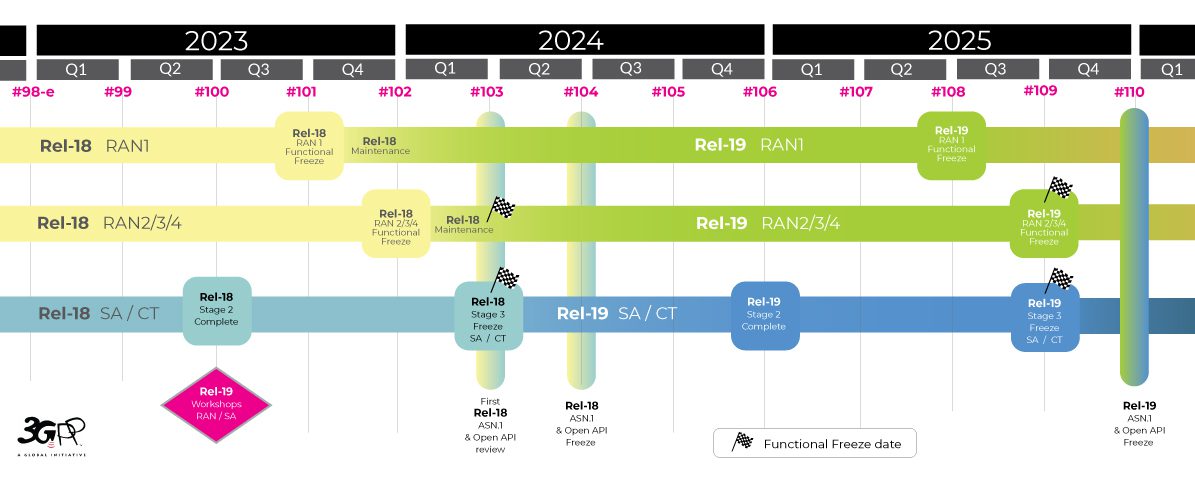
The current focus of 3GPP is work on Release 19 which Scrase described as having two primary themes. First, “It will continue to further evolve the 5G portfolio of capabilities and functionalities, so we will see continuous evolution then of 5G.” And second, “It will also pave the way for the next generation to come, so some of the things we will see introduced in Release 19 will be precursors to what will eventually become a 6G work program.”
Stepping back, Release 18 is the first set of technical specifications for 5G-Advanced; some primary elements include ongoing enhancements to network performance delivered by enhanced MIMO, improved carrier aggregation and spectrum efficiency gains, extended use cases tailored to the needs of particular vertical markets, system-level energy efficiency improvements, and enhanced mobility management. It also included an emphasis on further integration of 5G with Non-terrestrial networks (NTNs) and the introduction of 5G NR Light, also called Reduced Capability (RedCap); RedCap is meant to take some of the performance improvements delivered by 5G and right-size the necessary technology for use in things like wearables and sensors.
Discussing RedCap Scrase reflected on the longer story of the internet of things (IoT) which is marked by “lots of forecasts…that there would be millions of devices per square kilometer…and that hasn’t happened. And there are good reasons why that hasn’t happened.” From a standards perspective, the big goal is supporting lower cost, lower performance IoT devices which maps to cost-effectiveness. To that point, “My prediction is that RedCap will be hugely successful because it has a particular focus on economy.”
NTN is a hot topic although not necessarily a new one; 2G, 3G and 4G all had satellite-based elements to varying degrees. But they weren’t designed in tandem with their terrestrial counterparts. In the 5G era, the standards approach has been to integrate satellite interfaces as a component of the standard rather than an add-on, Scrase said. This approach is meant to foster more seamless interoperability.
But with 5G and NTNs, “I would be lying to you if I said it was seamless,” Scrase said. “It isn’t But that’s the challenge now, having made this great step forward with 5G. As we go into Release 19 and beyond, we need to make that a seamless experience. And my optimism is that by the time we get to the next generation, it really will be seamless, so that you can roam not only from your Wi-Fi in your home to your mobile in your car, which is terrestrially based, but also to a non-terrestrial network and back again.”
And last, but certainly not least, AI. 3GPP is working on AI and machine learning (ML) for two reasons, Scrase said. “One is they wish to leverage AI to manage their networks, because this is a great technology if you want to have full automation of your networks without human intervention. But they also know that they will need to support AI applications that their consumers wish to use. So already in Release 19, there is work starting to define AI and ML interfaces, so that’s already in the Release 19 work program.”
But as that work progresses, telco AI is something of a goldrush at the moment. Telecoms vendors, both established and emerging, are putting into market a huge variety of AI-infused solutions—gen AI interfaces for internal document queries, algorithms to optimize energy efficiency/power consumption at radio sites, GPUs at edge sites to run third-party workloads, and the list goes on. As Scrase put it, “We do not need to wait for that next generation to actually start to leverage AI and ML.”

