

RCR Wireless
  • News
  • Channels
    • 5G
    • 6G
    • BSS OSS
    • Carriers
    • IoT
    • Network Infrastructure
    • Open RAN
    • Private 5G
    • Telco AI
    • Telco Cloud
    • Test & Measurement
  • Resources
    • Reports
    • Webinars
    • White papers
    • AI Fundamentals
    • Analyst Angle
    • Editorial Calendar
    • Fundamentals
      • 5G NR Release 17
      • AI
        • Telco AI in 2025
    • Podcasts
      • Let’s Get Digital with Carrie Charles
      • Wireless Connectivity to Enable Industry 4.0 for the Middleprise
      • Well Technically…
      • Will 5G Change the World
      • Accelerating Industry 4.0 Digitalization
  • AI Infrastructure
  • Programs
  • Events
  • RCRtv
  • Advertise
  • Subscribe
Saturday, July 4, 2026
RCR Wireless
  • News
  • Channels
    • 5G
    • 6G
    • BSS OSS
    • Carriers
    • IoT
    • Network Infrastructure
    • Open RAN
    • Private 5G
    • Telco AI
    • Telco Cloud
    • Test & Measurement
  • Resources
    • Reports
    • Webinars
    • White papers
    • AI Fundamentals
    • Analyst Angle
    • Editorial Calendar
    • Fundamentals
      • 5G NR Release 17
      • AI
        • Telco AI in 2025
    • Podcasts
      • Let’s Get Digital with Carrie Charles
      • Wireless Connectivity to Enable Industry 4.0 for the Middleprise
      • Well Technically…
      • Will 5G Change the World
      • Accelerating Industry 4.0 Digitalization
  • AI Infrastructure
  • Programs
  • Events
  • RCRtv
  • Advertise
  • Subscribe
Add RCR Wireless as a preferred source on Google
  • Qualcomm 6G Insights
  • Huawei Content Hub
  • Qualcomm – 6G Vision
  • OSS/BSS Channel
RCR Wireless
RCR Wireless
  • Advanced Mimo
  • Mobile mmWave
  • 5G Positioning
  • Green Networks
  • Metaverse
  • Automotive
  • Industrial and Wide-area IoT
Copyright 2021 - All Right Reserved
Home - ‘The driver is not low latency’ – Airbus is positive, also cautious, on private 5G
Private NetworksIndustry 4.0Internet of Things (IoT)IoTPrivate 5G

‘The driver is not low latency’ – Airbus is positive, also cautious, on private 5G

by James Blackman April 27, 2023
written by James Blackman April 27, 2023 Share
LinkedinEmail
Share 0LinkedinEmail
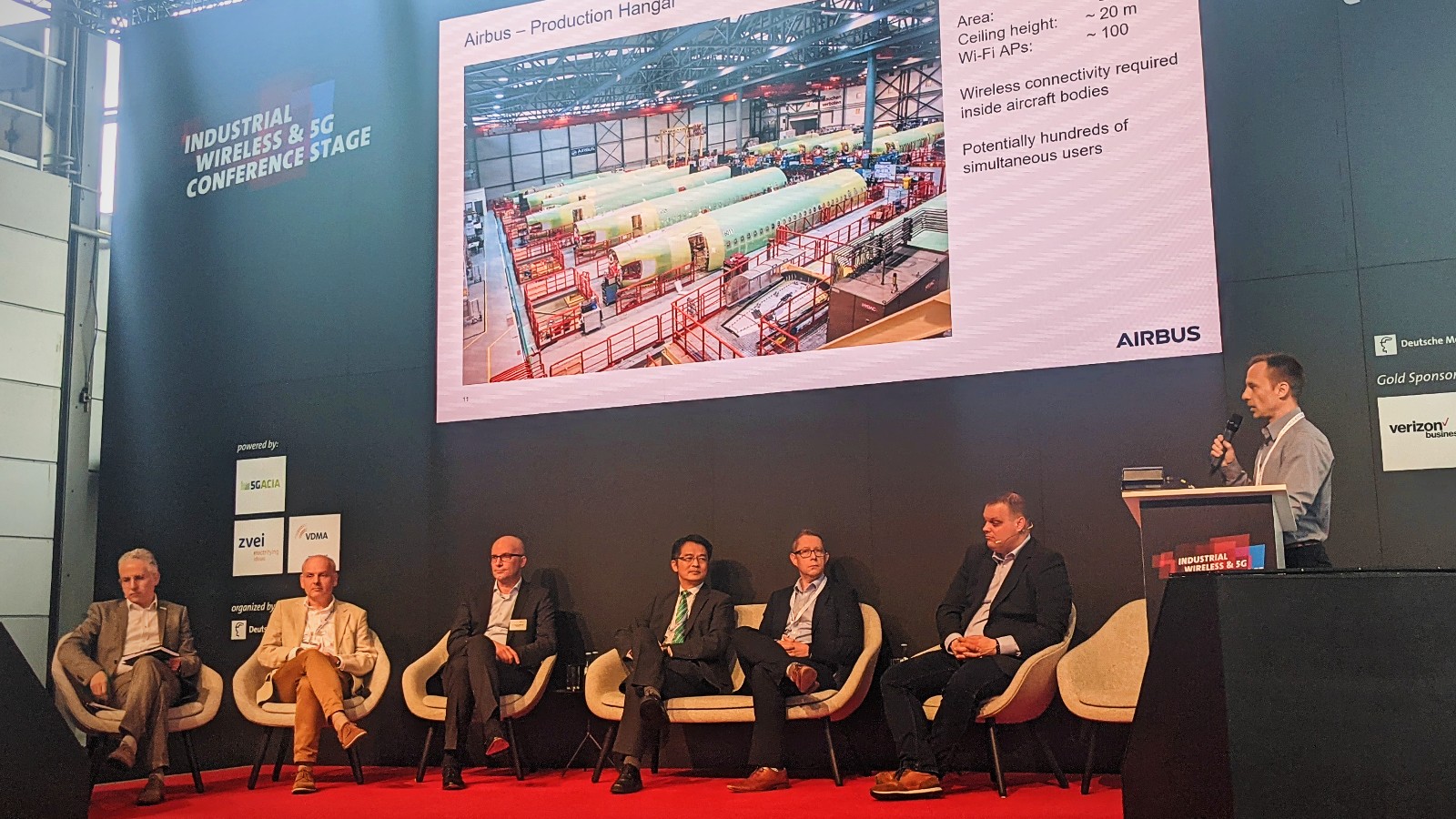
Jirka Klaue from Airbus – speaking during a panel session in the 5G Arena at Hannover Messe, flanked (from left) by Ericsson, Volkswagen, Bosch, Moxa, Radisys, and Siemens
194

Airbus listed the key benefits of private cellular networks, more or less in order, at Hannover Messe last week, and said, as it has before, that the initial business case hinges on coverage, mostly, in terms of both outdoor reach and indoor penetration. The second factor is the higher security afforded by all-edge private 5G infrastructure, it said; network performance and network costs, both related to the coverage aspect, are also strong benefits.

Jirka Klaue, from the firm’s IT department, joined a panel at Hannover Messe, together with execs from Bosch, Ericsson, Siemens, and Volkswagen, plus others, to present the enterprise case for 5G. His arguments were clearer; the Airbus position comes with less of the vendor bias of Ericsson, and even of Siemens, and less of the ecosystem bias (in this setting at least) of Bosch, which was represented on the panel by 5G-ACIA chair Andreas Mueller.

The Airbus position on private 5G is also bolder, arguably, than Volkswagen’s, presented on stage directly afterwards, which confirmed Klaue’s review of industrial 5G use cases, but to also express its own misgivings about the short-term applicability of 5G for easy-to-manage critical operations. Volkswagen, the biggest car maker in the world, only has four test networks in place, it said; by contrast, Airbus is among the first industrial firms to scale private 5G, albeit slowly.

“The first and most important point is the coverage,” said Klaue. Coverage, in terms of both distance and penetration, lends itself to certain other benefits, he explained, noticeably reliability and cost. The Airbus manufacturing plant at the Hamburg-Finkenwerder airport, covers an area of 3.6 square-kilometres, he said. It is already covered (badly) by 2,700 Wi-Fi access points; on paper, it can cover it rather better with just 60-odd cellular antennas.

Quite how far along Airbus is with extending its private 5G network at Hamburg-Finkenwerder is unclear. But it reckons it can get away with around 20 outdoor antennas and 40 indoor small cells, all pegged to the 3.7-3.8 GHz enterprise band in Germany. He emphasised the complexity of its manufacturing environments – in and out of aircraft – and said cellular solves a bunch of indoor coverage issues, for handsets, headsets, tablets, drills, and robots.

He said: “Cost is a point we are not sure on yet, but we think we will save money with private networks.” Some years ago, RCR Wireless caught Airbus at an HPE event, where Nokia also spoke about the still-novel concept of edge-based private cellular on private spectrum, where it talked about the idea that “yes, the driller has to drill, but it also has to compute”. Cellular holds-up in and around the aircraft, where rivets and screws are drilled, noted Klaue. 

“We have measured [signal performance] everywhere, and [we get a] 1.5 Gbps data rate everywhere,” he said, also confirming that the higher cybersecurity afforded by on-premise private 5G in private spectrum is another upside. “When we go to private networks, the data stays local, which is an advance in terms of both performance and cyber security… The driver is not super-low latency, but rather the coverage, reliability, and cyber security aspects.”

Klaue listed the initial use cases that Airbus is looking to enable, or to migrate from Wi-Fi: basic connectivity for sundry mobile devices to link to the manufacturing execution system (MES) on site; augmented and virtual reality (AR and VR) applications, notably for remote support, assistance, and inspection; plus for some robots, and commonly for “moving platforms” to transport aircraft parts, and classically for automated guided vehicles (AGVs).

He also returned to the “driller-has-to-compute” point about IoT monitoring and control in work devices, which gets less press coverage. “We use smart tools, so we know where they are and how much pressure and power – and that communication requires very low latency on the network side,” he said. But Klaue also noted some headaches and posers, including how to integrate private cellular into existing wireless LAN systems, as per the Volkswagen beef.

And the jury is out on the network management model, which Airbus has until now preferred to handle by itself. “We don’t know yet. At movement, we are doing it all ourselves. But to scale worldwide, we will probably go to outsource the service. And it will take some years to deploy everything in all plants.” So a note of caution at the end, and a reminder about just how early we are with 5G-enabled Industry 4.0.


You Might Also Like
  • Wednesday | Telco agents and smash hits (Editorial Diary)
  • ‘You can’t tame it’ – private networks, open standards and the AI proof for IoT
  • LoRaWAN eyes ‘fourth pillar’ status as IoT apps start to stack
  • New LoRaWAN roadmap puts focus on usability in bid for ‘massive’-scale IoT
  • In defense of CBRS – protecting American university innovation (Reader Forum)
  • T-Mobile’s big telco plot twist – from ‘un-carrier’ rebel to industry pace-setter
Share 0 LinkedinEmail
James Blackman
James Blackman

James Blackman has been writing about the technology and telecoms sectors for over a decade. He has edited and contributed to a number of European news outlets and trade titles. He has also worked at telecoms company Huawei, leading media activity for its devices business in Western Europe. He is based in London.

previous post
Vodafone intros full private 5G managed service offer in the UK
next post
The big shake-up in the cellular IoT platform market (Reader Forum)

White Papers

  • CSG White Paper: Telco AI Enabler: Mediation’s Defining Role

  • Enea White Paper: Scalable Database Design for 5G and Beyond

  • Supermicro and NVIDIA Whitepaper: Powering sovereign AI at scale

  • VIAVI Whitepaper: RAN scenario generators and their critical role for future-proofing AI-native RAN in Advanced 5G and 6G networks

  • Emerson/NI White Paper: 2026 Technology Trends Impacting the Wireless Communications Industry

Editorial Reports

  • Report: Scaling Optical Networks For The Hyperscale And AI Era

  • Test And Measurement Market Pulse Report

  • Editorial Report: Securing telecom infrastructure for the quantum era

Webinars

  • Webinar: Rethinking the RAN as AI, cloud and openness converge

  • Webinar: Scale-Up, Scale-Out, Scale-Across – Building AI-Era Network Fabrics

  • Webinar: NTN in motion – evolving standards, expanding services

  • Webinar: Noise-Figure Measurements with RFmx and PXI VSTs

  • Qualcomm Webinar – Building the 6G Standard: Key developments to know

Since 1982, RCR Wireless News has been providing wireless and mobile industry news, insights, and analysis to mobile and wireless industry professionals, decision makers, policy makers, analysts and investors.

Facebook Twitter Youtube Linkedin Envelope Rss

Useful Links

  • Subscribe
  • About RCR Wireless News
  • Contact Us
  • Advertise
  • Editorial Calendar
  • Archive
  • RSS
  • Wireless News Archive
  • Subscribe
  • About RCR Wireless News
  • Contact Us
  • Advertise
  • Editorial Calendar
  • Archive
  • RSS
  • Wireless News Archive

Edtior's Picks

Samsung’s AI RAN optimizer boosts KDDI 5G speeds up to 52% in live...
Indosat outlines AI Grid vision as 5G modernization targets nationwide AI-ready network
Wednesday | Telco agents and smash hits (Editorial Diary)

Latest Articles

Samsung’s AI RAN optimizer boosts KDDI 5G speeds up to 52% in live trial
Indosat outlines AI Grid vision as 5G modernization targets nationwide AI-ready network
Wednesday | Telco agents and smash hits (Editorial Diary)
Trust you can see – the convergence of voice, messaging, and identity (Reader Forum)

© 2026 RCR Wireless News All Right Reserved. Developed by Eight Hats.

Cookie Policy | Privacy Policy

RCR Wireless
  • News
  • Channels
    • 5G
    • 6G
    • BSS OSS
    • Carriers
    • IoT
    • Network Infrastructure
    • Open RAN
    • Private 5G
    • Telco AI
    • Telco Cloud
    • Test & Measurement
  • Resources
    • Reports
    • Webinars
    • White papers
    • AI Fundamentals
    • Analyst Angle
    • Editorial Calendar
    • Fundamentals
      • 5G NR Release 17
      • AI
        • Telco AI in 2025
    • Podcasts
      • Let’s Get Digital with Carrie Charles
      • Wireless Connectivity to Enable Industry 4.0 for the Middleprise
      • Well Technically…
      • Will 5G Change the World
      • Accelerating Industry 4.0 Digitalization
  • AI Infrastructure
  • Programs
  • Events
  • RCRtv
  • Advertise
  • Subscribe
RCR Wireless
  • News
  • Channels
    • 5G
    • 6G
    • BSS OSS
    • Carriers
    • IoT
    • Network Infrastructure
    • Open RAN
    • Private 5G
    • Telco AI
    • Telco Cloud
    • Test & Measurement
  • Resources
    • Reports
    • Webinars
    • White papers
    • AI Fundamentals
    • Analyst Angle
    • Editorial Calendar
    • Fundamentals
      • 5G NR Release 17
      • AI
        • Telco AI in 2025
    • Podcasts
      • Let’s Get Digital with Carrie Charles
      • Wireless Connectivity to Enable Industry 4.0 for the Middleprise
      • Well Technically…
      • Will 5G Change the World
      • Accelerating Industry 4.0 Digitalization
  • AI Infrastructure
  • Programs
  • Events
  • RCRtv
  • Advertise
  • Subscribe
@2020 - All Right Reserved. Designed and Developed by PenciDesign