

RCR Wireless
  • News
  • Channels
    • 5G
    • 6G
    • BSS OSS
    • Carriers
    • IoT
    • Network Infrastructure
    • Open RAN
    • Private 5G
    • Telco AI
    • Telco Cloud
    • Test & Measurement
  • Resources
    • Reports
    • Webinars
    • White papers
    • AI Fundamentals
    • Analyst Angle
    • Editorial Calendar
    • Fundamentals
      • 5G NR Release 17
      • AI
        • Telco AI in 2025
    • Podcasts
      • Let’s Get Digital with Carrie Charles
      • Wireless Connectivity to Enable Industry 4.0 for the Middleprise
      • Well Technically…
      • Will 5G Change the World
      • Accelerating Industry 4.0 Digitalization
  • AI Infrastructure
  • Programs
  • Events
  • RCRtv
  • Advertise
  • Subscribe
Wednesday, August 5, 2026
RCR Wireless
  • News
  • Channels
    • 5G
    • 6G
    • BSS OSS
    • Carriers
    • IoT
    • Network Infrastructure
    • Open RAN
    • Private 5G
    • Telco AI
    • Telco Cloud
    • Test & Measurement
  • Resources
    • Reports
    • Webinars
    • White papers
    • AI Fundamentals
    • Analyst Angle
    • Editorial Calendar
    • Fundamentals
      • 5G NR Release 17
      • AI
        • Telco AI in 2025
    • Podcasts
      • Let’s Get Digital with Carrie Charles
      • Wireless Connectivity to Enable Industry 4.0 for the Middleprise
      • Well Technically…
      • Will 5G Change the World
      • Accelerating Industry 4.0 Digitalization
  • AI Infrastructure
  • Programs
  • Events
  • RCRtv
  • Advertise
  • Subscribe
Add RCR Wireless as a preferred source on Google
  • Qualcomm 6G Insights
  • Huawei Content Hub
  • Qualcomm – 6G Vision
  • OSS/BSS Channel
  • RCRTech Roundtable: AI Infrastructure
RCR Wireless
RCR Wireless
  • Advanced Mimo
  • Mobile mmWave
  • 5G Positioning
  • Green Networks
  • Metaverse
  • Automotive
  • Industrial and Wide-area IoT
Copyright 2021 - All Right Reserved
Home - “Yes, the driller has to drill, but it also has to compute” – and other Airbus rules for Industry 4.0
Data AnalyticsFundamentalsInternet of Things (IoT)SensorsSmart FactoryWired Networks, Fiber

“Yes, the driller has to drill, but it also has to compute” – and other Airbus rules for Industry 4.0

by James Blackman January 24, 2019
written by James Blackman January 24, 2019 Share
LinkedinEmail
Share 0LinkedinEmail
169

Note, this was originally intended to be a two part series covering Airbus’ four essential lessons for Industry 4.0. Here, we are inserting another entry and another lesson, of sorts, into the middle of the planned schedule. Watch out for the final instalment; sign up for the newsletter here.

An important aspect of the digital architecture Airbus has established is to bring computer processing power to the tools in the hands of its factory workers.

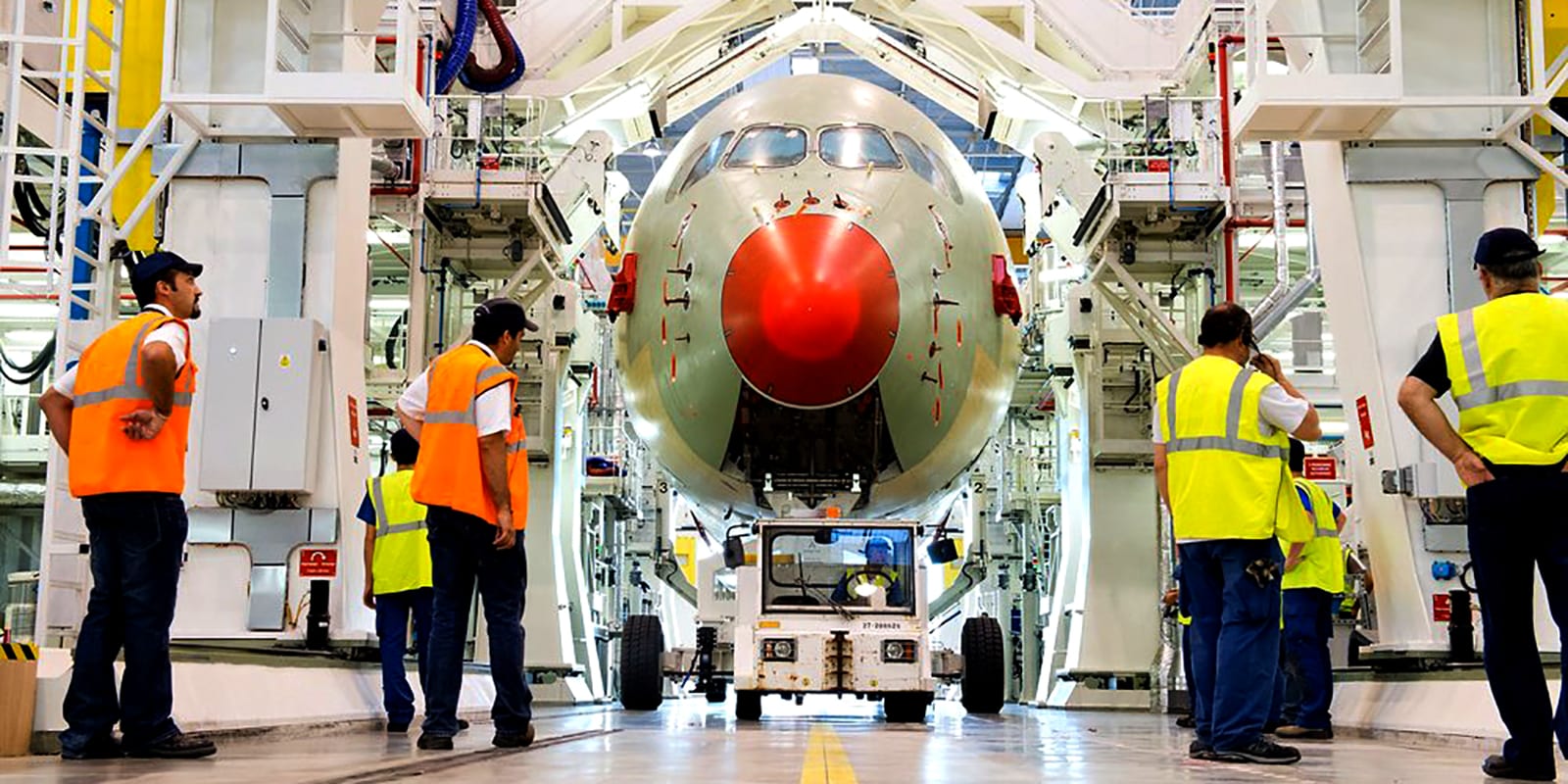
Airbus, as we have heard, is big on drilling – 120 million holes go into the fuselage, empennage, wings, and other body parts of its airplanes; 75 per cent of these are drilled by hand.

Amid the advanced automation and analytics on its production line, the European aeropsace company recognises the high impact of its regular workforce on its product and brand, and wants digital technologies to bring insights that raise their contribution.

For Airbus, the process of digitisation is not just about connecting programmable logic controllers (PLCs) on the shop floor, explains Sébastien Boria, R&D technology leader at Airbus, speaking at a recent HPE event in Switzerland. “Humans are unpredictable,” he explains.

Motion sensors are required to record their movements; embedded systems are needed to control the data logic. “Just solving the problem with OPC-UA won’t help. Because most of these tools – most of the clients integrated within them – are not PLCs. They are micro-controllers and digital signal processors,” he explains.

The hand tools, themselves, are running bespoke embedded systems, with ‘real-time’ constraints, and some compute power, memory, and a radio. “My OT world is more about embedded systems than just connecting things,” he says.

Boria’s role at Airbus is to tread the middle line, between IT and OT, and bring the two sides closer.

The difference, for Airbus, is many of its industrial devices are set to send data at low-frequency, low-latency intervals. In terms of their noise and discretion, they are silent and smart compared with default industrial setups, where data feeds indiscriminately into a centralised cloud function.

“Those are thin clients; what I call stupid clients,” says Boria. “They are really like TCP connectors. They might have a fancy function, like a display, but they aren’t intelligent – they are verbose; [data goes from] one system to another, without filtering, and without adding value.”

Airbus wants a closer hand in the dialogue, to manage the flow of data. “It’s just a computer version of Industry 3.0. It’s not Industry 4.0 – 4.0 means you are an actor in your digitalisation process. It’s not just data logging, which is fine, but it’s not enough.”

Airbus has developed and drafted-in its own factory tools for its production line, with their own custom compute systems and middleware.

“We don’t buy tools anymore that are only designed for the purpose they are meant for; yes, the driller has to drill, but it is also an actor with computation power, which will influence other parts of the process,” explains Boria.

The company is marrying these with robust connectivity (“not persistent, but there when we need it”), and strict rules about data transmission. “We don’t want verbose communication if it doesn’t fit with the action.”

This goes back to its low frequency and low latency requirements for data transmissions. “Instead of a fancy network link that gathers data every three seconds, we are keeping the information in the tool,” he explains.

Unless there’s an anomaly to report, Airbus’s bespoke drills transmit every 20 minutes. “It sounds a long time,” he says. But it is right for aerospace manufacturing. “If you have a takt time of 20 or 30 seconds, like in automotive, it is far too long. But our takt time is 12-16 hours.”

The key, it seems, is not the frequency; with repetitive tasks, the intelligence comes from filtering out the repetitive data – at source. On a 12-hour shift, manual tasks might be performed thousands of times across the production line.

The cleverness comes from knowing – in as near to real-time as possible – when the process or the product (or the process before the product) goes awry, and adjusting the production line to make light work of the discrepancy.

“It doesn’t have to be live; its just has to be there on time. Sometimes you have errors – you have a drilling that doesn’t go right. What we want is not just to train / trade that. But what is better is to be able to correct and repair the hole before we go to the next stage.”

A new report and webinar on edge computing in industrial IoT setups, called AI and IoT at the cutting edge – when to move intelligence closer to the action, is available; go here for the report,  go here for the webinar.

“Take your bullshit tech, and come back when it’s ready” – and other Airbus rules for Industry 4.0

“Yes, the driller has to drill, but it also has to compute” – and other Airbus rules for Industry 4.0

“Put an IT and OT in the same room, have them talk about ‘real time’” – and other Airbus rules for Industry 4.0

You Might Also Like
  • Physical AI is exposing a data sovereignty gap (Reader Forum)
  • Japan’s private 5G market is finally moving beyond demo experiments (Analyst Angle)
  • Hollow-core fiber won’t hit cost parity for a decade – regarding HKT’s 3.2Tbps DCI ‘superhighway’
  • AI drives new demands on optical networks, Ciena says
  • Monday (telco diary) | Sovereign AI for Industry 4.0
  • When the push becomes the pull – private 5G and physical AI
Share 0 LinkedinEmail
James Blackman
James Blackman

James Blackman has been writing about the technology and telecoms sectors for over a decade. He has edited and contributed to a number of European news outlets and trade titles. He has also worked at telecoms company Huawei, leading media activity for its devices business in Western Europe. He is based in London.

previous post
Huawei unveils 5G chipset and CPE; teases smartphone launches at MWC
next post
Kamstrup, Siemens to roll out large-scale smart metering project in Ireland

White Papers

  • Norton eBook: The 2026 Telco Playbook

  • Enea White Paper: Why Intelligent AAA is the Swiss Army Knife of Telecom

  • CSG White Paper: Telco AI Enabler: Mediation’s Defining Role

  • Enea White Paper: Scalable Database Design for 5G and Beyond

  • Supermicro and NVIDIA Whitepaper: Powering sovereign AI at scale

Editorial Reports

  • Market Pulse Report: Telco AI in 2026 – Trends, Challenges and Opportunities

  • Nvidia Report: The State of AI in Telecommunications: 2026 Trends

  • Report: Scaling Optical Networks For The Hyperscale And AI Era

Webinars

  • Webinar: Building 6G — aligning technology, policy and purpose

  • SIMCom Webinar: Scaling your next deployment – from plastic to provisioning

  • Webinar: Rethinking the RAN as AI, cloud and openness converge

  • Webinar: Scale-Up, Scale-Out, Scale-Across – Building AI-Era Network Fabrics

  • Webinar: NTN in motion – evolving standards, expanding services

Since 1982, RCR Wireless News has been providing wireless and mobile industry news, insights, and analysis to mobile and wireless industry professionals, decision makers, policy makers, analysts and investors.

Facebook Twitter Youtube Linkedin Envelope Rss

Useful Links

  • Subscribe
  • About RCR Wireless News
  • Contact Us
  • Advertise
  • Editorial Calendar
  • Archive
  • RSS
  • Wireless News Archive
  • Subscribe
  • About RCR Wireless News
  • Contact Us
  • Advertise
  • Editorial Calendar
  • Archive
  • RSS
  • Wireless News Archive

Edtior's Picks

SpaceX targets US carriers with small-cell terrestrial rollout and mega demand from physical...
SoftBank lifts AI growth outlook as cloud infrastructure enters monetization phase
Agentic AI is exposing telecom’s visibility problem (Reader Forum)

Latest Articles

SpaceX targets US carriers with small-cell terrestrial rollout and mega demand from physical AI
SoftBank lifts AI growth outlook as cloud infrastructure enters monetization phase
Agentic AI is exposing telecom’s visibility problem (Reader Forum)
Tuesday (telco diary) | More about ISAC – on battlefields and sportsfields

© 2026 RCR Wireless News All Right Reserved. Developed by Eight Hats.

Cookie Policy | Privacy Policy

RCR Wireless
  • News
  • Channels
    • 5G
    • 6G
    • BSS OSS
    • Carriers
    • IoT
    • Network Infrastructure
    • Open RAN
    • Private 5G
    • Telco AI
    • Telco Cloud
    • Test & Measurement
  • Resources
    • Reports
    • Webinars
    • White papers
    • AI Fundamentals
    • Analyst Angle
    • Editorial Calendar
    • Fundamentals
      • 5G NR Release 17
      • AI
        • Telco AI in 2025
    • Podcasts
      • Let’s Get Digital with Carrie Charles
      • Wireless Connectivity to Enable Industry 4.0 for the Middleprise
      • Well Technically…
      • Will 5G Change the World
      • Accelerating Industry 4.0 Digitalization
  • AI Infrastructure
  • Programs
  • Events
  • RCRtv
  • Advertise
  • Subscribe
RCR Wireless
  • News
  • Channels
    • 5G
    • 6G
    • BSS OSS
    • Carriers
    • IoT
    • Network Infrastructure
    • Open RAN
    • Private 5G
    • Telco AI
    • Telco Cloud
    • Test & Measurement
  • Resources
    • Reports
    • Webinars
    • White papers
    • AI Fundamentals
    • Analyst Angle
    • Editorial Calendar
    • Fundamentals
      • 5G NR Release 17
      • AI
        • Telco AI in 2025
    • Podcasts
      • Let’s Get Digital with Carrie Charles
      • Wireless Connectivity to Enable Industry 4.0 for the Middleprise
      • Well Technically…
      • Will 5G Change the World
      • Accelerating Industry 4.0 Digitalization
  • AI Infrastructure
  • Programs
  • Events
  • RCRtv
  • Advertise
  • Subscribe
@2020 - All Right Reserved. Designed and Developed by PenciDesign
