


Extending the 5G experience and its impact on the radio system
The adoption of 5G continues to thrive in the mobile market, with a raft of device types beyond smartphones set to form part of the wider ecosystem, extending to new industries and a wide array of device categories, including automotive, Extended Reality (XR), Personal Computers (PCs), wearables, Mobile Broadband (MBB) and the Industrial Internet of Things (IIoT). However, democratization of this extended 5G experience will be constrained, not just by the modem and application processor, but also by the growing complexity of the Radio Frequency Front End (RFFE). In turn, the sheer number of Radio Frequency (RF) components now needed in a 5G device has grown exponentially, while pressure to improve performance, increase thermal efficiency and condense the overall die size area have become ever more important to help reduce costs and ensure signal integrity and communication reliability.
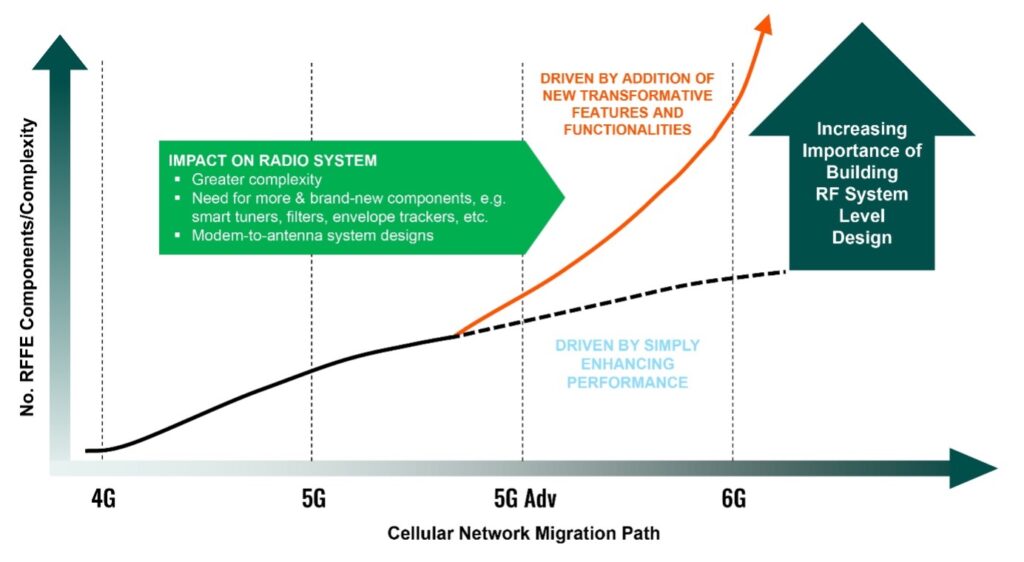
For this market growth to become reality, however, the industry will need to extend its reach beyond smartphones and Enhanced Mobile Broadband (eMBB) in general. The upcoming transition of 5G has its challenges and requires not only new modems, but also improved radio system components, including more filters, smarter tuning, envelope trackers, etc., to help support performance through the addition of new bands, carrier aggregation, etc. The addition of these new functionalities will place increasing demands on hardware, and this growth in RF content sparks a greater need for better radio designs that solve how to integrate the entire 5G cellular system into devices from the antenna to the modem, improving integration, power management and efficiencies. This is designed to make the task easier for Original Equipment Manufacturers (OEMs) to develop devices more quickly and effectively, while addressing both added costs and scalability.
In addition, as technology enhancements look to expand the device ecosystem, 5G is also gearing up to enter its next transformational phase, which will be driven largely by its transition to 5G-Advanced, while also trading on its coexistence with both Artificial Intelligence (AI) and next-generation Wi-Fi, notably Wi-Fi 7. The shift to integrate and conjoin these technologies with 5G will bring about substantial improvements, driven by the introduction of new use cases, features and functionalities. However, it also brings additional challenges to the radio system, including the addition of brand-new component types and the development of new device designs.
As the first step to overcoming these challenges, vendors are moving away from RF and RFFE assembly to adopt system-level radio designs, which is backed by numerous companies and organizations, including Qualcomm, MediaTek, etc. This approach can help maximize device performance without compromising overall device design, time to market, or cost.
Figure 1: New features and functionalities driving greater complexity in radio systems
Solving RF systems for advanced multimode cellular and Wi-Fi pplications
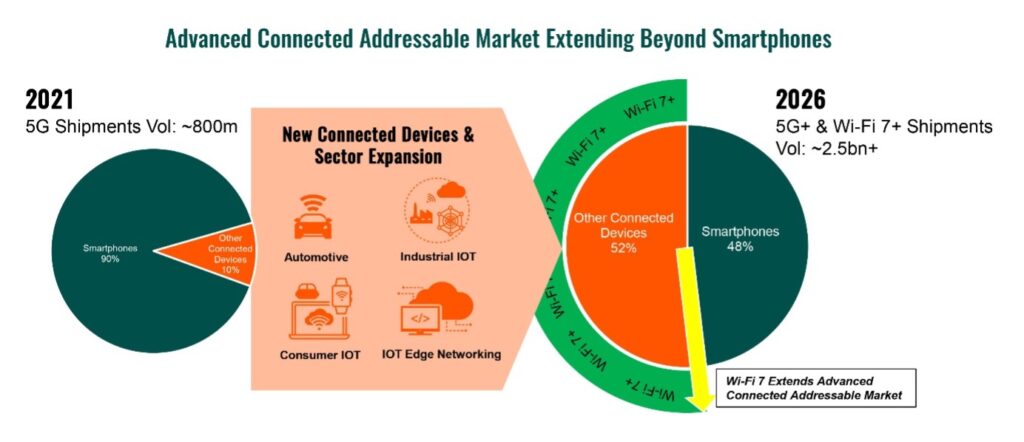
While the burden of 5G on the RFFE is starting to be resolved by the industry, this complexity is set to increase again if high bandwidths available in 5G are to be unlocked, coupled with coexistence with next-generation Wi-Fi, which also operates at high frequencies. Having the ability to provide greater integration between 5G and Wi-Fi connectivity, under this advanced connected market environment, will make the task easier for OEMs to develop devices more quickly and effectively, while addressing both added costs and scalability.
Figure 2: Advanced connected market moving rapidly beyond smartphones
In comparison to the rollout of 5G, great leaps in Wi-Fi performance have been enabled by the rapid expansion of available unlicensed spectrum in recent years, delivering enhanced throughput and latency speeds. However, this development has also heralded significant RF challenges in Wi-Fi not been previously experienced. Indeed, the expansion of Wi-Fi into the 6 Gigahertz (GHz) band and the emergence of the new Wi-Fi 7 standard are causing unprecedented technology complexity and challenges in the way that the radio is designed and implemented.
As witnessed in the 5G space, new RF designs and a greater number of filter derivatives are helping to address upcoming Wi-Fi challenges, such as addressing higher bandwidths, multiple channels, adjacencies to 5G New Radio (NR) frequencies, etc. However, further advancements are required in order to harness the full power of the newly available unlicensed spectrum in all markets and the promised technical improvements offered by Wi-Fi 7. Thus, RF design becomes essential in ensuring next-generation Wi-Fi-enabled equipment can effectively deliver on its promises, despite these new features putting tremendous constraints on the RFFE, and filter designs in particular. The use of multiple channels in Wi-Fi 7 and the tight adjacencies with 5G NR (5 – 7 GHZ Wi-Fi adjacent to 5G NR n79) makes the design of efficient filters that allow seamless coexistence with Wi-Fi spectrum extremely challenging.
Using AI to enhance the wireless communications air interface
The next wave of development is bringing AI to the radio system level to help boost performance, improve wireless communication and enable new use cases. Current methods for providing these solutions, such as active positioning, have limitations and the use of AI helps improve accuracy, while also reducing power consumption. Using this approach combines the complementary strengths of Machine Learning (ML) with the 5G domain to solve or improve difficult wireless communications challenges, which can create optimal solutions and accelerate wireless innovations. This AI enhancement can enrich end devices, improve the overall spectral efficiency of wireless networks, and enable new user experiences and use cases.
With wireless communications and RF sensing technologies continuing to advance, AI/ML is set to play an expanding role as the industry moves to new releases from The 3rd Generation Partnership Project (3GPP), and as it eventually transitions from 5G to 6G. However, to optimally exploit the capabilities of AI requires innate knowledge of the wireless environment.
Figure 3: AI enhanced radio enabling better device-network collaboration
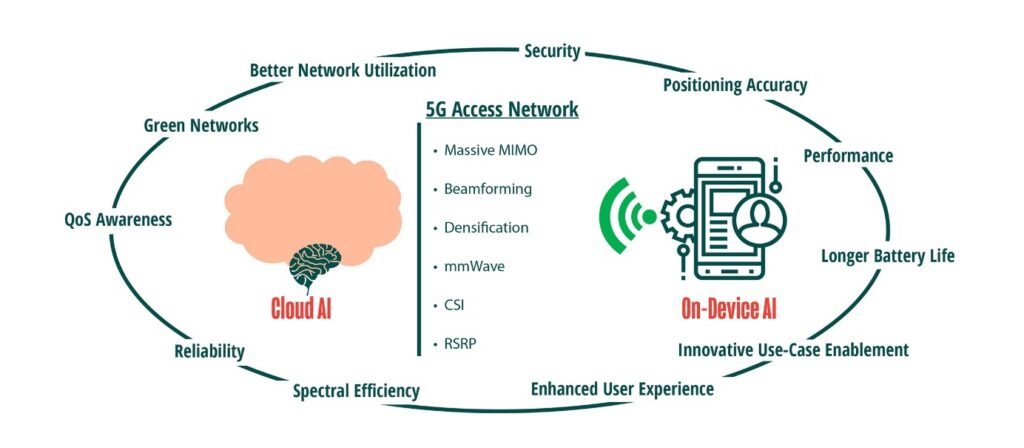
Part of the rationale behind adding AI to the radio system is providing additional help to combat the rapidly changing and challenging physical environment in which 5G devices are being used, both in terms of users’ locations and their handling of a device. Addressing these issues through AI will help mitigate dropped calls or degraded signal quality, while also conserving battery life. Such an approach will result in the key benefits of providing a better quality of network experience and enhancement of the user experience through more intelligent beamforming/beam management, while power management is improved by taking advantage of better contextual awareness on the device. Other benefits derived from adding AI include improved system performance and better radio security, while the computation of metrics, such as location, travel speed and other aspects of environmental and applications awareness, help improve signal robustness and data throughput.
Applying AI to wireless has its challenges, and it is still very much in its infancy, but it holds undoubted benefits and promise for the wireless arena. A number of companies and organizations along the wireless value chain, such as Qualcomm, MediaTek and Intel, have been researching the intersection of these technologies and are aiming to tackle advancing wireless communications and RF sensing. Specifically, Qualcomm has taken a pioneering role in adding AI into RF systems and has launched a number of AI-based solutions, including a dedicated AI processor and an 5G adaptive antenna tuning solution. It has also announced a modem-to-antenna system using AI/ML to enhance overall RF performance in 5G sub-6 GHz and Millimeter Wave (mmWave) for improved speeds, coverage, mobility and link robustness. Each of these solutions is set to provide enhanced user experiences and efficiencies to the device ecosystem. However, further iterations and more use cases will be added to the lineup, providing an evolution in AI-enhanced RF systems, buoyed further by emerging products from companies like MediaTek, Broadcom and Intel.
5G-Advanced transformational phase set to unlock new uses cases and applications
So far, 5G has correlated largely with use cases that require eMBB performance, which is mainly smartphones and a number of new device types, including Fixed Wireless Access (FWA) and hotspot router products. The technology has yet to attract new and lucrative business opportunities in either the consumer or enterprise segments beyond eMBB. However, this is set to change with future 3GPP 5G releases, including Release 16, Release 17 and beyond. While some cellular improvements will come about organically from the advent of 5G-Advanced, others will be the result of the introduction of new features and applications that are essential for a plethora of use cases and applications.
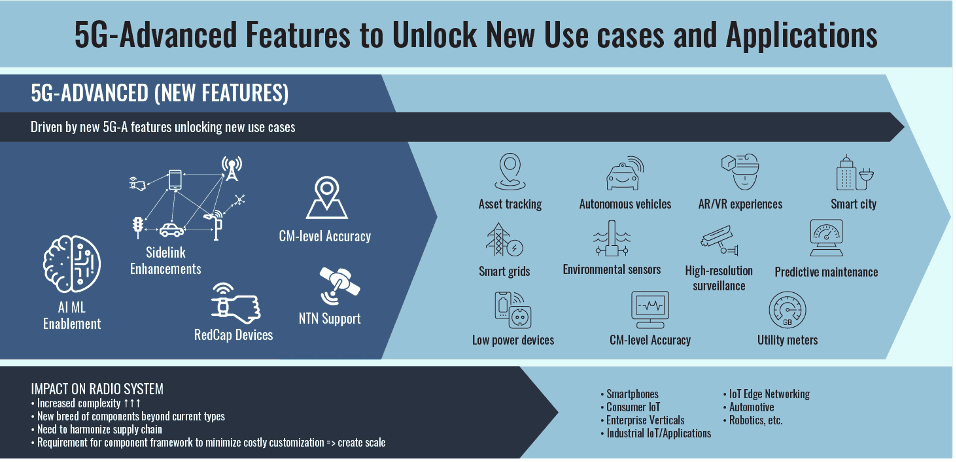
The new features and functionalities that 5G-Advanced brings will see a massive uplift in applications as they are designed to sustain a whole new raft of uses cases and device types. These new features — notably sidelink, Non-Terrestrial Network (NTN) support, Reduced Capability (RedCap) (5G NR-Light), accurate positioning and AI/ML enablement —are all 5G evolution vectors. These are designed to help unlock and more efficiently support both existing and a broad range of new use cases and more challenging applications. However, to address these new 5G-Advanced features will require additional new RF components and the support of new frequency bands, adding greater complexity to the radio system with some necessitating the use of additional hardware on top of what is already being addressed. In turn, adding such features will create additional product design considerations and constraints that will all need to be resolved, which adds yet another layer of complexity.
Figure 4: 5G transformational phase unlocking new uses cases and applications
It remains to be seen how long it takes before all 5G-Advanced features will make it to the marketplace and what market forces are likely to drive their implementations. It is now necessary for the mobile industry to accelerate its 5G-Advanced agenda to capitalize on its full potential. With the evolution toward 5G-Advanced, there is still much to be done to fully unlock the value of the 5G ecosystem and realize its full potential.
Key to unlocking new use cases and experiences
Such an expansion in 5G use cases designed to unlock these next-gen advanced experiences will lead to the development of greater numbers of device form factors and market segments, and advances in those that need to be more fine-tuned and sophisticated. This will lead to a large increase in the volume of devices taking market growth way beyond mobile phones. These new market applications will impact not just the consumer market, but also represent a huge opportunity in the enterprise sector across its multiple verticals. Indeed, considerable growth in a variety of uses cases will be improved and derive benefit from the introduction of 5G-Advanced, AI and next-gen Wi-Fi, which will ultimately lead to enhanced user experiences and efficiencies in the device ecosystem.
As the market continues its shift to 5G and beyond, the promise of sustained device and network enhancements, including the enablement of new use cases, faster data speeds, high signal performance, call reliability and quality, power efficiencies and improved coverage, all point to the use of technologies that are set to revolutionize RF design and drastically improve consumer experiences and use cases.
Figure 5: Market growth in advanced connectivity needs requisite system-level design
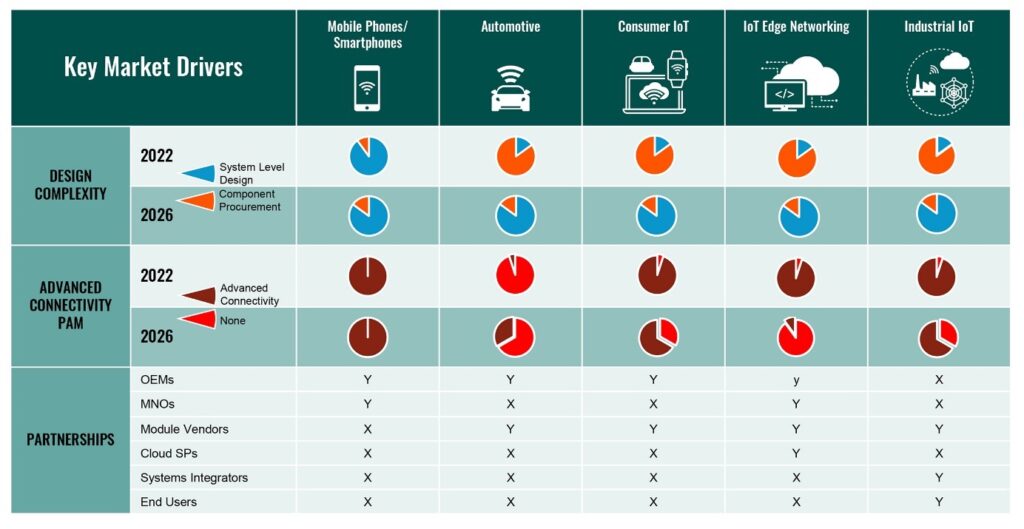
It is important to push the industry toward grasping the fundamentals for resolving the snowballing complexity of integrating these advanced connectivities while learning lessons in cellular radio design. The RF companies that win out and gain industry support will need to demonstrate that their solution—in whatever form that takes—is able to improve performance, reduce time to market, lower overall costs and allow flexibility and customization. Such metrics will become imperative for end-device differentiation, notably as the RF battleground extends into new sectors and markets beyond smartphones. Moreover, under such a market environment, it is expected that many of these new use cases will be mission-critical, so the radio system must be near-perfect; otherwise, it jeopardizes their existence before they even have the chance to get started.
Table of Contents

