

Among the many things we’ve learned during the era of Covid-19 is the importance of efficient, reliable, and always-available healthcare services. The urgency of the pandemic has not only spurred innovation and progress but has shined a bright light on the promise of healthcare IoT as society looks for ways to improve healthcare delivery systems and patient outcomes.
When considering what is most important when choosing connectivity technology for healthcare IoT, two important criteria stand out: security and reliability.
Nowhere in IoT (with the exception perhaps of banking) is data security as important as it is in healthcare IoT, where sensitive, personal patient information — including time-sensitive, critically-important data — must be monitored, transmitted, and analyzed. Data security must be established from the outset and it must extend from hospital and clinic networks on through to the connected health devices used by patients.
Connected healthcare IoT devices include a wide range of product types from simple fitness wearables, to medical equipment trackers, to even more complex devices measuring heart-rate, temperature, and blood pressure, some of which may contain alarm or emergency calling features. While many hospitals and clinics have used Wi-Fi and Bluetooth for communications, these technologies are not stable and cannot be reliable when a high volume of devices are connected.
To fulfill the promise of IoT healthcare and realize the high value of the market opportunity it represents, healthcare facilities and user devices need flexible, fast, and reliable connectivity even in remote areas. User devices cannot be dependent on Wi-Fi or Bluetooth tethers to smartphones, and the limitation of these types of solutions is clear: what does one do if not within the vicinity of his smartphone or Wi-Fi router, or the smartphone battery has died?
It has become clear that always-on, everywhere-available cellular is the only connectivity technology that can provide the security and reliability, and yes, simplicity, needed for effective and dependable healthcare delivery, and for healthcare IoT devices that consumers will freely use.
In 4G and 5G cellular IoT technology today, there are three options for connecting healthcare IoT devices: LTE-M, NB-IoT, and LTE Cat 1. The connectivity choice is made based on the application type and data speed required. LTE-M and NB-IoT are the narrowband technologies defined for low data rate IoT applications with LTE-M providing several hundreds of kilobits per second of throughput and NB-IoT merely tens of kilobits. LTE Cat 1 provides throughput up to 10 megabits per second.
LTE-M is suitable for most patient monitoring applications where patient data is expected to be transmitted periodically a few times per day. NB-IoT may be used for very low data rate applications such as temperature sensing of hospital rooms or organ transplant transport containers. Higher data rate LTE Cat 1 technology is ideal for more demanding applications, such as those requiring delivery of higher amounts of data more often, voice or video, or instantaneous data transfer. Cat 1 application examples include medical transport containers requiring regular transfer of large amounts of data, or remote patient/doctor video conversations.
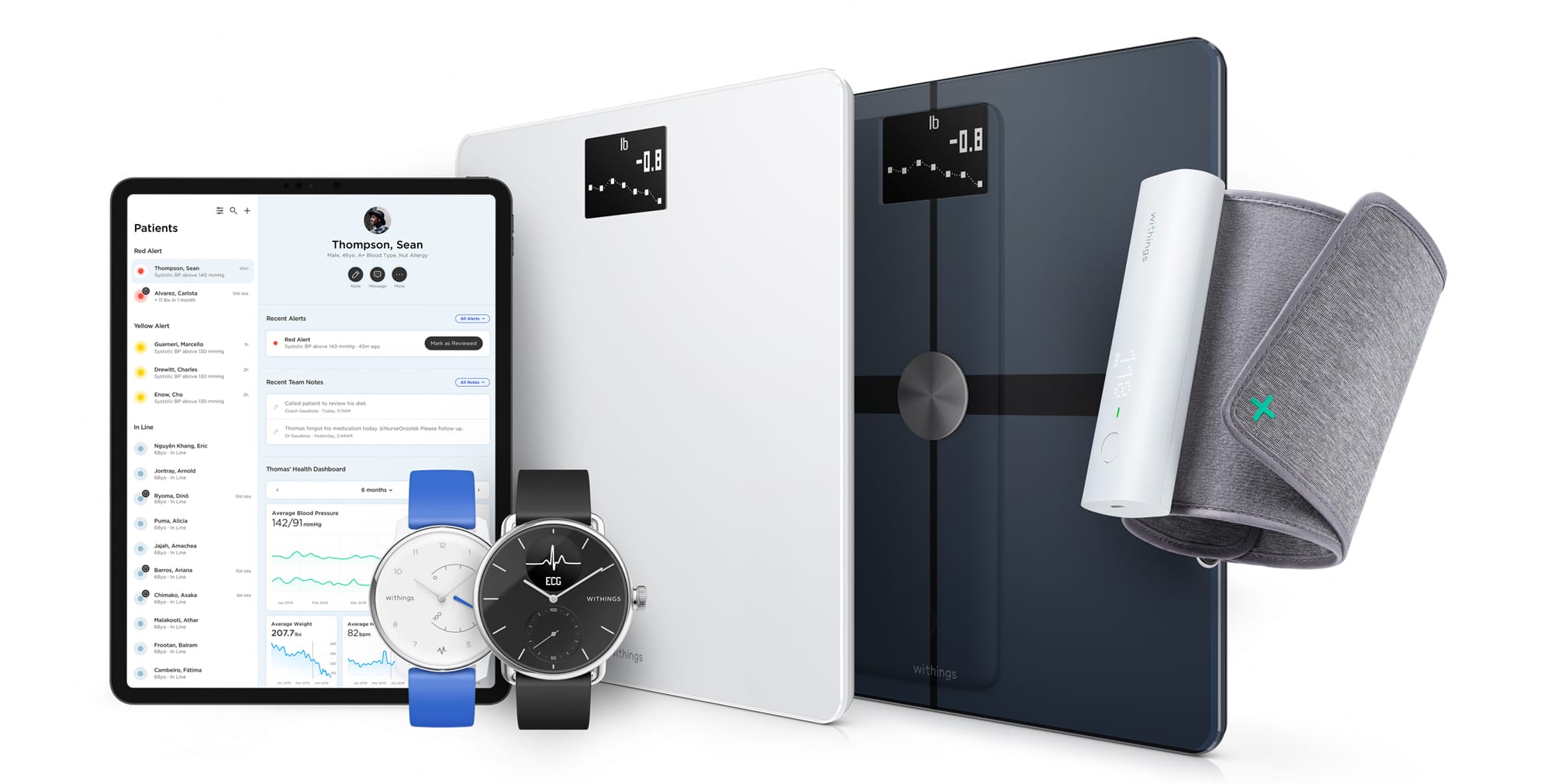
Withings, a pioneer in the connected healthcare IoT movement, is one of the many healthcare IoT device makers convinced that cellular LTE-M/NB-IoT technology is a strong and reliable connectivity technology that makes sense in the medical IoT world. Withings builds a wide range of health monitoring devices including activity trackers, body weight and cardiovascular monitors, blood pressure monitors, and advanced sleep analyzers.
To connect their next generation of healthcare IoT devices, Withings has selected Sequans Monarch 2 LTE-M/NB-IoT cellular IoT module. In addition to the reliable and proven LTE-M connectivity, Withings is using Sequans’ Monarch 2 technology because of its very high security level. Monarch 2 is one of the world’s only cellular IoT modules that supports an EAL5+¹ secure enclave for integrated SIM capability.
EAL5+ guarantees the highest level of patient data security possible today. By way of comparison, NFC (near field communication) and standard SIM cards are usually EAL4+ common criteria certified, and NATO requires only an EAL3+ level of security for their software solutions.
Withings also chose Monarch 2 because of its ultra-low power consumption—the lowest in the industry—a quality extremely important for battery-powered healthcare IoT devices because it significantly extends battery life. Monarch 2 consumes a mere 1 microamp of power at rock bottom, enabling standard batteries to last more than four years, assuming a use case where data is transmitted once every four hours, as in a typical patient monitoring application.
Other healthcare IoT devices connected by Sequans’ Monarch 2 technology today include a battery-powered patient monitor that records heart-rate, patient position, motion, temperature, blood pressure and weight. This device uploads data to the cloud every two hours and is designed to send an alarm should the patient’s vital signs exceed a pre-set limit. The value of patient monitoring devices like this is seen in their ability to significantly lower the cost of patient monitoring that has been traditionally done in person by doctors or nurses.
In another key example in use today, LTE-M is being used to connect sleep apnea masks that need to report daily, actual patient usage to doctors and/or medical insurance companies. These are usually connected to wall electrical outlets, so while they are not demanding in terms of power optimization, they need to be extremely reliable with always-on connectivity and they need to be simple to use.
For those healthcare IoT applications requiring higher than LTE-M speed, LTE Cat 1 technology with throughput up to 10 megabits per second is the answer. Sequans offers Calliope 2 LTE Cat 1 technology that features the same ultra-low power consumption and EAL5+ security and iSIM capability as Monarch 2, but its higher throughput and support for voice enables it to be used for more sophisticated applications.
One key application in use today is personal emergency response devices with voice functionality. Users of these devices, typically the elderly, can call for aid by simply pressing a button that connects them to personnel at call centers who can immediately initiate a voice call with the user. These devices run on batteries, and feature location technology.
LTE Cat 1, and sometimes LTE-M, can be used to monitor medical transport containers for temperature, location, and tampering. The data throughput required for may vary from several tens of kilobits to several megabits per second. Vaccine shipments, for example, must be monitored to maintain a required, constant low temperature, and medical equipment or other valuable medical supplies must be monitored for tampering. Whatever the data requirement, these IoT healthcare solutions ensure the security of medical shipments from origin to destination.
Another important consideration for healthcare IoT device makers when choosing a connectivity solution is the total cost of ownership. The cost of building a healthcare IoT device includes not only the cost of the connectivity module, but also the cost of all the additional components needed to build a full solution, the cost of integration, and the cost of batteries.
When using optimized cellular IoT modules such as Monarch 2 with its ultra-low power consumption and low voltage power supply that allows the use of simple, standard batteries, device makers can eliminate expensive components such as DC/DC converters or buck boosters for a distinct cost advantage.
The global IoT healthcare market is projected to grow from USD 72.5 billion in 2020 to 188.2 billion by 2025 and the key growth drivers are: 1) growth in patient engagement, 2) cost control, and 3) reliability of network connectivity technologies for IoT.² Today’s cellular IoT connectivity solutions deliver on all three, enabling the promise of healthcare IoT to become a present reality, vastly improving medical treatment outcomes to millions and millions of people around the world.
[1] Evaluation Assurance Level (EAL1 – EAL7) is awarded to an IT product or system after completing a Common Criteria security evaluation; CC is an international standard in effect since 1999.
[2] IoT in Healthcare Market by Component (Medical Device, Systems & Software, Services, and Application, End User, and Region – Global Forecast to 2025, Markets and Markets, June 2020

