
RCR Wireless
  • News
  • Channels
    • 5G
    • 6G
    • BSS OSS
    • Carriers
    • IoT
    • Network Infrastructure
    • Open RAN
    • Private 5G
    • Telco AI
    • Telco Cloud
    • Test & Measurement
  • Resources
    • Reports
    • Webinars
    • White papers
    • AI Fundamentals
    • Analyst Angle
    • Editorial Calendar
    • Fundamentals
      • 5G NR Release 17
      • AI
        • Telco AI in 2025
    • Podcasts
      • Let’s Get Digital with Carrie Charles
      • Wireless Connectivity to Enable Industry 4.0 for the Middleprise
      • Well Technically…
      • Will 5G Change the World
      • Accelerating Industry 4.0 Digitalization
  • AI Infrastructure
  • Programs
  • Events
  • RCRtv
  • Advertise
  • Subscribe
Tuesday, August 4, 2026
RCR Wireless
  • News
  • Channels
    • 5G
    • 6G
    • BSS OSS
    • Carriers
    • IoT
    • Network Infrastructure
    • Open RAN
    • Private 5G
    • Telco AI
    • Telco Cloud
    • Test & Measurement
  • Resources
    • Reports
    • Webinars
    • White papers
    • AI Fundamentals
    • Analyst Angle
    • Editorial Calendar
    • Fundamentals
      • 5G NR Release 17
      • AI
        • Telco AI in 2025
    • Podcasts
      • Let’s Get Digital with Carrie Charles
      • Wireless Connectivity to Enable Industry 4.0 for the Middleprise
      • Well Technically…
      • Will 5G Change the World
      • Accelerating Industry 4.0 Digitalization
  • AI Infrastructure
  • Programs
  • Events
  • RCRtv
  • Advertise
  • Subscribe
Add RCR Wireless as a preferred source on Google
  • Qualcomm 6G Insights
  • Huawei Content Hub
  • Qualcomm – 6G Vision
  • OSS/BSS Channel
  • RCRTech Roundtable: AI Infrastructure
RCR Wireless
RCR Wireless
  • Advanced Mimo
  • Mobile mmWave
  • 5G Positioning
  • Green Networks
  • Metaverse
  • Automotive
  • Industrial and Wide-area IoT
Copyright 2021 - All Right Reserved
Home - New kid on the IoT block – fine-ranging with UWB and what it means for IoT
BuildingsFundamentalsInternet of Things (IoT)News & Event CoverageSensorsSmart CitiesSmart FactorySmart HomeWired Networks, Fiber

New kid on the IoT block – fine-ranging with UWB and what it means for IoT

by James Blackman July 8, 2020
written by James Blackman July 8, 2020 Share
LinkedinEmail
Share 0LinkedinEmail
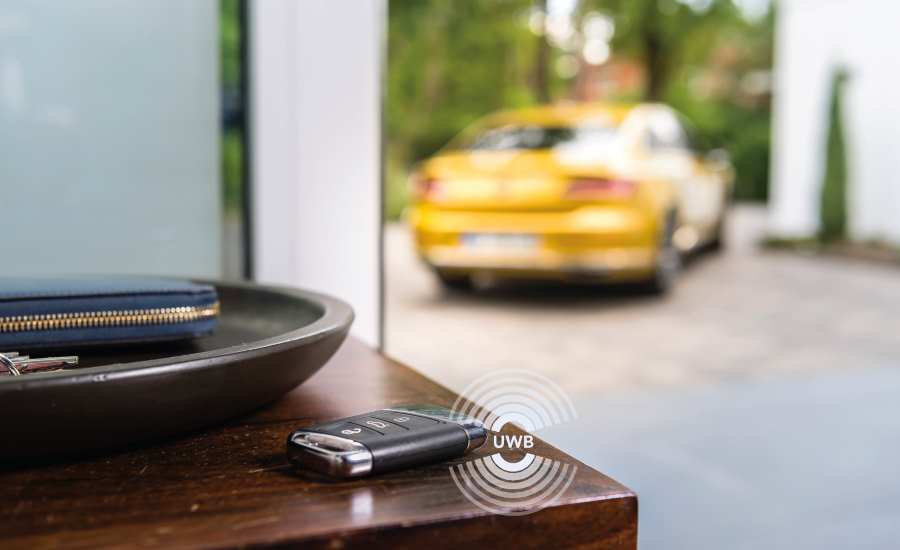
(Image: NXP Semiconductor)
286

Note, this article is taken from a new Enterprise IoT Insights editorial report, out tomorrow, on the combination of low-power short- and long-range communications technologies in hybrid IoT systems (see cover image below). Check back here for the full report (from July 9); a webinar on the same subject, including panellists from ABI Research, the Bluetooth SIG, and Nordic Semiconductor, among others, is scheduled for July 9, also. Register here to attend the webinar.

The latest rush of iPhones, at the end of 2019, was notable in IoT circles for the inclusion of a particular technology in its U1 chip: ultra wideband (UWB), based on the IEEE 802.15.4 standard. It was the first time UWB, a one-time competitor of Wi-Fi and some-time facility for military surveillance, had featured in everyday smartphones. The market took notice, naturally. “UWB is the new player in town,” notes a spokesperson at Nordic Semiconductor. 

UWB uses wide spectrum (500 MHz to several GHz) and high frequency (between 6.5 GHz and 9 GHz), at a remove from the busy ISM band at 2.4 GHz. The technology has evolved since its early incarnation as a rival to Wi-Fi into something quite different, going from an orthogonal frequency-division multiplexing (OFDM) protocol for high data-rate communications to an impulse-based ‘see-through-walls’ radar-imaging tech. 

UWB enables granular low-power short range positioning (‘fine ranging’) of objects in three-dimensional space – to about 10 centimetres, from a distance of about 200 metres. As well as locating objects with high precision, it can track them using distance measurements between radios, and calculate time arrival and angle of movement. Apple says it possesses ‘spatial awareness’. 

EIOTI Short King Range IoT CoverThe FiRa (fine-ranging) Consortium, whose members include major smartphone makers, module makers and machine makers (Bosch, NXP, Samsung, STMicroelectronics et al), says UWB outperforms other short-range technologies in terms of accuracy, reliability, and power consumption – “by a wide margin”. 

Ranging is achieved by time-of-flight (ToF) measurements of radar signals between devices. The process uses a large channel and short pulses, of about two nanoseconds each – issued 200-1,000 times per second. It makes location finding a real-time function. A UWB-enabled system is more resistant to interference, says the consortium, on the grounds UWB pulses resist ‘multi-path effect’, where signals reach the receiver by more than one path due to reflection or refraction, and are immune to fading and jamming. 

Security is higher, too. A key addition to UWB with the incoming 802.15.4z specification is an extra portion of the physical layer (PHY), used to send and receive data packets, which adds cryptography, random number generation, and other techniques to make it harder to attack or manipulate UWB systems. 

UWB use cases transfer easily into industrial IoT, and other sectors. The FiRa Consortium is developing specific protocols for multiple verticals and defining the necessary parameters for a range of applications, including physical access control, location-based services, device-to-device services, and others. 
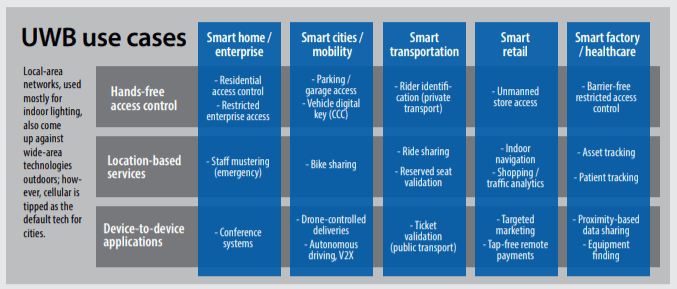
UWB use cases

But UWB is being positioned as a complementary low-power technology, suited to a wide range of IoT applications demanding precision location measurement and proximity awareness. Nordic has just announced a deal with US semiconductor firm Qorvo to collaborate on dual-mode BLE and UWB modules. 

A spokesperson says: “It doesn’t conflict with BLE. There is lots BLE can do that UWB can’t. It can be used to upload data encrypted to a local server; it does over-the-air updates; it brings mesh networking. It does all of these things, plus it is pretty accurate for indoor positioning. But it is rather like the last mile in fibre optics – UWB gives you that really rich, granular data, when you get closer to things.” 

Indeed, the Bluetooth industry expects UWB to be commonly paired with BLE. Jim Katsandres, senior director of developer relations at the Bluetooth SIG, remarks: “Oftentimes it is complementary. There is usually a BLE radio in there, as well, to handle connections, and the UWB is used for high accuracy measurements to know exactly where a key fob is, or whatever. But it is a different type of technology.” 

UWB offers direction of movement, as well; useful to determine if a device, whether a workstation or a door, should be locked or unlocked as a person approaches or leaves. The accuracy of UWB ranging allows use cases to define a precise ‘intent range’ to cascade instructions in a system without false triggering – so a garage door opens as a car approaches, followed by an internal door into the living quarters as the car pulls up. 

But Katsandres notes the crossover between BLE and UWB for geolocation services in IoT applications, and draws attention to the latest 5.1 version of the Bluetooth specification, which brings more accurate positioning (“centimetre level, and even tighter with more radios”), and adds direction finding into the mix. “If you’re already using BLE, you will stick with that – just because of cost and optimisation,” he says. 

Adarsh Krishnan, principal analyst at ABI Research, says the addition of UWB for positioning will take IoT tracking applications further, however, down to millimetre-level accuracy even. UWB will be paired with low-power wide-area (LPWA) IoT networking, as well, he says. 

“The next thing could be UWB for millimetre level accuracy. We are already seeing individual devices using UWB in small form factors. There is nothing to say you won’t see it integrated with a wide-area technology like NB-IoT. It comes down to the cost, in the end.” 

Albert Behr, founder and chief executive at BehrTech, champion of the novel telegram-splitting over ultra-narrowband (TSUNB) technique for LPWA communications, is not so sure. The jury is still out, he says, and will take a while to return. “Except for high-precision indoor positioning, UWB applications for IoT are not widely discussed and its potential remains largely under question.”

Apple UWB

You Might Also Like
  • Physical AI is exposing a data sovereignty gap (Reader Forum)
  • Japan’s private 5G market is finally moving beyond demo experiments (Analyst Angle)
  • Hollow-core fiber won’t hit cost parity for a decade – regarding HKT’s 3.2Tbps DCI ‘superhighway’
  • AI drives new demands on optical networks, Ciena says
  • Monday (telco diary) | Sovereign AI for Industry 4.0
  • When the push becomes the pull – private 5G and physical AI
Share 0 LinkedinEmail
James Blackman
James Blackman

James Blackman has been writing about the technology and telecoms sectors for over a decade. He has edited and contributed to a number of European news outlets and trade titles. He has also worked at telecoms company Huawei, leading media activity for its devices business in Western Europe. He is based in London.

previous post
Samsung’s 5G vRAN adoption could be a key turning point for the industry
next post
Arm to hand control of IoT divisions to Softbank to focus on chips

White Papers

  • Norton eBook: The 2026 Telco Playbook

  • Enea White Paper: Why Intelligent AAA is the Swiss Army Knife of Telecom

  • CSG White Paper: Telco AI Enabler: Mediation’s Defining Role

  • Enea White Paper: Scalable Database Design for 5G and Beyond

  • Supermicro and NVIDIA Whitepaper: Powering sovereign AI at scale

Editorial Reports

  • Market Pulse Report: Telco AI in 2026 – Trends, Challenges and Opportunities

  • Nvidia Report: The State of AI in Telecommunications: 2026 Trends

  • Report: Scaling Optical Networks For The Hyperscale And AI Era

Webinars

  • Webinar: Building 6G — aligning technology, policy and purpose

  • SIMCom Webinar: Scaling your next deployment – from plastic to provisioning

  • Webinar: Rethinking the RAN as AI, cloud and openness converge

  • Webinar: Scale-Up, Scale-Out, Scale-Across – Building AI-Era Network Fabrics

  • Webinar: NTN in motion – evolving standards, expanding services

Since 1982, RCR Wireless News has been providing wireless and mobile industry news, insights, and analysis to mobile and wireless industry professionals, decision makers, policy makers, analysts and investors.

Facebook Twitter Youtube Linkedin Envelope Rss

Useful Links

  • Subscribe
  • About RCR Wireless News
  • Contact Us
  • Advertise
  • Editorial Calendar
  • Archive
  • RSS
  • Wireless News Archive
  • Subscribe
  • About RCR Wireless News
  • Contact Us
  • Advertise
  • Editorial Calendar
  • Archive
  • RSS
  • Wireless News Archive

Edtior's Picks

From missiles to pizzas – why 6G drone sensing has been fast-tracked for...
Cellnex sees AI, 5G and digital sovereignty driving Europe’s next infrastructure cycle
Wi-Fi carries over 80% of traffic; monetizing it is not a done deal...

Latest Articles

From missiles to pizzas – why 6G drone sensing has been fast-tracked for 5G
Cellnex sees AI, 5G and digital sovereignty driving Europe’s next infrastructure cycle
Wi-Fi carries over 80% of traffic; monetizing it is not a done deal (Analyst Angle)
Monday (telco diary) | Network platforms and an AI hill of beans

© 2026 RCR Wireless News All Right Reserved. Developed by Eight Hats.

Cookie Policy | Privacy Policy

RCR Wireless
  • News
  • Channels
    • 5G
    • 6G
    • BSS OSS
    • Carriers
    • IoT
    • Network Infrastructure
    • Open RAN
    • Private 5G
    • Telco AI
    • Telco Cloud
    • Test & Measurement
  • Resources
    • Reports
    • Webinars
    • White papers
    • AI Fundamentals
    • Analyst Angle
    • Editorial Calendar
    • Fundamentals
      • 5G NR Release 17
      • AI
        • Telco AI in 2025
    • Podcasts
      • Let’s Get Digital with Carrie Charles
      • Wireless Connectivity to Enable Industry 4.0 for the Middleprise
      • Well Technically…
      • Will 5G Change the World
      • Accelerating Industry 4.0 Digitalization
  • AI Infrastructure
  • Programs
  • Events
  • RCRtv
  • Advertise
  • Subscribe
RCR Wireless
  • News
  • Channels
    • 5G
    • 6G
    • BSS OSS
    • Carriers
    • IoT
    • Network Infrastructure
    • Open RAN
    • Private 5G
    • Telco AI
    • Telco Cloud
    • Test & Measurement
  • Resources
    • Reports
    • Webinars
    • White papers
    • AI Fundamentals
    • Analyst Angle
    • Editorial Calendar
    • Fundamentals
      • 5G NR Release 17
      • AI
        • Telco AI in 2025
    • Podcasts
      • Let’s Get Digital with Carrie Charles
      • Wireless Connectivity to Enable Industry 4.0 for the Middleprise
      • Well Technically…
      • Will 5G Change the World
      • Accelerating Industry 4.0 Digitalization
  • AI Infrastructure
  • Programs
  • Events
  • RCRtv
  • Advertise
  • Subscribe
@2020 - All Right Reserved. Designed and Developed by PenciDesign