


A Maravedis long read about the Wireless Broadband Alliance white paper on “Wi-Fi Monetization & Business Models” – a genuinely useful map of today’s commercial models, the debate it connects to, and an open invitation to write the next chapter.
- The WBA’s new monetization paper confirms Wi-Fi is the connectivity layer of the digital economy, carrying over 80 percent of traffic, while revenue attaches to what is built on top of it, not to access itself.
- Public Wi-Fi is maturing fastest, with neutral hosts, deliberate offload, and managed marketplaces like Uplink’s WBA soft launch finally giving roaming the economic layer it lacked.
- The sequel should cover what comes next: token incentives, micropayments, Wi-Fi sensing, and agent-native settlement, areas where the WBA is best positioned to lead.
The Wireless Broadband Alliance published its “Wi-Fi Monetization & Business Models” white paper in July 2026, authored by the Roaming Work Group with contributors from AT&T, Comcast, Cisco, Boldyn, Boingo, Calix, Charter, CableLabs, and others. Since Maravedis has worked with the WBA for a decade, including on its Annual Industry Report, readers should consider this a friendly reading from inside the family rather than an outside critic. The WBA white paper is a valuable contribution that practitioners across residential, hospitality, and enterprise should read in full.
It also confirms, segment by segment, a truth the industry is still absorbing: Wi-Fi has become the basic connectivity layer of modern life, carrying, by the paper’s own account, over 80 percent of smartphone traffic and underpinning the vast majority of in-home connectivity. The layer is indispensable, yet the open question, and the one the paper only begins to answer, is how an essential layer converts its structural position into durable revenue. The message of this article is simple: the value lies in what you build on top of the layer, and increasingly in what the layer itself is learning to do beyond moving bits.
What the report gets right
Three findings deserve amplification because each of them quietly reframes how the industry should think about its own economics.
The first is the stacking principle, expressed in the paper’s conclusion through the argument that the most successful business models will layer multiple revenue streams on shared infrastructure, so that a single access point can simultaneously carry a managed public Wi-Fi service, a converged broadband offering, wholesale or OpenRoaming capability, and an anonymized analytics stream sold as business intelligence, without those streams cannibalizing one another. This is exactly right, and it captures in one image the central idea that the network is the platform while the services stacked upon it are the products.
The second is the honest acknowledgment that the speed race is over, since as households approach gigabit speeds, bandwidth now outstrips demand, and premium offerings must shift toward experience-centric features such as latency, reliability, coverage, and security. The plain translation is that providers can no longer charge more for more megabits because nobody needs them, a single observation that quietly retires two decades of broadband marketing strategy.
The third is the clarity of the enterprise chapter, which states that for enterprise customers, Wi-Fi primarily supports internal operations rather than acting as a direct revenue source, a recognition that enterprises are really buying reduced IT workload, security, compliance, and productivity, with the network serving as a means to those ends and never as the end itself.
Monetization Avenues for Wi-Fi
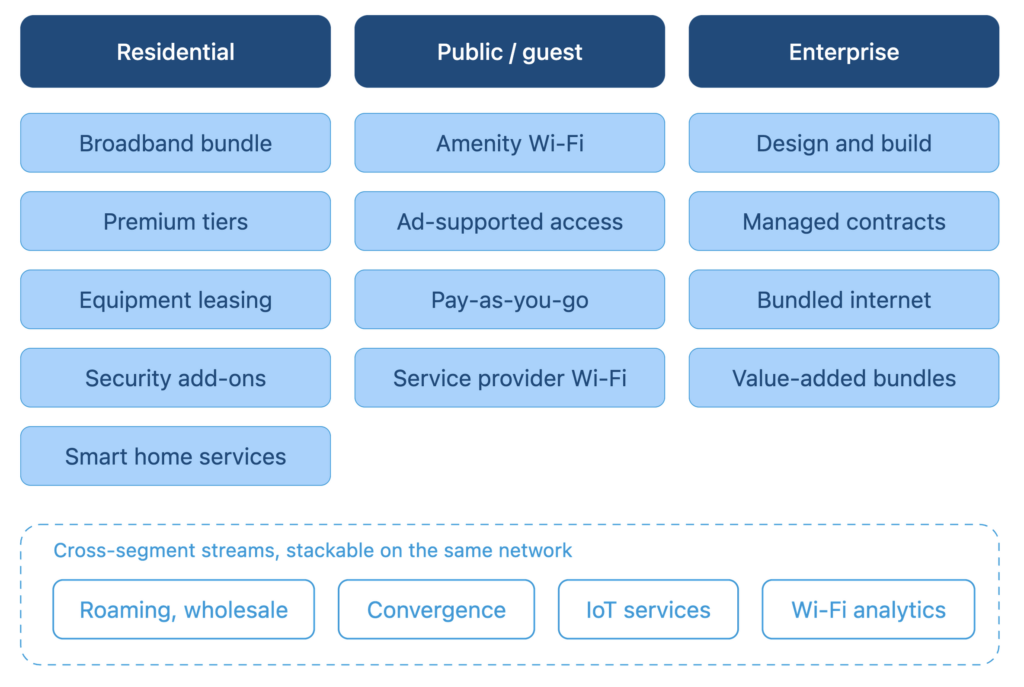
One pattern across five segments
Reading across all five segments the paper covers: residential, public/guest, enterprise, roaming, and IoT, a consistent pattern emerges that deserves to be stated plainly.
In residential, Wi-Fi is included with the internet connection, and monetization happens through add-ons such as security, parental controls, mesh coverage, and smart home services. In public and guest access, most connectivity in developed markets is free to the user, and the four commercial models the paper describes are all mechanisms for getting someone other than the user to pay, whether a sponsoring venue, an advertiser, or a carrier treating Wi-Fi as a differentiator.
In enterprise, connectivity is an operating expense justified by the outcomes it enables rather than a product in its own right, while in roaming, the paper concedes that the commercial value of inbound traffic must exceed the transaction costs of the agreement, which is a careful way of saying that margins depend on volume. In IoT, finally, the winning models are recurring services and system-as-a-service arrangements in which the customer pays for stored video, water savings, or uptime, and never for packets.
The pattern is not a flaw in the paper but its central finding: across five segments, revenue attaches to the services, outcomes, analytics, and integration built on top of Wi-Fi rather than to the access itself, which makes the pipe the admission ticket to those businesses rather than the business itself.
The market already delivered the same verdict
The public markets reached the same conclusion the hard way. As I wrote in June in Bleeding Subscribers, Flat ARPU: The MDU Answer US Broadband Keeps Circling, Q1 2026 broke the spell when Charter’s stock halved amid flat ARPU and 120,000 lost broadband subscribers while Optimum shed another 64,000. Network capex now buys parity rather than separation, because when every provider delivers 200 Mbps or more, customers experience no problem that a faster pipe would solve, and the highest-ARPU customers carry the highest churn risk. Convergence, the industry’s reflex response, defends the household without lifting the revenue ceiling.
There is an irony here worth noting gently: for a decade, being called a utility was the fate every operator strategy deck promised to avoid, and yet the industry ended up with utility economics anyway, essential, commoditized, capital-intensive, and ceiling-capped, without the utility’s regulated returns or, lately, its growth story, as power companies ride the very AI buildout that connectivity providers enable. That is what a layer looks like when it is priced as a product, and none of this is an argument against the layer itself; it is an argument for pricing what the layer makes possible.
Public Wi-Fi grows up: neutral hosts, offload, roaming
Nowhere is the tension between layer and value more visible than in public Wi-Fi, and nowhere is it being resolved faster. For twenty years, public Wi-Fi was the segment with the weakest economics of all, an amenity that was free to the user and paid for by a venue as a cost of doing business, and while the WBA paper describes the four commercial models honestly, amenity, advertising-supported, pay-as-you-go, and service provider Wi-Fi, all four share the same limitation in that they monetize the captive portal moment rather than the network’s structural position.
That structural position is considerable, and the industry is finally organizing around it through three converging developments.
The first is the neutral host model. As the WBA paper notes, neutral host operators aggregate numerous venues, large and small, into a unified roaming footprint, often capitalizing the infrastructure deployment in exchange for long-term operation and monthly recurring revenue, and in doing so they solve the problem that has kept most venues out of the connectivity economy entirely: a stadium, a transit system, or a mid-sized shopping center holds valuable radio real estate but has no capacity to negotiate with every operator that might want to reach its visitors. The neutral host converts that real estate into a shared, anchorable asset, and roaming standards convert the asset into tradable inventory.
The second is Wi-Fi offload becoming a deliberate operator strategy rather than a user accident. Users have always self-offloaded onto whatever Wi-Fi they could find, but what is new is the alignment of conditions that allows carriers and eSIM providers to offload deliberately: OpenRoaming and Passpoint have matured enough to support scalable and secure onboarding, eSIM adoption has accelerated globally and created an entirely new class of demand from travel eSIM providers whose economics depend on finding cheaper capacity, and operators face mounting pressure to optimize their roaming costs. The structural picture is an imbalance in which roaming traffic grows rapidly on one side while enormous underutilized Wi-Fi capacity sits in airports, hospitality, transport, and dense urban environments on the other, with the two worlds still poorly connected.
Why poorly connected? Because, and this is the third development, the missing piece was never technical but economic. Previous attempts at Wi-Fi roaming exchanges struggled for reasons the industry now understands well: demand was too fragmented to aggregate, onboarding was too clumsy, and, most importantly, early exchanges exposed pricing too directly, which led venue owners and network operators to fear exactly what this article describes, namely that an open marketplace would finish the job of turning their connectivity into a commodity and erode their margins through direct undercutting. Their fear was entirely rational, since raw access auctioned transparently converges on the marginal price of a bit, which is approximately zero.
The emerging answer is the managed marketplace, and it is telling that it arrived through the WBA’s own ecosystem. At the Wireless Global Congress in Dallas this May, Uplink soft-launched what it calls a neutral exchange for Wi-Fi offload, demonstrated live with eSIM providers and OpenRoaming-settled connections running on the venue network, and the design choices are the genuinely interesting part. Pricing is abstracted into controlled service tiers rather than exposed rawly; traffic is allocated by quality, SLA compliance, and venue class rather than lowest price; demand-side players integrate once and reach a curated supply pool; and suppliers gain incremental monetization without bilateral deal complexity or loss of commercial control. In other words, the marketplace is deliberately designed against price discovery on raw access and toward differentiation on quality, which is precisely the layer thesis implemented as market structure: because access alone races to zero, the exchange prices what sits above access, meaning assured quality, verified identity, simplified settlement, and reach.
For the venue and network owner, this is the moment public Wi-Fi stops being a cost center with a captive portal and starts being inventory, sellable capacity in high-value locations that is settled automatically, with neutral hosts aggregating the long tail and quality frameworks such as the WBA’s Access Network Metrics and Connect-Info providing the trust layer that makes the trade possible. The next phase of connectivity growth will be defined less by access itself than by how intelligently access is bought, sold, and optimized, a sentence that could serve as the thesis of the WBA paper’s missing chapter.
Sensing and agents: the stack is about to get taller
Two emerging themes map directly onto sections of the WBA paper, and together they show how much bigger the stack above basic connectivity is about to become.
The first is sensing. The paper notes that Wi-Fi Sensing has moved from concept to commercialization and can be bundled into smart home and smart office packages for intrusion detection, energy automation, and elder care, while the cellular world is pushing the same logic to its endpoint through integrated sensing and communication, which repurposes radio infrastructure into an awareness layer that exposes structured intelligence about motion, occupancy, anomalies, and environmental state through APIs. Scale that ambition to the hundreds of millions of Wi-Fi access points already installed inside homes, buildings, and venues, and the strategic point becomes clear: the radio infrastructure is about to take on a second job, and the second job pays better than the first, because an access point that merely moves bits earns a flat bundle fee while an access point that detects a fall in a senior living unit, occupancy in an office, or an intrusion in a store earns a recurring service fee with a named buyer and a budget line.
The second is the coming shift in who the customer even is. AI agents, meaning autonomous software that authenticates, negotiates, and transacts continuously, are emerging as a new customer class with a different economic logic, one measured in verified interactions rather than monthly subscriptions, in which identity assurance and deterministic performance become the true products. The industry has seen this movie before: operators built the networks that made the smartphone era possible, watched mobile ARPU decline for a decade, and saw the value land at Apple, Google, and the platform companies, and the lesson to draw is not bitterness but preparation, since Wi-Fi, sitting closest to where people, devices, and increasingly agents actually connect, is well placed to define the business model of the agent era rather than inherit someone else’s.
Missing chapter: tokens, agents, and new ways to pay
This is where I would gently push the Roaming Work Group toward a sequel, because the paper’s monetization toolkit is built almost entirely on familiar instruments, subscriptions, bundles, sponsorships, advertising, and wholesale agreements, while the more forward-leaning question, given Wi-Fi’s share of traffic, is whether new payment and incentive mechanisms can monetize the layer in ways those instruments cannot.
The managed marketplace arriving now is the first installment, since it collapses the transaction costs of roaming agreements, exactly the friction the paper identifies in its roaming chapter, and replaces bilateral negotiation with automated settlement, but the next installments push considerably further.
Token-based models deserve a serious look. Decentralized wireless projects have already demonstrated the mechanics, using token incentives to reward individuals and venues for deploying and sharing coverage and thereby converting millions of privately owned access points into a commercially addressable footprint without a single wholesale contract being negotiated. The first-generation experiments had well-documented growing pains, yet the underlying idea, using programmable incentives to aggregate supply and micropayments to settle usage, extends the marketplace logic to the long tail that no curated exchange will ever reach, and a world in which an access point earns a stream of micro-revenues for carrying verified traffic, sharing sensing data, or offloading a carrier’s subscribers is a world in which the 80 percent layer finally gets a native billing system.
The same logic completes the agent story above, because agents will not sign up for monthly bundles when their natural economic unit is the verified interaction, priced per query, per session, per attested identity, or per guaranteed latency window, and machine-to-machine micropayments, whether settled in tokens or over conventional rails, fit that pattern far better than ARPU ever will. The WBA, with OpenRoaming and its identity federation already in production and now with settled-offload marketplaces launching inside its own ecosystem, is arguably the best-positioned body in the industry to standardize how the connectivity layer gets paid in that world, and the building blocks are already in its portfolio, since Access Network Metrics and the Connect-Info framework are standardized, exposable quality data that a partner, whether human or machine, can build on and pay for.
None of this diminishes the paper. The suggestion is simply that the next edition treat payment innovation, meaning marketplaces, tokens, micropayments, and agent-native settlement, as a monetization category of its own rather than a footnote.
The Maravedis read
The WBA paper is a good map of the commercial models that exist today, and its stacking framework is the right lens for the ones coming next. The message is simple, and the paper’s own evidence supports it at every turn: Wi-Fi is the basic connectivity layer of the digital economy, carrying most of its traffic while capturing a modest share of its value, and closing that gap is the industry’s defining commercial project for the rest of the decade. Public Wi-Fi is showing the way first, as neutral hosts turn venues into inventory, offload turns idle capacity into revenue, and managed marketplaces give roaming the economic layer it always lacked, and completing the project will take exactly the kind of collaborative, standards-based work the WBA does best, extended to the sensing layer, the agent economy, and the payment and incentive mechanisms that will monetize both.
Wi-Fi is not the product, and it never was; it is the foundation everything else is built on, which is a stronger position provided the ecosystem prices what the foundation makes possible. The winners of the next five years will be the providers and vendors who price the outcome, productize the capability, and contract the account, and we look forward to the sequel.
Maravedis provides independent market intelligence across carrier and enterprise Wi-Fi, multifamily connectivity, and small business networking. Explore our coverage areas or get in touch to discuss how the value migration plays out in your segment.
Table of Contents

