

RCR Wireless
  • News
  • Channels
    • 5G
    • 6G
    • BSS OSS
    • Carriers
    • IoT
    • Network Infrastructure
    • Open RAN
    • Private 5G
    • Telco AI
    • Telco Cloud
    • Test & Measurement
  • Resources
    • Reports
    • Webinars
    • White papers
    • AI Fundamentals
    • Analyst Angle
    • Editorial Calendar
    • Fundamentals
      • 5G NR Release 17
      • AI
        • Telco AI in 2025
    • Podcasts
      • Let’s Get Digital with Carrie Charles
      • Wireless Connectivity to Enable Industry 4.0 for the Middleprise
      • Well Technically…
      • Will 5G Change the World
      • Accelerating Industry 4.0 Digitalization
  • AI Infrastructure
  • Programs
  • Events
  • RCRtv
  • Advertise
  • Subscribe
Tuesday, July 28, 2026
RCR Wireless
  • News
  • Channels
    • 5G
    • 6G
    • BSS OSS
    • Carriers
    • IoT
    • Network Infrastructure
    • Open RAN
    • Private 5G
    • Telco AI
    • Telco Cloud
    • Test & Measurement
  • Resources
    • Reports
    • Webinars
    • White papers
    • AI Fundamentals
    • Analyst Angle
    • Editorial Calendar
    • Fundamentals
      • 5G NR Release 17
      • AI
        • Telco AI in 2025
    • Podcasts
      • Let’s Get Digital with Carrie Charles
      • Wireless Connectivity to Enable Industry 4.0 for the Middleprise
      • Well Technically…
      • Will 5G Change the World
      • Accelerating Industry 4.0 Digitalization
  • AI Infrastructure
  • Programs
  • Events
  • RCRtv
  • Advertise
  • Subscribe
Add RCR Wireless as a preferred source on Google
  • Qualcomm 6G Insights
  • Huawei Content Hub
  • Qualcomm – 6G Vision
  • OSS/BSS Channel
  • RCRTech Roundtable: AI Infrastructure
RCR Wireless
RCR Wireless
  • Advanced Mimo
  • Mobile mmWave
  • 5G Positioning
  • Green Networks
  • Metaverse
  • Automotive
  • Industrial and Wide-area IoT
Copyright 2021 - All Right Reserved
Home - Who disaggregated my RAN? Part 4: Open RAN: Disaggregated and smart (Reader Forum)
Open RANReader Forum

Who disaggregated my RAN? Part 4: Open RAN: Disaggregated and smart (Reader Forum)

by Ganesh Shenbagaraman June 23, 2020
written by Ganesh Shenbagaraman June 23, 2020 Share
LinkedinEmail
Share 0LinkedinEmail
open RAN
116

In my last article in this “Who Disaggregated My RAN?” blog series, we covered the advances made by the O-RAN Alliance to deliver an open Fronthaul specification that supports multiple ways in which the base station will connect to the radio and ensures interoperability between various base station and radio vendors. 

This new open Radio Access Network for 5G networks must not only be disaggregated to enable a multi-vendor ecosystem; it must also be smart. The O-RAN Alliance has introduced the RAN Intelligent Controller (RIC) to bring automation and intelligence to the network.  

Bringing artificial intelligence and machine learning to telecom 

There has been a lot of discussions within the telecom industry to apply Artificial Intelligence (AI) and Machine Learning (ML) to the network – especially in the RAN – to support increased efficiencies and reduce operational expenses. 

For 4G networks, mobile operators approached the management of the RAN network as a manual and mechanical process that required human intervention for network management, configuration and operations. Mobile operators were also seeking to virtualize their networks and to add automation to reduce operational expenses. 

The O-RAN Alliance, led by the mobile operator community with vendor support, proposes to achieve both autonomous control and intelligence in the way radio networks are managed by the addition of RAN Intelligent Controller (RIC) nodes.

The RAN network is designed to operate at extremely low latency levels – a few milliseconds or less – so it is often defined as a “real-time network” which cannot afford any delay in the transmission of data. Operations must be highly efficient and data transmissions must happen within predetermined time limits.  

The O-RAN Alliance has specified two new layers for the mobile network architecture with its RAN Intelligent Controller (RIC): 

  • Near Real-time RAN Intelligent Controller 
  • Non Real-time RAN Intelligent Controller 
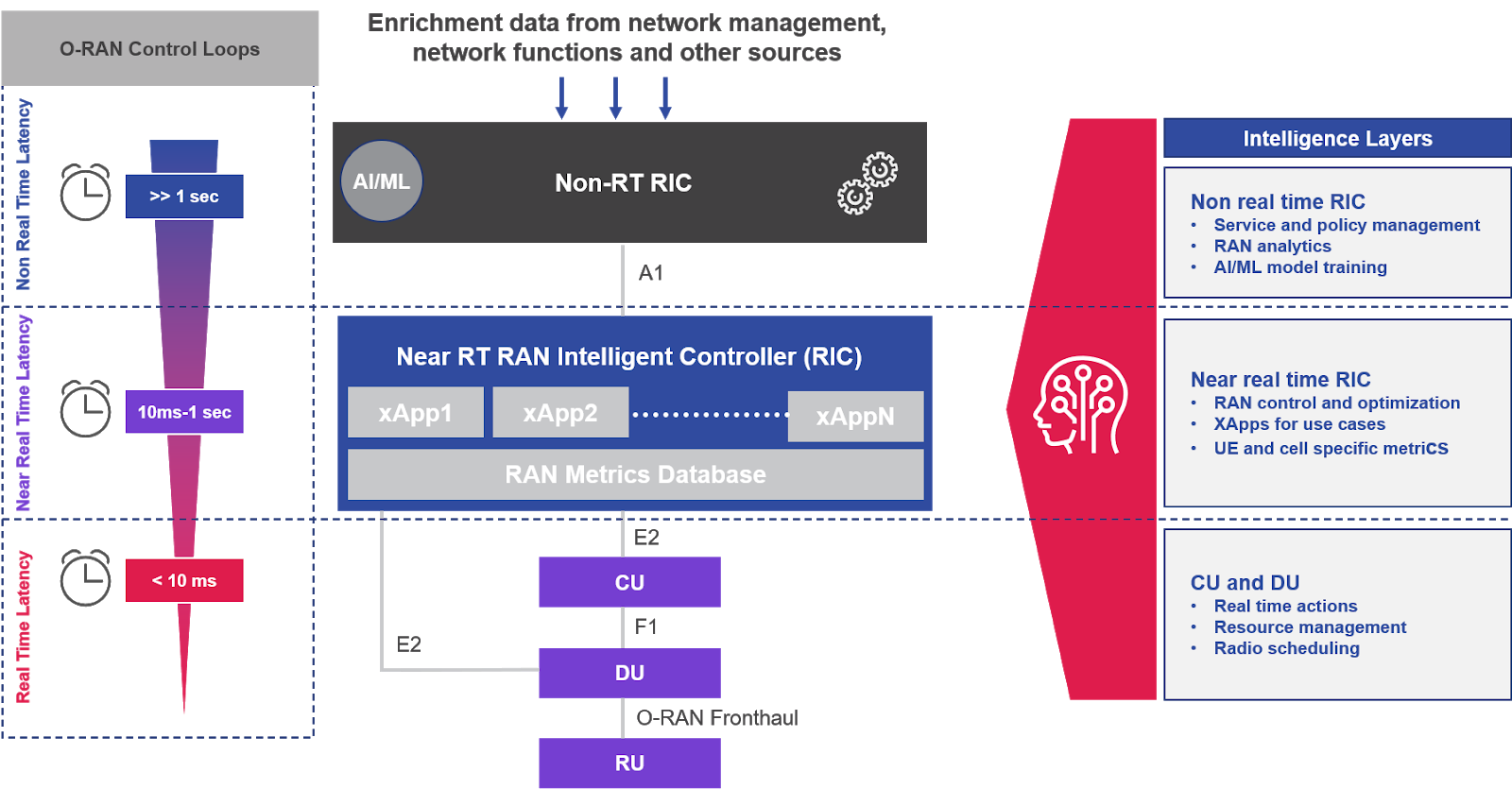
open RAN Figure 1: O-RAN RIC: Intelligence and Control in Action

Figure 1: O-RAN RIC: Intelligence and Control in Action

The Near Real-time RIC 

If we look at the latency numbers in the figure above, the Near Real-time RIC acts within 10 to 1000 milliseconds to make decisions based on metrics from RAN nodes. These decisions are driven by sophisticated algorithms built in to the “xApps.” But, why is there the need for these algorithms or XApps?

An average user of a mobile network expects quality of service and constant connectivity – even when moving through zones with limited coverage. As the device begins to lose signal strength from one base station, the connection is handed off to another base station to allow the user to enjoy seamless connectivity, even while traveling at high speeds in a car. However, on 4G networks, this isn’t the experience that users always get. For 5G networks we are trying to achieve that seamless connectivity experience by making the RAN smarter, not only in the connection management, but also in the quality of service, the data rates, and priority of service. There can be many xApps in the Near Real-time RIC to solve these problems, serve those uses, and delivery much better QoE (Quality of Experience) to the mobile subscribers.

Operators are moving to making the network more intelligent, adding more sophisticated algorithms into the controllers and enabling multiple use cases as seen in the figure above. Handover optimization, load balancing, and other use cases can be handled by algorithms in the Near Real-time RIC and adds automation to the network. 

The Near Real-time RIC specification developed within the O-RAN Alliance is now available for download. The introduction of RIC fundamentally alters the way RAN is managed and optimized by the operators. This also impacts the way RAN base stations (CU and DU) are delivered as products by vendors. In addition, it opens the arena to a completely new set of players who can focus on the problem solving at a network level with clever algorithms.

AI/ML and Support for xApps 

In this new architecture, AI and ML are algorithmic in nature and in the Real-time Intelligent Controller platform, they support the collection of all of the underlying network nodes in the RAN. This creates a database in the platform that will support multiple applications and it is called xApps. xApps can be used for a specific use case, a specific optimization, or a specific feature. 

We are all familiar with App Stores for Android and iOS devices. We download and use different apps for a variety of purposes. The xApps will be hosted on the RIC, and in a not-so-distant future, there will be an “xApps Store” for the mobile network. Multiple vendors will submit their own algorithms for the store. For example, a company could develop an app that is focused just on load balancing or just on mobility control. Mobile operators will be able to select which apps they want to use in the RIC. 5G networks with this intelligence layer added with the RIC should perform much better and more dynamically react to the changing conditions of the network. 

The Non Real-time RIC 

Looking one layer above the Near Real-time RIC is the Non Real-time RIC. The Non Real-time RIC enables network optimization and provides policy control. It ingests and processes a lot of enrichment information – data that is pulled from management entities (SMOs), network functions and other sources. This valuable data from the network can be huge in volume. This data can be processed further with AI/ML algorithms to deduce insights and actions. Policy management for fulfilling different services is another key aspect of this node. Policies are communicated to the Near Real-time RIC via the A1 interface. The latency for the Non Real-time RIC is greater than a second due to the sheer amount of processing required.

Conclusion 

We will also see the rise of new ecosystem players that are specialized in these algorithms. The RAN will become even more disrupted as these players serve this space in a big way and change the RAN landscape forever. 

In the next part of this series, I’ll share how systems integration support is critical to enabling a viable Open RAN ecosystem. 

You Might Also Like
  • Why throwing money at broadband speeds isn’t fixing America’s internet (Reader Forum)
  • Only 50 of 170 digital infrastructure firms will exist in in five years (Reader Forum)
  • The most expensive wireless system is the one you install twice (Reader Forum)
  • Agentic AI – the $60bn opportunity for telecom operators (Reader Forum)
  • The (agentic) future of AI-to-AI connectivity (Reader Forum)
  • Friday (telco diary) | Telco reset, RAN reboot, P5G reality check

Table of Contents

  • Bringing artificial intelligence and machine learning to telecom 
  • The Near Real-time RIC 
  • AI/ML and Support for xApps 
  • The Non Real-time RIC 
  • Conclusion 
Share 0 LinkedinEmail
Ganesh Shenbagaraman

Ganesh Shenbagaraman is Vice President Engineering at Radisys driving 4G and 5G wireless product development and Open RAN ecosystem partnership. He represents Radisys in industry forums like O-RAN, Small Cell Forum and TIP. Ganesh is a co-chair of O-RAN working group focusing on base station stack reference design.

previous post
Rising COVID scams and malware protection for mobile operators. And a point on connectivity (Reader Forum)
next post
Keysight Webinar: Testing IoT Innovations-Trends, Challenges, Solutions

White Papers

  • Norton eBook: The 2026 Telco Playbook

  • Enea White Paper: Why Intelligent AAA is the Swiss Army Knife of Telecom

  • CSG White Paper: Telco AI Enabler: Mediation’s Defining Role

  • Enea White Paper: Scalable Database Design for 5G and Beyond

  • Supermicro and NVIDIA Whitepaper: Powering sovereign AI at scale

Editorial Reports

  • Market Pulse Report: Telco AI in 2026 – Trends, Challenges and Opportunities

  • Nvidia Report: The State of AI in Telecommunications: 2026 Trends

  • Report: Scaling Optical Networks For The Hyperscale And AI Era

Webinars

  • Webinar: Building 6G — aligning technology, policy and purpose

  • SIMCom Webinar: Scaling your next deployment – from plastic to provisioning

  • Webinar: Rethinking the RAN as AI, cloud and openness converge

  • Webinar: Scale-Up, Scale-Out, Scale-Across – Building AI-Era Network Fabrics

  • Webinar: NTN in motion – evolving standards, expanding services

Since 1982, RCR Wireless News has been providing wireless and mobile industry news, insights, and analysis to mobile and wireless industry professionals, decision makers, policy makers, analysts and investors.

Facebook Twitter Youtube Linkedin Envelope Rss

Useful Links

  • Subscribe
  • About RCR Wireless News
  • Contact Us
  • Advertise
  • Editorial Calendar
  • Archive
  • RSS
  • Wireless News Archive
  • Subscribe
  • About RCR Wireless News
  • Contact Us
  • Advertise
  • Editorial Calendar
  • Archive
  • RSS
  • Wireless News Archive

Edtior's Picks

The Agentic Network — Cisco on the platform path to agentic operations
Private 5G – hype, hope, and (some) hard maths 
Network agents are “ready” for commercial use, but are telcos? (Analyst Angle)

Latest Articles

The Agentic Network — Cisco on the platform path to agentic operations
Private 5G – hype, hope, and (some) hard maths 
Network agents are “ready” for commercial use, but are telcos? (Analyst Angle)
Monday (telco diary) | ‘A new telco growth profile’?

© 2026 RCR Wireless News All Right Reserved. Developed by Eight Hats.

Cookie Policy | Privacy Policy

RCR Wireless
  • News
  • Channels
    • 5G
    • 6G
    • BSS OSS
    • Carriers
    • IoT
    • Network Infrastructure
    • Open RAN
    • Private 5G
    • Telco AI
    • Telco Cloud
    • Test & Measurement
  • Resources
    • Reports
    • Webinars
    • White papers
    • AI Fundamentals
    • Analyst Angle
    • Editorial Calendar
    • Fundamentals
      • 5G NR Release 17
      • AI
        • Telco AI in 2025
    • Podcasts
      • Let’s Get Digital with Carrie Charles
      • Wireless Connectivity to Enable Industry 4.0 for the Middleprise
      • Well Technically…
      • Will 5G Change the World
      • Accelerating Industry 4.0 Digitalization
  • AI Infrastructure
  • Programs
  • Events
  • RCRtv
  • Advertise
  • Subscribe
RCR Wireless
  • News
  • Channels
    • 5G
    • 6G
    • BSS OSS
    • Carriers
    • IoT
    • Network Infrastructure
    • Open RAN
    • Private 5G
    • Telco AI
    • Telco Cloud
    • Test & Measurement
  • Resources
    • Reports
    • Webinars
    • White papers
    • AI Fundamentals
    • Analyst Angle
    • Editorial Calendar
    • Fundamentals
      • 5G NR Release 17
      • AI
        • Telco AI in 2025
    • Podcasts
      • Let’s Get Digital with Carrie Charles
      • Wireless Connectivity to Enable Industry 4.0 for the Middleprise
      • Well Technically…
      • Will 5G Change the World
      • Accelerating Industry 4.0 Digitalization
  • AI Infrastructure
  • Programs
  • Events
  • RCRtv
  • Advertise
  • Subscribe
@2020 - All Right Reserved. Designed and Developed by PenciDesign
