

RCR Wireless
  • News
  • Channels
    • 5G
    • 6G
    • BSS OSS
    • Carriers
    • IoT
    • Network Infrastructure
    • Open RAN
    • Private 5G
    • Telco AI
    • Telco Cloud
    • Test & Measurement
  • Resources
    • Reports
    • Webinars
    • White papers
    • AI Fundamentals
    • Analyst Angle
    • Editorial Calendar
    • Fundamentals
      • 5G NR Release 17
      • AI
        • Telco AI in 2025
    • Podcasts
      • Let’s Get Digital with Carrie Charles
      • Wireless Connectivity to Enable Industry 4.0 for the Middleprise
      • Well Technically…
      • Will 5G Change the World
      • Accelerating Industry 4.0 Digitalization
  • AI Infrastructure
  • Programs
  • Events
  • RCRtv
  • Advertise
  • Subscribe
Saturday, July 18, 2026
RCR Wireless
  • News
  • Channels
    • 5G
    • 6G
    • BSS OSS
    • Carriers
    • IoT
    • Network Infrastructure
    • Open RAN
    • Private 5G
    • Telco AI
    • Telco Cloud
    • Test & Measurement
  • Resources
    • Reports
    • Webinars
    • White papers
    • AI Fundamentals
    • Analyst Angle
    • Editorial Calendar
    • Fundamentals
      • 5G NR Release 17
      • AI
        • Telco AI in 2025
    • Podcasts
      • Let’s Get Digital with Carrie Charles
      • Wireless Connectivity to Enable Industry 4.0 for the Middleprise
      • Well Technically…
      • Will 5G Change the World
      • Accelerating Industry 4.0 Digitalization
  • AI Infrastructure
  • Programs
  • Events
  • RCRtv
  • Advertise
  • Subscribe
Add RCR Wireless as a preferred source on Google
  • Qualcomm 6G Insights
  • Huawei Content Hub
  • Qualcomm – 6G Vision
  • OSS/BSS Channel
  • RCRTech Roundtable: AI Infrastructure
RCR Wireless
RCR Wireless
  • Advanced Mimo
  • Mobile mmWave
  • 5G Positioning
  • Green Networks
  • Metaverse
  • Automotive
  • Industrial and Wide-area IoT
Copyright 2021 - All Right Reserved
Home - Can we conquer the challenges of open RAN rollout? (Reader Forum)
Open RANReader Forum

Can we conquer the challenges of open RAN rollout? (Reader Forum)

by Reader Forum June 4, 2020
written by Reader Forum June 4, 2020 Share
LinkedinEmail
Share 0LinkedinEmail
open ran viavi
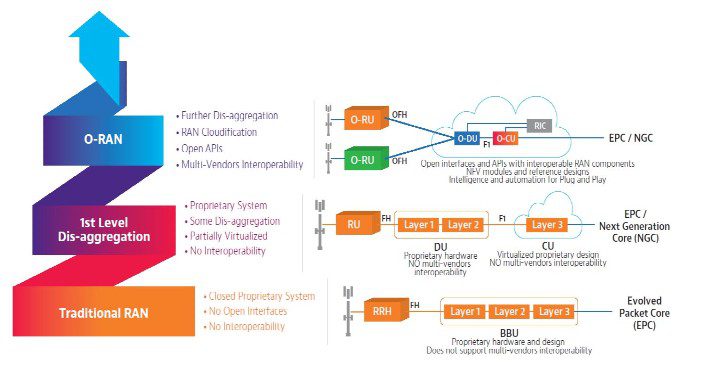
Image courtesy of VIAVI Solutions.
428

Network operators  worldwide are turning to open radio access network (O-RAN) architectures in an effort to simplify 5G RAN deployment and management, allowing more efficient scalability to meet rising data demands. With the recent formation of the Open RAN Policy Coalition, and a liaison between the TIP OpenRAN Project and O-RAN Alliance earlier this year, a new level of collaboration is widely expected to drive greater adoption and accelerate the timelines for O-RAN deployments.

While it’s encouraging to see vendors and operators working together on technology that could significantly bolster 5G network deployment, the reality is that disaggregating RAN infrastructure creates complexities that still must be addressed for Open RAN networks to succeed.

The push for Open RAN

Traditionally, RAN components have been built on proprietary hardware with vendor-specific protocols for communications, software functions and interfaces. Open RAN initiatives were developed to help operators evolve their infrastructure quickly to monetize new 5G business opportunities, while also enabling them to better manage CAPEX and maintain OPEX.

Deployment and management of the RAN is one of the most expensive parts of wireless networks. To deliver 5G profitably, operators need to look closely at how they manage the high cost areas of network evolution, growth and maintenance. Open RAN architectures give them some new options to accomplish several goals, including:

  • An open, multi-vendor interoperable ecosystem that drives healthier competition, higher innovations and lower costs for RAN equipment from a larger pool of vendors
  • Support for automation, which further reduces deployment and management costs
  • Network scale and agility, as network components work as software functions that are scaled per user, network capability and capacity demand.

Despite these benefits, however, significant deployment challenges need to be overcome to speed rollout and maximize network performance. 

Roadblocks on the open road

When considering deployment and management of networks based on Open RAN architecture, the most pressing concern for both operators and equipment manufacturers is how to ensure interoperability, manageability, optimization and end-to-end performance in an O-RAN environment.

Designing the 5G RAN requires planning for a range of new features, including multiple-input, multiple-output (MIMO) antennas, large spectrum bandwidth and multi-band carrier aggregation. This poses a challenge for the growth and maintenance of the networks, which now need to support multiple generations  of connectivity – 3G, 4G and 5G – while also scaling to meet rising data demands.

Historically, operators  have struggled to converge a wide range of components from different vendors. Now imagine a network where RAN components such as central unit , distributed unit and radio unit are all supported by multiple vendors. This multi-vendor environment makes it even more challenging to identify and isolate issues in the network. For example, it can be difficult to establish exactly where performance bottlenecks are located when experiencing delays. How do you deliver the best possible service when optimizing the configuration of the control plane? This complexity can impact the Call Attempts Per Second, which in turn affects the performance of the 5G-NR gNodeB (gNb) base station under high load conditions.

With the move toward Open RANs, operators and integrators need to validate that the technology all works together before it goes into the live network. Addressing these issues requires more than testing the interoperability of distinct vendor technology as part of an Open RAN set-up. Operators also need to see how the technology interacts with legacy 4G equipment in the network, as well as how it responds to different user equipment (UE) environments. 

Another challenge that operators face with O-RAN is knowing how to solve network issues after the network has been deployed. In a multi-vendor environment, it’s more difficult to identify product-related network performance issues than it is in a traditional single-vendor network. In the past, operators only had one vendor to work with when addressing product-related network performance issues. With an Open RAN network, operators need open standards and vendor-independent validation and troubleshooting to resolve network performance issues. And the biggest question of all is identifying who should take ownership of performance issues when there are multiple vendors involved.

Conquering O-RAN challenges

Success of disaggregated RAN networks will depend on the ability of operators to integrate and meet network key performance indicators (KPIs) in a multi-vendor environment. With O-RAN architecture, operators will deploy a network with an O-RAN Radio Unit (O-RU) from one vendor, O-RAN Distributed Unit (O-DU)  from another, and Central Unit (O-CU)  from a third — but only if the performance meets their targets and network integration is robust. Operators need to have the confidence that all components in an O-RAN network have been validated and verified in a trusted and controlled environment, and all open interfaces and components are working correctly so that network performance is equal to, or better than, the performance of a single-vendor network. 

Certain critical performance aspects to be evaluated include:

  • End-to-end network performance
  • Handover and mobility scenarios 
  • Ability of the network to handle large numbers of UEs carrying different types of traffic
  • Robustness (low BER and synchronization) of the fronthaul O-RU to O-DU connection.

To this end, a number of use cases can help identify, isolate and resolve network performance issues before an O-RAN multi-vendor network goes live. These include multi-vendor interoperability tests for functionality, performance, reliability, robustness and resilience; subsystem wrap-around tests; system-level tests; protocol compliance tests for open interfaces and protocols; continuous test process throughout the entire lifecycle; and performance monitoring of open interfaces and protocols to ensure optimum operation.

O-RAN networks hold tremendous promise for operators through an open ecosystem that removes vendor lock-in, while also creating the foundation for virtualized network elements and enabling white-box hardware that can be quickly scaled through software-based nodes. For today’s operators to reap the benefits of open architecture, however, they will need to integrate robust multi-vendor testing processes from the lab to deployment, and beyond.

You Might Also Like
  • The (agentic) future of AI-to-AI connectivity (Reader Forum)
  • Friday (telco diary) | Telco reset, RAN reboot, P5G reality check
  • How operations leaders see 5G as vital for mission-critical workflows (Reader Forum)
  • How the FCC can protect IoT innovation and GPS resilience in the 900 MHz band (Reader Forum)
  • Trust you can see – the convergence of voice, messaging, and identity (Reader Forum)
  • Subsea resilience needs to move beyond cable count – here’s why (Reader Forum)

Table of Contents

  • The push for Open RAN
  • Roadblocks on the open road
  • Conquering O-RAN challenges
Share 0 LinkedinEmail
Reader Forum

Submit Reader Forum articles to [email protected]. Articles submitted to RCR Wireless News become property of RCR Wireless News and will be subject to editorial review and copy edit. Posting of submitted Reader Forum articles shall be at RCR Wireless News sole discretion.

previous post
Altran White Paper: How You Grow Matters Post COVID-19
next post
More than 100 5G devices now available, GSA says

White Papers

  • Norton eBook: The 2026 Telco Playbook

  • Enea White Paper: Why Intelligent AAA is the Swiss Army Knife of Telecom

  • CSG White Paper: Telco AI Enabler: Mediation’s Defining Role

  • Enea White Paper: Scalable Database Design for 5G and Beyond

  • Supermicro and NVIDIA Whitepaper: Powering sovereign AI at scale

Editorial Reports

  • Nvidia Report: The State of AI in Telecommunications: 2026 Trends

  • Report: Scaling Optical Networks For The Hyperscale And AI Era

  • Test And Measurement Market Pulse Report

Webinars

  • Webinar: Building 6G — aligning technology, policy and purpose

  • SIMCom Webinar: Scaling your next deployment – from plastic to provisioning

  • Webinar: Rethinking the RAN as AI, cloud and openness converge

  • Webinar: Scale-Up, Scale-Out, Scale-Across – Building AI-Era Network Fabrics

  • Webinar: NTN in motion – evolving standards, expanding services

Since 1982, RCR Wireless News has been providing wireless and mobile industry news, insights, and analysis to mobile and wireless industry professionals, decision makers, policy makers, analysts and investors.

Facebook Twitter Youtube Linkedin Envelope Rss

Useful Links

  • Subscribe
  • About RCR Wireless News
  • Contact Us
  • Advertise
  • Editorial Calendar
  • Archive
  • RSS
  • Wireless News Archive
  • Subscribe
  • About RCR Wireless News
  • Contact Us
  • Advertise
  • Editorial Calendar
  • Archive
  • RSS
  • Wireless News Archive

Edtior's Picks

Red Hat outlines AI-RAN roadmap
Ericsson wins role in £8bn UK’s defense upgrade as private 5G moves to...
Thursday (telco diary) | Satellite versus terrestrial

Latest Articles

Red Hat outlines AI-RAN roadmap
Ericsson wins role in £8bn UK’s defense upgrade as private 5G moves to frontline
Thursday (telco diary) | Satellite versus terrestrial
The Agentic Network — Deutsche Telekom on APIs for trusted AI

© 2026 RCR Wireless News All Right Reserved. Developed by Eight Hats.

Cookie Policy | Privacy Policy

RCR Wireless
  • News
  • Channels
    • 5G
    • 6G
    • BSS OSS
    • Carriers
    • IoT
    • Network Infrastructure
    • Open RAN
    • Private 5G
    • Telco AI
    • Telco Cloud
    • Test & Measurement
  • Resources
    • Reports
    • Webinars
    • White papers
    • AI Fundamentals
    • Analyst Angle
    • Editorial Calendar
    • Fundamentals
      • 5G NR Release 17
      • AI
        • Telco AI in 2025
    • Podcasts
      • Let’s Get Digital with Carrie Charles
      • Wireless Connectivity to Enable Industry 4.0 for the Middleprise
      • Well Technically…
      • Will 5G Change the World
      • Accelerating Industry 4.0 Digitalization
  • AI Infrastructure
  • Programs
  • Events
  • RCRtv
  • Advertise
  • Subscribe
RCR Wireless
  • News
  • Channels
    • 5G
    • 6G
    • BSS OSS
    • Carriers
    • IoT
    • Network Infrastructure
    • Open RAN
    • Private 5G
    • Telco AI
    • Telco Cloud
    • Test & Measurement
  • Resources
    • Reports
    • Webinars
    • White papers
    • AI Fundamentals
    • Analyst Angle
    • Editorial Calendar
    • Fundamentals
      • 5G NR Release 17
      • AI
        • Telco AI in 2025
    • Podcasts
      • Let’s Get Digital with Carrie Charles
      • Wireless Connectivity to Enable Industry 4.0 for the Middleprise
      • Well Technically…
      • Will 5G Change the World
      • Accelerating Industry 4.0 Digitalization
  • AI Infrastructure
  • Programs
  • Events
  • RCRtv
  • Advertise
  • Subscribe
@2020 - All Right Reserved. Designed and Developed by PenciDesign
