

RCR Wireless
  • News
  • Channels
    • 5G
    • 6G
    • BSS OSS
    • Carriers
    • IoT
    • Network Infrastructure
    • Open RAN
    • Private 5G
    • Telco AI
    • Telco Cloud
    • Test & Measurement
  • Resources
    • Reports
    • Webinars
    • White papers
    • AI Fundamentals
    • Analyst Angle
    • Editorial Calendar
    • Fundamentals
      • 5G NR Release 17
      • AI
        • Telco AI in 2025
    • Podcasts
      • Let’s Get Digital with Carrie Charles
      • Wireless Connectivity to Enable Industry 4.0 for the Middleprise
      • Well Technically…
      • Will 5G Change the World
      • Accelerating Industry 4.0 Digitalization
  • AI Infrastructure
  • Programs
  • Events
  • RCRtv
  • Advertise
  • Subscribe
Monday, July 13, 2026
RCR Wireless
  • News
  • Channels
    • 5G
    • 6G
    • BSS OSS
    • Carriers
    • IoT
    • Network Infrastructure
    • Open RAN
    • Private 5G
    • Telco AI
    • Telco Cloud
    • Test & Measurement
  • Resources
    • Reports
    • Webinars
    • White papers
    • AI Fundamentals
    • Analyst Angle
    • Editorial Calendar
    • Fundamentals
      • 5G NR Release 17
      • AI
        • Telco AI in 2025
    • Podcasts
      • Let’s Get Digital with Carrie Charles
      • Wireless Connectivity to Enable Industry 4.0 for the Middleprise
      • Well Technically…
      • Will 5G Change the World
      • Accelerating Industry 4.0 Digitalization
  • AI Infrastructure
  • Programs
  • Events
  • RCRtv
  • Advertise
  • Subscribe
Add RCR Wireless as a preferred source on Google
  • Qualcomm 6G Insights
  • Huawei Content Hub
  • Qualcomm – 6G Vision
  • OSS/BSS Channel
  • RCRTech Roundtable: AI Infrastructure
RCR Wireless
RCR Wireless
  • Advanced Mimo
  • Mobile mmWave
  • 5G Positioning
  • Green Networks
  • Metaverse
  • Automotive
  • Industrial and Wide-area IoT
Copyright 2021 - All Right Reserved
Home - Cellular under the tree in ’83: The first commercial cellular call in America
OpinionReader Forum

Cellular under the tree in ’83: The first commercial cellular call in America

by Reader Forum October 16, 2018
written by Reader Forum October 16, 2018 Share
LinkedinEmail
Share 0LinkedinEmail
first commercial cellular call
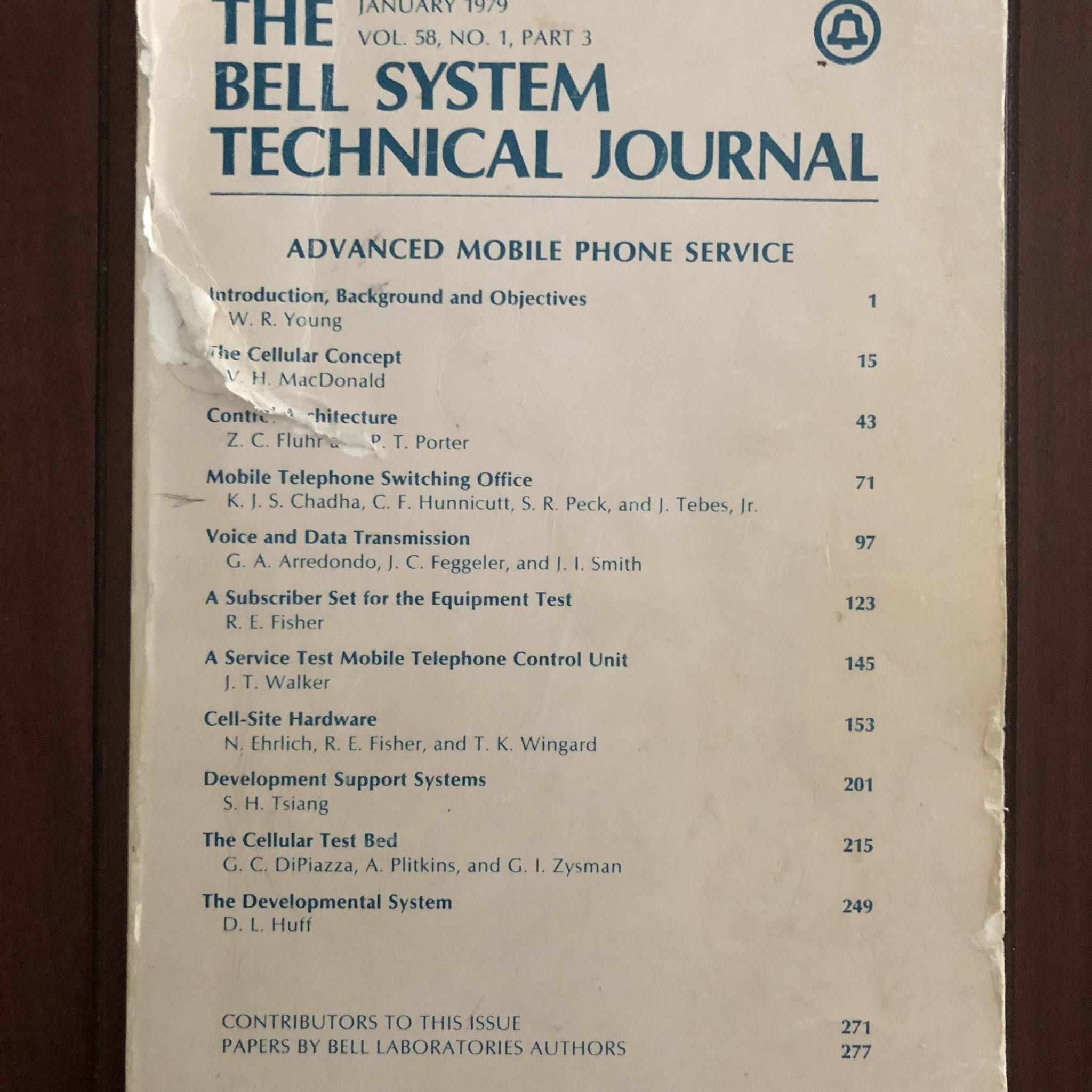
Keith Radousky's technical manual from the first commercial cellular call (Image: Keith Radousky)
346

Editor’s note: Keith Radousky, president of RadVisory 5G, shares his personal recollection of the first commercial cellular call, in October 1983 at Soldier Field in Chicago, Illinois. 

This past weekend marked the 35th anniversary of the first commercial cellular phone call in America on October 13, 1983 — then referred to as “AMPS,“ short for Advanced Mobile Phone Service and now referred to as the first generation, or 1G, cellular phone standard.

I was there in Chicago on that chilly day as part of the recovery team should a problem occur. At the time, I was 19 years old and had been working for Motorola as an electronics technician for more than three years. I had been installing and repairing two-way radios and car phones for Motorola, an authorized agent of Bell Labs, which was in the midst of their 2,500 AMPS user trial in Chicago.

My story is an American story. The year was 1968, I was 4 years old when my brother and I began playing with walkie talkies. Soon, I began speaking with neighbors and truckers. As you may have guessed, these were “Citizen Band” radios. From there, at age 14 I earned an Amateur “Extra” class ham radio license (AK9T), then took and passed the Federal Communications Commission commercial radio telephone license (PG-18-9380) and then went to work for Motorola at age 16, installing and repairing two-way radios and car phones.

Back to the “call,” which was placed, with much fanfare, from the parking lot of Chicago’s Soldier Field by Bob Barnett, president of Illinois Bell (later part of Ameritech), to Alexander Graham Bell’s great-grandson in Germany. It was a chilly Chicago day as Bob dialed from his Chrysler Lebaron convertible equipped with an installed Oki car phone. The call went through perfectly!

I also recall that about 10 other cars were equipped with car phones, with eager folks witnessing the event awaiting the opportunity to place calls.

This monumental event was made possible by a team effort of folks from the Bell System (Parent AT&T, Bell Labs, Western Electric and Illinois Bell) and many partners including Motorola (and its authorized service centers), Oki, and EF Johnson, just to name a few.

That first call on October 13, 1983 was the culmination of herculean efforts by thousands of people and dozens of companies over the previous 37 years. Most notably, the Bell System.

The mobile telephone story really began with Marconi’s 1895 radio invention, but let’s fast-forward to the Bell System’s June 17th, 1946 commercial launch of Mobile Telephone Service (MTS) in St. Louis.

MTS utilized a Western Electric Type 38/39 VHF police two-way radio installed in the trunk (80 lbs) with a Type 41a handset mounted in the cabin. To modify the radio into a carphone, a “selector” was added that enabled users to find, or more likely wait, for one of three channels. In order to receive calls, a ‘decoder” function was added. The network consisted of one base station located on a tall building in the city center and on tall towers along highways between cities.

When an available channel was seized, the user had to set-up the call through a mobile operator. Once connected, the user and called party had to speak and then listen, as the system didn’t support simultaneous transmitting and receiving.

By 1948, MTS urban service was available in 60 cities in the United States and Canada, with 4,000 users, handling almost 120,000 calls per month.  Highway service was in place in 85 cities with 1,900 mobile subscribers, handling approximately 36,000 calls per month, with most major highways in the East and Midwest covered.

Over the next 35 years (until cellular) only three major MTS advances occurred. First was the introduction of full-duplex, which enabled users to not have to communicate in a two-way radio fashion (over) and be able to speak and listen at the same time.

The second major advancement that occurred in the late 1950’s was the ability for users to direct dial which was indeed a welcomed feature. The third and final MTS advancement was in 1964 as MTS was “improved” and subsequently referred to as IMTS which added extra channels (not nearly enough, though) and retained full duplex speech and direct dial.

One interesting fact is that there was no privacy for either MTS or IMTS users since all could listen in and often did!

While users of IMTS enjoyed the convenience of carphones (as depicted in 1970’s TV shows such as Canon and Mannix), they had to endure massive network blocking, often waiting 30 minutes or more for an available channel.

The Bell System (and independent radio common carriers, which is beyond this article’s scope, also serving the car phone market) recognized the gap between customer demand and network capacity quite early. Additional channels were allocated by the FCC and soon deployed but never came close to adequately serving user demand.

Bell Labs conceptualized today’s cellular concept in 1947 (multiple base stations in a city re-using channels) but the processing technology required to support the “hand-off” function between base stations didn’t exist. Interestingly this was the same year that Bell Labs invented the transistor!

Finally, as transistors evolved into integrated circuits in the 1970’s, the Bell Lab’s team were able to design cellular base station and mobile equipment to finally trial the early cellular concepts in Chicago. Then came the moment of truth with that first call back on October 13, 1983 and the goal of having cellular under the tree in ’83 was realized and the world hasn’t been the same since!

This first of three installments celebrating the 35th anniversary of the first commercial cellular phone call and going into some detail on pre-cellular carphones and service. Installment 2 will cover the exponential growth of the cellular business covering network roll-out, cell phone distribution, roaming, network operator consolidation, network equipment provider consolidation, cellular data, digital evolution (2G, 3G and 4G), smart phone impact and finally network operators leap into content. The third installment will cover this author’s take on 5G, IoT and predictions for the next 35 years.




You Might Also Like
  • Netgear’s quiet reinvention as a B2B and SaaS company (Analyst Angle)
  • Friday (telco diary) | Telco reset, RAN reboot, P5G reality check
  • How operations leaders see 5G as vital for mission-critical workflows (Reader Forum)
  • Thursday (telco diary) | The plumbing is the product
  • How the FCC can protect IoT innovation and GPS resilience in the 900 MHz band (Reader Forum)
  • Thursday (telco diary) | The telco AI imperative
Share 0 LinkedinEmail
Avatar of Reader Forum
Reader Forum

Submit Reader Forum articles to [email protected]. Articles submitted to RCR Wireless News become property of RCR Wireless News and will be subject to editorial review and copy edit. Posting of submitted Reader Forum articles shall be at RCR Wireless News sole discretion.

previous post
Streaming video | Assuring quality depends on how you look at it
next post
Qualcomm shipping 802.11ay chipsets for multi-gigabit Wi-Fi

White Papers

  • Enea White Paper: Why Intelligent AAA is the Swiss Army Knife of Telecom

  • CSG White Paper: Telco AI Enabler: Mediation’s Defining Role

  • Enea White Paper: Scalable Database Design for 5G and Beyond

  • Supermicro and NVIDIA Whitepaper: Powering sovereign AI at scale

  • VIAVI Whitepaper: RAN scenario generators and their critical role for future-proofing AI-native RAN in Advanced 5G and 6G networks

Editorial Reports

  • Report: Scaling Optical Networks For The Hyperscale And AI Era

  • Test And Measurement Market Pulse Report

  • Editorial Report: Securing telecom infrastructure for the quantum era

Webinars

  • Webinar: Building 6G — aligning technology, policy and purpose

  • SIMCom Webinar: Scaling your next deployment – from plastic to provisioning

  • Webinar: Rethinking the RAN as AI, cloud and openness converge

  • Webinar: Scale-Up, Scale-Out, Scale-Across – Building AI-Era Network Fabrics

  • Webinar: NTN in motion – evolving standards, expanding services

Since 1982, RCR Wireless News has been providing wireless and mobile industry news, insights, and analysis to mobile and wireless industry professionals, decision makers, policy makers, analysts and investors.

Facebook Twitter Youtube Linkedin Envelope Rss

Useful Links

  • Subscribe
  • About RCR Wireless News
  • Contact Us
  • Advertise
  • Editorial Calendar
  • Archive
  • RSS
  • Wireless News Archive
  • Subscribe
  • About RCR Wireless News
  • Contact Us
  • Advertise
  • Editorial Calendar
  • Archive
  • RSS
  • Wireless News Archive

Edtior's Picks

Korean telcos pivot to AI infra as government pursues AI G3 ambitions
Wireless Logic’s 21st acquisition exposes IoT consolidation paradox
Netgear’s quiet reinvention as a B2B and SaaS company (Analyst Angle)

Latest Articles

Korean telcos pivot to AI infra as government pursues AI G3 ambitions
Wireless Logic’s 21st acquisition exposes IoT consolidation paradox
Netgear’s quiet reinvention as a B2B and SaaS company (Analyst Angle)
Friday (telco diary) | Telco reset, RAN reboot, P5G reality check

© 2026 RCR Wireless News All Right Reserved. Developed by Eight Hats.

Cookie Policy | Privacy Policy

RCR Wireless
  • News
  • Channels
    • 5G
    • 6G
    • BSS OSS
    • Carriers
    • IoT
    • Network Infrastructure
    • Open RAN
    • Private 5G
    • Telco AI
    • Telco Cloud
    • Test & Measurement
  • Resources
    • Reports
    • Webinars
    • White papers
    • AI Fundamentals
    • Analyst Angle
    • Editorial Calendar
    • Fundamentals
      • 5G NR Release 17
      • AI
        • Telco AI in 2025
    • Podcasts
      • Let’s Get Digital with Carrie Charles
      • Wireless Connectivity to Enable Industry 4.0 for the Middleprise
      • Well Technically…
      • Will 5G Change the World
      • Accelerating Industry 4.0 Digitalization
  • AI Infrastructure
  • Programs
  • Events
  • RCRtv
  • Advertise
  • Subscribe
RCR Wireless
  • News
  • Channels
    • 5G
    • 6G
    • BSS OSS
    • Carriers
    • IoT
    • Network Infrastructure
    • Open RAN
    • Private 5G
    • Telco AI
    • Telco Cloud
    • Test & Measurement
  • Resources
    • Reports
    • Webinars
    • White papers
    • AI Fundamentals
    • Analyst Angle
    • Editorial Calendar
    • Fundamentals
      • 5G NR Release 17
      • AI
        • Telco AI in 2025
    • Podcasts
      • Let’s Get Digital with Carrie Charles
      • Wireless Connectivity to Enable Industry 4.0 for the Middleprise
      • Well Technically…
      • Will 5G Change the World
      • Accelerating Industry 4.0 Digitalization
  • AI Infrastructure
  • Programs
  • Events
  • RCRtv
  • Advertise
  • Subscribe
@2020 - All Right Reserved. Designed and Developed by PenciDesign