

RCR Wireless
  • News
  • Channels
    • 5G
    • 6G
    • BSS OSS
    • Carriers
    • IoT
    • Network Infrastructure
    • Open RAN
    • Private 5G
    • Telco AI
    • Telco Cloud
    • Test & Measurement
  • Resources
    • Reports
    • Webinars
    • White papers
    • AI Fundamentals
    • Analyst Angle
    • Editorial Calendar
    • Fundamentals
      • 5G NR Release 17
      • AI
        • Telco AI in 2025
    • Podcasts
      • Let’s Get Digital with Carrie Charles
      • Wireless Connectivity to Enable Industry 4.0 for the Middleprise
      • Well Technically…
      • Will 5G Change the World
      • Accelerating Industry 4.0 Digitalization
  • AI Infrastructure
  • Programs
  • Events
  • RCRtv
  • Advertise
  • Subscribe
Wednesday, July 8, 2026
RCR Wireless
  • News
  • Channels
    • 5G
    • 6G
    • BSS OSS
    • Carriers
    • IoT
    • Network Infrastructure
    • Open RAN
    • Private 5G
    • Telco AI
    • Telco Cloud
    • Test & Measurement
  • Resources
    • Reports
    • Webinars
    • White papers
    • AI Fundamentals
    • Analyst Angle
    • Editorial Calendar
    • Fundamentals
      • 5G NR Release 17
      • AI
        • Telco AI in 2025
    • Podcasts
      • Let’s Get Digital with Carrie Charles
      • Wireless Connectivity to Enable Industry 4.0 for the Middleprise
      • Well Technically…
      • Will 5G Change the World
      • Accelerating Industry 4.0 Digitalization
  • AI Infrastructure
  • Programs
  • Events
  • RCRtv
  • Advertise
  • Subscribe
Add RCR Wireless as a preferred source on Google
  • Qualcomm 6G Insights
  • Huawei Content Hub
  • Qualcomm – 6G Vision
  • OSS/BSS Channel
RCR Wireless
RCR Wireless
  • Advanced Mimo
  • Mobile mmWave
  • 5G Positioning
  • Green Networks
  • Metaverse
  • Automotive
  • Industrial and Wide-area IoT
Copyright 2021 - All Right Reserved
Home - 5G transport: How does fronthaul enable network densification?
5GNetwork Infrastructure

5G transport: How does fronthaul enable network densification?

by Sean Kinney, Principal Analyst September 30, 2018
written by Sean Kinney, Principal Analyst September 30, 2018 Share
LinkedinEmail
Share 0LinkedinEmail
211

5G transport networks must evolve in tandem with the RAN and core

Operators around the world are working to build and commercialize 5G networks while simultaneously upgrading existing networks to provide a gigabit-class LTE surround for the next generation of cellular connectivity. And while enhancements to the radio access and core networks garner significant mind share, 5G transport networks must concurrently evolve to support the massive increases in network capacity and device density commanded by 5G.

A key aspect of network densification in the ramp to 5G is the addition of radio sites, in particular small cells. The first wave of small cell deployments was meant to provide pinpoint coverage and capacity to supplement the reach of macro networks. The second wave of small cells was a much wider deployment intended to offload data from the macro network in densely populated areas. Now, with early 5G deployments centered on millimeter wave frequencies, operators will provide a dense network with gigabit speeds over that air, using high-band spectrum, with more limited propagation than 4G, resulting in smaller, more closely spaced cells at street level.

The emerging small cell architecture, designed to improve spectral and network efficiency, is called C-RAN (Centralized RAN) wherein centralized baseband units are connected to multiple, remote radio sites. Pooling baseband functionality allows for radio coordination across multiple sites lending a new level of flexibility in the rapidly changing cellular landscape. But these investments in the RAN require updates to the transport network.

The link between a C-RAN hub and a remote radio site is called fronthaul, as opposed to backhaul, which links the baseband with the core network. Dark fiber (i.e. fiber with no transport equipment in the circuit) is the preferred medium for fronthaul, because it has the lowest latency. For carriers, this means leasing fiber, and using it as efficiently as possible, by using dense wave division multiplexing to maximize the amount of data that can be transmitted across each fiber.

Ericsson’s Kevin Murphy, technical solutions manager, discussed the challenges operators face in providing fronthaul capacity with DWDM to meet the demands of 5G.

Kevin Murphy 20170305 041 Edit“Macro cell sites can have many radios and would need many fibers to connect the radios to a C-RAN hub. Since fiber is leased per circuit, this would be very costly, and the fiber circuits may not be immediately available. To save leasing costs, a DWDM system like the Ericsson Fronthaul 6000 can be used to multiplex up to 24 fronthaul circuits onto a single fiber strand.

“The introduction of 5G creates an even greater challenge, since 5G radios have much higher bandwidth and typically need many more fiber per site. When 5G radios are installed on an existing 4G site, DWDM allows the operators to use the existing fiber without incurring any extra fiber leasing costs.”

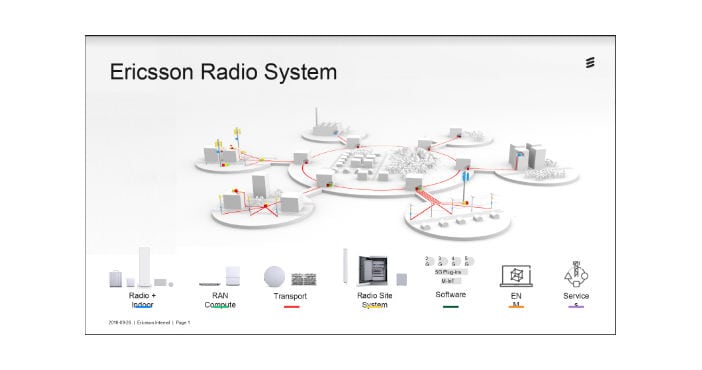
Another key aspect of 5G deployment is the ability to conceal equipment on utility poles to comply with city permits and avoid problems with residents concerned with the aesthetics of their area. By coordinating the development of the radio and the transport equipment, Ericsson was able to create a unified appearance for the pole mounted components, using the smallest possible form factor, to make the equipment aesthetically pleasing. This facilitates the permitting process and greatly improves time to market.

“As 5G evolves,” Murphy said, “we will see new interfaces, in addition to fronthaul and backhaul, with different capacity and latency demands. Already we are planning to increase port capacity from 10 Gbps to more than 25 Gbps. Any transport solution that is installed today must be able to quickly adapt to new protocols and data rates while simultaneously supporting legacy RAN interfaces. The Ericsson Fronthaul solution is designed to keep pace with these changes by using “protocol and rate agnostic” ports that can be configured to support all the upcoming RAN interfaces. This is the advantage of having RAN and transport equipment designed together as an end to end solution.

5G transport

Ericsson Fronthaul 6000 products

To learn more about Ericsson’s 5G transport portfolio and how it fits into the company’s end-to-end 5G solution set, ​click here​.

You Might Also Like
  • What defines network performance in 5G and beyond? A CTO Perspective
  • Elisa says AI automation has cut network incidents by over 80%
  • Huawei outlines AI-centric network roadmap for telecom monetization
  • Indosat outlines AI Grid vision as 5G modernization targets nationwide AI-ready network
  • Wednesday | Telco agents and smash hits (Editorial Diary)
  • Huawei shows how 5G and AI are reshaping tourism in China
Share 0 LinkedinEmail
Sean Kinney
Sean Kinney, Principal Analyst

Sean focuses on multiple subject areas including 5G, 6G, Open RAN, hybrid cloud, edge computing, and Industry 4.0. Prior to his work at RCR, Sean studied journalism and literature at the University of Mississippi then spent six years based in Key West, Florida, working as a reporter for the Miami Herald Media Company. He currently lives in Fayetteville, Arkansas.

previous post
What is MEC and why does it matter?
next post
Sequans CEO rebuts analyst’s designation of Qualcomm as “king of IoT silicon” (Reality Check)

White Papers

  • Enea White Paper: Why Intelligent AAA is the Swiss Army Knife of Telecom

  • CSG White Paper: Telco AI Enabler: Mediation’s Defining Role

  • Enea White Paper: Scalable Database Design for 5G and Beyond

  • Supermicro and NVIDIA Whitepaper: Powering sovereign AI at scale

  • VIAVI Whitepaper: RAN scenario generators and their critical role for future-proofing AI-native RAN in Advanced 5G and 6G networks

Editorial Reports

  • Report: Scaling Optical Networks For The Hyperscale And AI Era

  • Test And Measurement Market Pulse Report

  • Editorial Report: Securing telecom infrastructure for the quantum era

Webinars

  • Webinar: Rethinking the RAN as AI, cloud and openness converge

  • Webinar: Scale-Up, Scale-Out, Scale-Across – Building AI-Era Network Fabrics

  • Webinar: NTN in motion – evolving standards, expanding services

  • Webinar: Noise-Figure Measurements with RFmx and PXI VSTs

  • Qualcomm Webinar – Building the 6G Standard: Key developments to know

Since 1982, RCR Wireless News has been providing wireless and mobile industry news, insights, and analysis to mobile and wireless industry professionals, decision makers, policy makers, analysts and investors.

Facebook Twitter Youtube Linkedin Envelope Rss

Useful Links

  • Subscribe
  • About RCR Wireless News
  • Contact Us
  • Advertise
  • Editorial Calendar
  • Archive
  • RSS
  • Wireless News Archive
  • Subscribe
  • About RCR Wireless News
  • Contact Us
  • Advertise
  • Editorial Calendar
  • Archive
  • RSS
  • Wireless News Archive

Edtior's Picks

How the FCC can protect IoT innovation and GPS resilience in the 900...
What defines network performance in 5G and beyond? A CTO Perspective
Elisa says AI automation has cut network incidents by over 80%

Latest Articles

How the FCC can protect IoT innovation and GPS resilience in the 900 MHz band (Reader Forum)
What defines network performance in 5G and beyond? A CTO Perspective
Elisa says AI automation has cut network incidents by over 80%
“We’re going after the operator channel” – Druid bets on simplicity to scale private 5G

© 2026 RCR Wireless News All Right Reserved. Developed by Eight Hats.

Cookie Policy | Privacy Policy

RCR Wireless
  • News
  • Channels
    • 5G
    • 6G
    • BSS OSS
    • Carriers
    • IoT
    • Network Infrastructure
    • Open RAN
    • Private 5G
    • Telco AI
    • Telco Cloud
    • Test & Measurement
  • Resources
    • Reports
    • Webinars
    • White papers
    • AI Fundamentals
    • Analyst Angle
    • Editorial Calendar
    • Fundamentals
      • 5G NR Release 17
      • AI
        • Telco AI in 2025
    • Podcasts
      • Let’s Get Digital with Carrie Charles
      • Wireless Connectivity to Enable Industry 4.0 for the Middleprise
      • Well Technically…
      • Will 5G Change the World
      • Accelerating Industry 4.0 Digitalization
  • AI Infrastructure
  • Programs
  • Events
  • RCRtv
  • Advertise
  • Subscribe
RCR Wireless
  • News
  • Channels
    • 5G
    • 6G
    • BSS OSS
    • Carriers
    • IoT
    • Network Infrastructure
    • Open RAN
    • Private 5G
    • Telco AI
    • Telco Cloud
    • Test & Measurement
  • Resources
    • Reports
    • Webinars
    • White papers
    • AI Fundamentals
    • Analyst Angle
    • Editorial Calendar
    • Fundamentals
      • 5G NR Release 17
      • AI
        • Telco AI in 2025
    • Podcasts
      • Let’s Get Digital with Carrie Charles
      • Wireless Connectivity to Enable Industry 4.0 for the Middleprise
      • Well Technically…
      • Will 5G Change the World
      • Accelerating Industry 4.0 Digitalization
  • AI Infrastructure
  • Programs
  • Events
  • RCRtv
  • Advertise
  • Subscribe
@2020 - All Right Reserved. Designed and Developed by PenciDesign
