
RCR Wireless
  • News
  • Channels
    • 5G
    • 6G
    • BSS OSS
    • Carriers
    • IoT
    • Network Infrastructure
    • Open RAN
    • Private 5G
    • Telco AI
    • Telco Cloud
    • Test & Measurement
  • Resources
    • Reports
    • Webinars
    • White papers
    • AI Fundamentals
    • Analyst Angle
    • Editorial Calendar
    • Fundamentals
      • 5G NR Release 17
      • AI
        • Telco AI in 2025
    • Podcasts
      • Let’s Get Digital with Carrie Charles
      • Wireless Connectivity to Enable Industry 4.0 for the Middleprise
      • Well Technically…
      • Will 5G Change the World
      • Accelerating Industry 4.0 Digitalization
  • AI Infrastructure
  • Programs
  • Events
  • RCRtv
  • Advertise
  • Subscribe
Wednesday, August 5, 2026
RCR Wireless
  • News
  • Channels
    • 5G
    • 6G
    • BSS OSS
    • Carriers
    • IoT
    • Network Infrastructure
    • Open RAN
    • Private 5G
    • Telco AI
    • Telco Cloud
    • Test & Measurement
  • Resources
    • Reports
    • Webinars
    • White papers
    • AI Fundamentals
    • Analyst Angle
    • Editorial Calendar
    • Fundamentals
      • 5G NR Release 17
      • AI
        • Telco AI in 2025
    • Podcasts
      • Let’s Get Digital with Carrie Charles
      • Wireless Connectivity to Enable Industry 4.0 for the Middleprise
      • Well Technically…
      • Will 5G Change the World
      • Accelerating Industry 4.0 Digitalization
  • AI Infrastructure
  • Programs
  • Events
  • RCRtv
  • Advertise
  • Subscribe
Add RCR Wireless as a preferred source on Google
  • Qualcomm 6G Insights
  • Huawei Content Hub
  • Qualcomm – 6G Vision
  • OSS/BSS Channel
  • RCRTech Roundtable: AI Infrastructure
RCR Wireless
RCR Wireless
  • Advanced Mimo
  • Mobile mmWave
  • 5G Positioning
  • Green Networks
  • Metaverse
  • Automotive
  • Industrial and Wide-area IoT
Copyright 2021 - All Right Reserved
Home - Analyst Angle: IoT for service providers is not business as usual
Analyst AngleCarriersInternet of Things (IoT)

Analyst Angle: IoT for service providers is not business as usual

by Enterprise IoT Insights January 31, 2017
written by Enterprise IoT Insights January 31, 2017 Share
LinkedinEmail
Share 0LinkedinEmail
open source software internet of things iot 5G
109

Internet of things presents a significant opportunity for service providers. The number of connected devices is growing exponentially and is projected to reach 50 billion by 2020. Service providers with their extensive networks and other assets are exceptionally well positioned to reap significant financial benefits from the tremendous growth of IoT. Most service providers have embraced IoT. Their strategies have differed, but trends have started to emerge. Some operators, typically smaller ones, have pursued a horizontal strategy, seeking to be primarily a connectivity provider; other service providers, seeing significant value in the application part of IoT, have pursued a vertical strategy, where they have end-to-end offerings along chosen verticals. Examples include Verizon’s focus on fleet management and smart cities, Orange’s focus on healthcare.

To succeed in a vertical approach, service providers must consider several important imperatives and embrace the fact that the IoT framework and drivers for success can differ materially from their established business model and operations.

  1. Although service providers have significant connectivity assets, primarily in terms of 3G, 4G/LTE, and in some cases WIFI and wired connectivity, it is important to recognize that IoT may have different connectivity needs, will require low-power WAN connectivity (LPWAN), such as LoRA, Sigfox, LTE-M1 and NB1, and will involve a significantly larger number of connected devices than their networks today are designed for. Major operators are making significant strides in testing and deploying these technologies. LTE-M1 seems to be gaining favor with Verizon and AT&T in the US. LoRa has momentum in Europe, with the Netherlands building a country-wide LoRa network.
  2. Operating in a vertical will necessitate deep expertise in that vertical. Service providers typically will lack that expertise. Therefore, they need to acquire and integrate the right assets, hire experts, and structure the right partnerships. Failing to execute on these initiatives will put their business at risk.
  3. The service providers’ current organizations are often attuned to the needs of their existing business with established methods and procedures, a carefully planned and deliberate go-to-market strategy, and operational and business support systems that are often based on yesterday’s technology and market needs. IoT requires agility and a dynamic go-to-market strategy, which should closely align with the needs of the vertical. To customers in the vertical, IoT is not a standalone service they receive from the service provider but rather an integral part of their operations and business strategy. The service provider will need to work with them to understand their needs and build the capabilities to satisfy those needs.
  1. IoT generates substantial amounts of data, which often needs to be processed in real time. Therefore, a significant amount of the data generated needs to be processed at the edge of the network, to avoid the delays and bandwidth bottlenecks which would result if the data were sent to remote data centers. Therefore, service providers need to build “fog computing” infrastructure. This will be a marked change from the way their networks are currently architected.
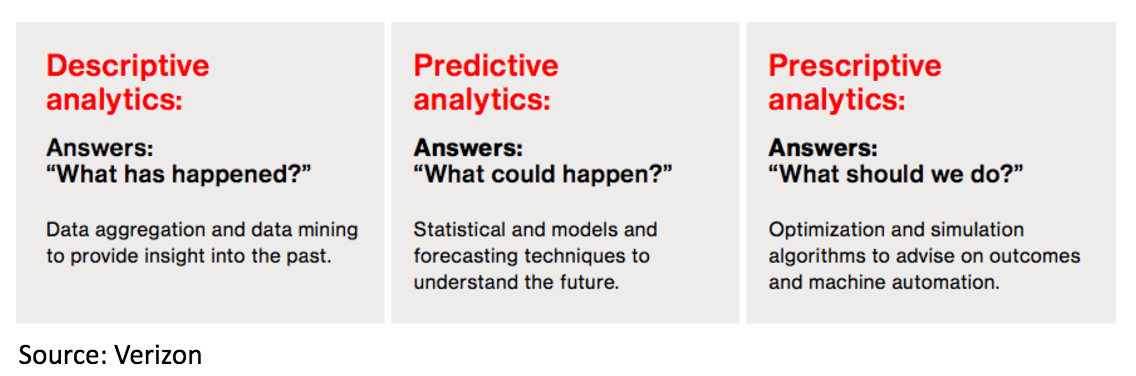
  2. A key driver for IoT is analytics. Improving operations or preventing failure are often at the heart of what leads industries to adopt an IoT strategy. There are three main levels of analytics in IoT:
Screen Shot 2017 01 31 at 7.43.45 AM

Therefore, it is essential for service providers to create a well thought out analytics capability that is specifically tailored to the needs of the IoT verticals on which it is focused. Analytics is still an immature capability for service providers, and often the capability is hosted in various parts of the business based on specific needs. This approach will not work for IoT, which requires a cohesive and holistic approach. Therefore, the service provider should create an IoT specific capability that addresses the needs of the vertical and make it separate from other analytics initiatives across the company.

  1. Security is a key challenge when it comes to IoT. The significant amount of data collected in IoT should be protected at all stages of the collection, transition through the network, processing and warehousing. Furthermore, in some industries, for example, healthcare, there are privacy rules and regulation that need to be satisfied. Although service providers are well positioned in that regard with a good track record, the needs of IoT will by far exceed the security demands of their current business, and therefore, they need to define a comprehensive security management ecosystem to protect the IoT environment end to end.
  2. Given the complexity of the IoT solutions, and the scope of what needs to be offered, it is imperative that service provider structure the right partnerships with the appropriate entities to offer an end-to-end solution that meets the needs of the customers in the verticals. This is not trivial, because such partnerships are likely to be broader in scope and intricacy than what is mostly typical for them. Although this provides significant opportunities for them, it also introduces an element of risk.
  3. The business metrics that will drive the IoT business operation are markedly different from established business processes for most service providers. Traditionally, service providers have been primarily connectivity enablers. Service providers that have embraced the vertical IoT approach have taken on a major role as solutions providers that requires them to build deep expertise along specific verticals to establish new business and operational processes and metrics, new revenue expectations and arrangements (e.g. revenue share). Furthermore, it is essential that service providers do not bind their IoT business by tightly associating it with the rest of the business. On the contrary, they should keep it as a separate business, operating at arm’s length from the traditional business, with independent leadership and structure, independent financial goals and metrics, and its own operating environment.
You Might Also Like
  • Tuesday (telco diary) | More about ISAC – on battlefields and sportsfields
  • From missiles to pizzas – why 6G drone sensing has been fast-tracked for 5G
  • Wi-Fi carries over 80% of traffic; monetizing it is not a done deal (Analyst Angle)
  • Monday (telco diary) | Network platforms and an AI hill of beans
  • Poste deal advances as TIM eyes growth in AI services, mission-critical industries
  • Physical AI is exposing a data sovereignty gap (Reader Forum)
Share 0 LinkedinEmail
Enterprise IoT Insights

previous post
Vendors find opportunities, challenges in adopting open source platforms
next post
Nokia adds LoRa and NB-IoT connectivity to its IoT platform

White Papers

  • Norton eBook: The 2026 Telco Playbook

  • Enea White Paper: Why Intelligent AAA is the Swiss Army Knife of Telecom

  • CSG White Paper: Telco AI Enabler: Mediation’s Defining Role

  • Enea White Paper: Scalable Database Design for 5G and Beyond

  • Supermicro and NVIDIA Whitepaper: Powering sovereign AI at scale

Editorial Reports

  • Market Pulse Report: Telco AI in 2026 – Trends, Challenges and Opportunities

  • Nvidia Report: The State of AI in Telecommunications: 2026 Trends

  • Report: Scaling Optical Networks For The Hyperscale And AI Era

Webinars

  • Webinar: Building 6G — aligning technology, policy and purpose

  • SIMCom Webinar: Scaling your next deployment – from plastic to provisioning

  • Webinar: Rethinking the RAN as AI, cloud and openness converge

  • Webinar: Scale-Up, Scale-Out, Scale-Across – Building AI-Era Network Fabrics

  • Webinar: NTN in motion – evolving standards, expanding services

Since 1982, RCR Wireless News has been providing wireless and mobile industry news, insights, and analysis to mobile and wireless industry professionals, decision makers, policy makers, analysts and investors.

Facebook Twitter Youtube Linkedin Envelope Rss

Useful Links

  • Subscribe
  • About RCR Wireless News
  • Contact Us
  • Advertise
  • Editorial Calendar
  • Archive
  • RSS
  • Wireless News Archive
  • Subscribe
  • About RCR Wireless News
  • Contact Us
  • Advertise
  • Editorial Calendar
  • Archive
  • RSS
  • Wireless News Archive

Edtior's Picks

Tuesday (telco diary) | More about ISAC – on battlefields and sportsfields
Intelligent RAN Forum 2026
NTN Integration Forum 2026

Latest Articles

Tuesday (telco diary) | More about ISAC – on battlefields and sportsfields
Intelligent RAN Forum 2026
NTN Integration Forum 2026
From missiles to pizzas – why 6G drone sensing has been fast-tracked for 5G

© 2026 RCR Wireless News All Right Reserved. Developed by Eight Hats.

Cookie Policy | Privacy Policy

RCR Wireless
  • News
  • Channels
    • 5G
    • 6G
    • BSS OSS
    • Carriers
    • IoT
    • Network Infrastructure
    • Open RAN
    • Private 5G
    • Telco AI
    • Telco Cloud
    • Test & Measurement
  • Resources
    • Reports
    • Webinars
    • White papers
    • AI Fundamentals
    • Analyst Angle
    • Editorial Calendar
    • Fundamentals
      • 5G NR Release 17
      • AI
        • Telco AI in 2025
    • Podcasts
      • Let’s Get Digital with Carrie Charles
      • Wireless Connectivity to Enable Industry 4.0 for the Middleprise
      • Well Technically…
      • Will 5G Change the World
      • Accelerating Industry 4.0 Digitalization
  • AI Infrastructure
  • Programs
  • Events
  • RCRtv
  • Advertise
  • Subscribe
RCR Wireless
  • News
  • Channels
    • 5G
    • 6G
    • BSS OSS
    • Carriers
    • IoT
    • Network Infrastructure
    • Open RAN
    • Private 5G
    • Telco AI
    • Telco Cloud
    • Test & Measurement
  • Resources
    • Reports
    • Webinars
    • White papers
    • AI Fundamentals
    • Analyst Angle
    • Editorial Calendar
    • Fundamentals
      • 5G NR Release 17
      • AI
        • Telco AI in 2025
    • Podcasts
      • Let’s Get Digital with Carrie Charles
      • Wireless Connectivity to Enable Industry 4.0 for the Middleprise
      • Well Technically…
      • Will 5G Change the World
      • Accelerating Industry 4.0 Digitalization
  • AI Infrastructure
  • Programs
  • Events
  • RCRtv
  • Advertise
  • Subscribe
@2020 - All Right Reserved. Designed and Developed by PenciDesign