

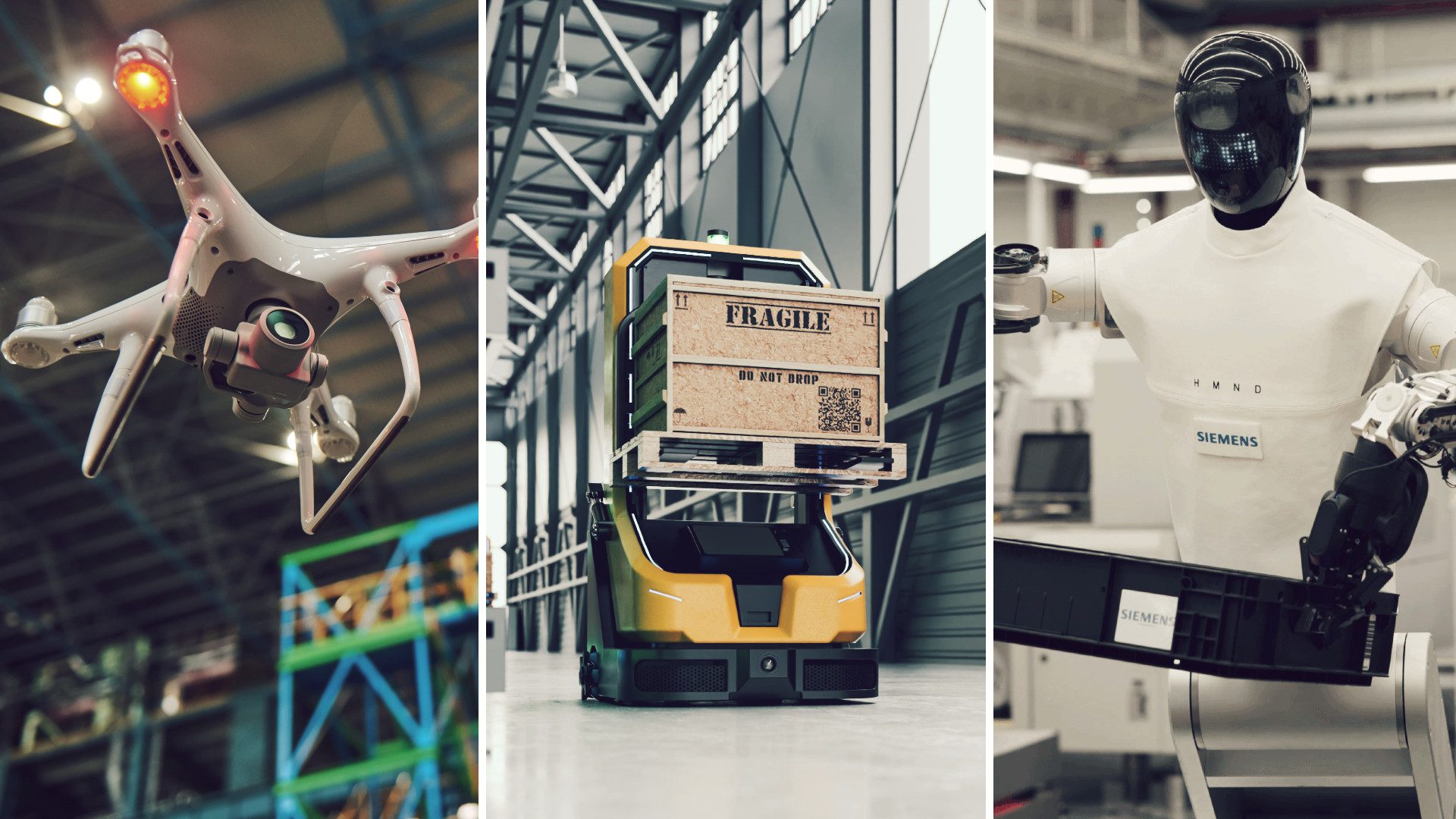
Private 5G was once sold as telecom’s answer to industrial connectivity. Now physical AI, covering robotics and automation, is changing the dynamic: industrial enterprises – and their technology providers – are increasingly pulling private 5G into factories, plants, and supply chains.
In sum – what to know:
Connectivity to capability – physical AI in the shape of robotics, vehicles, machines, cameras, and sundry industrial sensors are adding new value layers on top of private 5G enterprise networks.
Push becomes the pull – robot makers and industrial technology vendors are increasingly recommending private 5G as the connectivity foundation for mobile, reliable and mission-critical AI applications.
Testbeds for telecoms – smaller, controlled private 5G environments are accelerating real-world trials of AI networks, including for network automation and for RAN-based AI compute (AI-RAN).
Where were we? ‘If telecoms is searching for a future, then private 5G is probably the closest thing it has to a working prototype’. That was how we signed-off last week, talking about how industrial 5G networks might be perceived as miniature 5G testbeds for all the bells-and-whistles capabilities in the 5G standard, which might be monetized someday by the whole telecoms industry. So let us count the ways, here – as cribbed from the long catalogue-listing of industry successes appended to the SNS Telecom & Research market forecast about the private 5G sector. The market for private 5G networks will pass $6.6 billion through 2029, it reckons, on a compound annual growth curve (CAGR) of about 34 percent. It is growing mature, it suggests, and about to be super-charged by AI.
1 | AI – physical, mostly; plus WI-Fi, as well
The private 5G market will reach this 2030 number as “physical AI takes hold”, writes SNS. This is not the biggest takeaway from the company’s report, but it is the trendiest – and the one that makes the headline company’s own headline. It also blurs with a bunch of other big presumptions and projections. These things – 34 percent average annual growth in private 5G revenues, spurred by some other compound-rate surge in physical AI (anywhere from $430 billion to over $2 trillion, depending on the scope and the analyst) – will come to pass, it says, as “industrial giants scale multi-site, multi-national” deployments across “existing and new greenfield facilities” in order to connect “AGVs, AMRs, drones, cranes, forklifts, vehicles, robots, and even semi-humanoid systems”.
“The adoption of physical AI is particularly pronounced,” it writes. And really, it seems from SNS that the private 5G story is not just a zero-sum contra-Wi-Fi narrative any longer. That tale is told, and has been corrected (some time ago, actually): the two technologies are often complementary (outdoors and indoors) or hybrid (working together), and the replacement pitch places private 5G where mobility, coverage and reliability are critical – such as in various physical AI scenarios. All of which feels more realistic than the bolshy fighting talk from a couple of years ago. That said, SNS also presents cases from John Deere, BP, and CJ Logistics where private 5G cost-effectively replaces Wi-Fi for better coverage and performance (with 82, 60-80, and 300 access points, versus four, four, and 22 radios).
So latency, yes; but also infrastructure complexity, plus cost (especially when combined with futuristic physical AI cases). SNS sees physical AI as a primary long-term growth driver. It explicitly links private 5G to machine vision and other video analytics, predictive maintenance and remote operation, autonomous vehicles and robotics. Of course, most of these have been use cases since the LTE-days, from before Nvidia boss Jensen Huang made ‘physical AI’ a modish hype trend towards the end of last year. It is striking that SNS says robot vendors are recommending private 5G themselves. Again, we have talked about this for ages – about machine makers producing expensive industrial gadgetry with embedded 5G. But the push has become a pull. Humanoids are a buzzy business.
Beyond SNS, Morgan Stanley sees rapid scaling, pegging China’s humanoid market alone at $15 billion by 2030 (double what SNS is putting on private 5G), driven by government subsidies and factory / warehouse deployments. Long term, it projects the wider ecosystem to surpass $5 trillion by 2050. Goldman Sachs says the global market for humanoid robots will reach $38 billion by 2035, across 1.4 million units; it also cites factory labor as the commercial tipping point. Barclays & Citi sees humanoids as the core solution to global manufacturing shortages. China will deliver over 11 million units by 2035, it says. Back to SNS, which provides examples (names anyway) of “physical AI at scale” in verticals in mining, manufacturing, agriculture, forestry, aviation, logistics.
Boston Dynamics and AgiBot “recommend” private 5G networks as the “preferred connectivity medium for their products in industrial settings,” writes SNS. Chinese auto components manufacturer Fulin Precision has 100 semi-humanoid robots, apparently, which have delivered a 50 percent reduction in manual delivery costs. Agriculture giant Cargill is using quadruped robots for autonomous inspection, predictive maintenance, and shut-down avoidance – as charted in these pages. Air New Zealand, also covered here, has robot-tethered inventory drones at a warehouse at Auckland Airport for automated “high-bay” stock counting, also reducing worker risk. State-owned power firm China Huaneng Group has 100 autonomous electric mining trucks.
Hiroshima Gas in Japan is using local 5G-connected smart patrol robots to detect gas leaks and temperature abnormalities at its production plants. There are valet parking robots at Lyon-Saint Exupéry Airport in the southeast of France, connected on private 5G to increase “parking efficiency” by 50 percent. Lufthansa has a robot something-or-other at a cargo facility at LAX, which has brought a 75 percent improvement in “operational process speed”. These are not lab demos, the message from SNS goes; they are operational systems generating real business value, and harbingers of the role (and type) of 5G that will be used to connect the physical AI economy. For too long, the private 5G industry has pushed connectivity as the killer case; AI promises to stack new value on top.
The integration of precise positioning, integrated sensing (ISAC), and other supplementary 5G features further enhances the value of the 5G network itself for physical AI applications. Of course, AI is being increasingly used network-side, too – networks for AI, but also AI for networks. SNS presents the flipside: “agentic AI to improve network operations, especially for complex or multi-site deployments, which naturally extends to the cybersecurity and device management domains as well”. Most vendors have developed AI-enabled / -badged management and orchestration platforms to simplify network deployment and administration, optimize performance and energy efficiency, automate policy enforcement, and reduce downtime.
One of the “most sophisticated examples”, it writes, is an agentic AI solution for autonomous network optimization – including adaptive power control – on vessels operated by Norwegian shipping company Color Line.” A bit of a dig, and the description seems to refer to French start-up BubbleRAN, which developed the Opti-Sphere maritime AI solution with Nvidia and Telenor using open RAN small cells from Taiwanese firm LiteOn and a core network from France-based Amarisoft. It also references work by domestic integrator NTT East in Japan to evaluate open RAN intelligent controller (RIC) functionality from 26 vendors (no less) for AI-enabled network control applications supporting transmit power optimization and interference mitigation in private 5G networks.
And so while the big telecoms industry has spent three years or more talking about generative AI in OSS and BSS architectures in public 5G systems, SNS is signposting that effective level-something network automation work, way more controlled, is live in private 5G systems already – often for live use by futuristic-sounding physical AI solutions. And there’s more, too: while the industry talks about AI grids and AI-RAN, even for scattered macro-scale GPU as-a-service offers, SNS says AI is being tested in private 5G networks in factories, plants, campuses, and proper-grids in various countries already. The difficult concept of the network as a platform looks much simpler in these venues. And private 5G looks like a simpler part of a larger AI infrastructure grid-stack already.
SNS writes: “This concept is commonly referred to as AI-on-RAN within the broader AI-RAN movement. In comparison to larger public mobile operator networks, private 5G environments provide a far less complex operational setting for converging AI processing and RAN control, given the smaller infrastructure footprint that is typically dedicated to a single end user organization. Initial proofs-of-concept for AI-on-RAN over private 5G networks have already been conducted in Japan, China, and the US, focusing on physical AI and other network-enabled applications requiring AI inference at the edge.”

